- 品牌焦点
BOVET’s Amadeo Leads the Way in Dual-Faced, Ultra-Complicated Watchmaking.
本文出自: Darren Ho
2026年4月8日
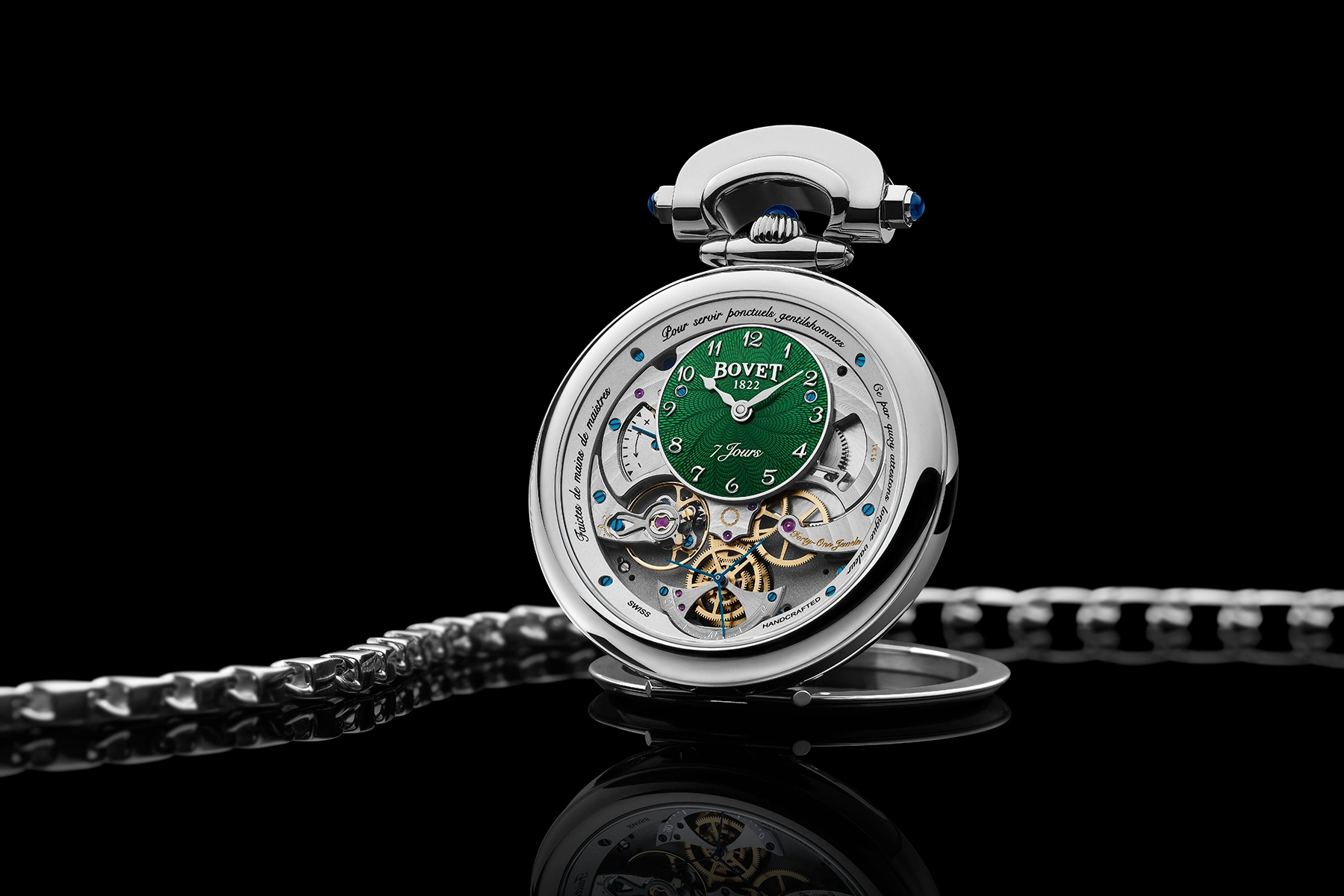
For most watchmakers, a grand complication – by definition, a timepiece which has a timing, chiming, and astronomical complication – is the pinnacle of watchmaking. Around a century ago, as wealthy collectors competed for ownership of the most sophisticated timepiece, the über-complication watch emerged. This led to highly oversized and hefty watches such as Franck Muller‘s Aeternitas Mega. Alternatively, the other way to show every function was to add a second dial on the back of the movement and watch. The double dial wristwatch evolved from double hunter pocket watches, which were popular at the turn of the 20th century. On a double dial watch, the primary dial usually displays the running time and select complications, while the rest are shown on the secondary display.
The 1930s saw the release of two wristwatches that were designed with flippable cases to protect the dials: Jaeger-LeCoultre’s Reverso and Cartier‘s Tank Basculante. Designed for the sport of polo, they had a solid case back rather than a secondary dial. It was not until the 2000s that Jaeger-LeCoultre was able to present complications running on a single gear train and movement, on dual back-to-back dials. (On the reverse side, the time display would otherwise run anticlockwise.) However, in the development of complicated watches, there is another watchmaker which should be credited with driving this style of wristwatch design: BOVET. The steady development of the Amadeo convertible system has led others to introduce dual-dialled watches and the resurgence of the über-complication watch.
BOVET's Revival

Mr Raffy, awarded the Men’s Complication Prize for the BOVET Récital 30 at the Grand Prix d’Horlogerie de Genève 2025. (Credit: BOVET)
From its founding to the mid-19th century, BOVET was recognised for its hand-engraved timepieces, many of which were detailed with gemsetting and at an incredible level of detail. The watchmaker became popular in China during the Qing dynasty for its fine craftsmanship, in particular for the Fleurisanne engraving technique it applied on movement bridges. A series of different owners from the 1930s onwards led to a period of sporadic production, up until 2001 when it was fully acquired by current owner and CEO, Pascal Raffy.
A former pharmaceutical executive who led his company to early success, Mr Raffy retired from the industry and found himself in a position of privilege. He wanted to build a business that was in line with his interests, which included fine watchmaking – a passion that was passed down from his grandfather. In fact, he first discovered BOVET from his grandfather’s collection, and between 2001 and 2006, shaped his vision of the watchmaker from a niche brand into a fully integrated watchmaker.
Raffy intended to showcase BOVET’s mastery of decorative crafts with movements and cases, which were finished to equally high standards on both sides of the watch case. Perhaps inspired by the double hunter pocket watch, which was often used by owners as a desk clock as well by opening both covers as a stand, he conceived the idea of a transformable watch well before this trend took off in the watch and jewellery industries. The patented Amadeo system was presented in 2010 with four different ways of carrying or wearing it: a wristwatch with reversed hand-fitting; a pocket watch (or necklace, a la Flava Flav); and as a table clock, thanks to a hidden hinge on the rear bezel so it doubles as a stand.

The BOVET Amadeo Amadeo Unique Piece, featuring a hand-painted Madonna dial on Mother-of-Pearl, showcasing exquisite craftsmanship and detailed mechanical movement. (Credit: BOVET)
The Amadeo system offers owners versatility with regards to how the watch is used, but what its reversible hand-fitting provides is additional real estate on the watch dial. With twice as much space to design from, BOVET can freely present its handcrafts and watch complications without over-cluttering the watch dial. The Fleurier collection, which includes the Virtuoso series and special releases such as the Amadeo Amadeo Tourbillon Unique Piece, combines innovative high-end watchmaking with artistic crafts such as guilloché à main or rose engine engraving, miniature painting on mother-of-pearl, Fleurisanne engraving, and gemsetting. The movement has an autonomy of up to seven days on a single barrel, with a seconds display on the rotating carriage of the tourbillon regulator.
The watchmaker is among a handful of brands still practising freehand Fleurisanne engraving, seen on the caseband, bezels, lugs, and movement bridges of the watch, which is a bas-relief style technique using a burin to remove the background material. The artist carves scrollwork, acanthus leaves or vine motifs into the watch, before using a punching tool to create a matte, grained finish on the background while the motifs are mirror polished.
Technically and Artistically Sophisticated

The Monsieur BOVET features a blue guilloché dial with patented double co-axial seconds display, housed in a polished red gold case. (Credit: BOVET)
The Fleurier models have also featured a number of unique developments by BOVET, such as the patented double co-axial seconds displayed on the Monsieur BOVET. The wheels driving the running seconds counters are mounted co-axially and run in opposite directions for the reversed hand-fitting. The Virtuoso III combines Fleurisanne engraving on the case, bezel, lugs, and movement bridges, with a perpetual calendar with retrograde date complication that’s displayed on the primary dial. The skeletonisation work is amplified around the hand-finished tourbillon regulator, which enhances the visual spectacle of the watch.
In the Virtuoso VII, the perpetual calendar is presented in a contemporary display, with a central dial and bridges decorated with a guilloché motif and coated with translucent lacquer. Here, the sapphire crystal discs on which the days, months, and leap years are printed are fully visible, set above the racks and levers of the calendar’s mechanism. The reverse dial shows the running seconds counter, escapement, and power reserve indication of up to five days.

The BOVET Virtuoso V features a red guilloché dial with a traditional time display with visible movement on one side, and jumping hours with retrograde minutes on the reverse, housed in a rose gold reversible case. (Credit: BOVET)
The Virtuoso V is a time-only model that shows the hours and minutes in two different ways. One dial has jump hour window and retrograde minutes display on a lacquered, guilloché dial while the other has a two-hand display with a subdial for the running seconds and power reserve. The energy supply of the watch, which comes from a single barrel, is a signature of the brand. While it is already impressive, BOVET developed a pocket watch in 1910 with a 370-day power reserve, sufficient to run for a year without winding. Today, its movements offer power reserves ranging from five to 22 days, with patenting winding efficiencies to reduce the effort needed to wind each reference. That same model from 1910 is alleged to be the first watch with an exhibition caseback, an invention that soon became de rigueur in the industry.
In recent years, as über-complication and rare handcraft watches have grown in popularity among collectors, and the under-40mm case size trend continues to spread, double dials are a convenient way to park additional information. And for less complicated watches, splitting up the timekeeping and complication displays can also improve legibility with a minimalist, elegant aesthetic. Aside from its practicality, however, double dials are a playful addition, offering a hidden display only known to its owner. In fact, with watch designers now experimenting with the case band and other aspects as a secondary dial, this is a wonderfully glorious moment for creative displays of time beyond the typical dial.
观点推荐
阅读所有观点-

- 高登精选
Cortina Curates Local: The Art of Stillness by Taiwanese Glass Artist Chen Chien-Chih
2026年9月4日
-

- 品牌焦点
Cartier’s Shift Towards Smaller Dials
2026年8月27日
-

- 新闻
Bell & Ross – BR-X5 Meteorite
2026年8月27日
-

- 品牌焦点
Parmigiani’s Design Ethos Preserves Michel Parmigiani’s Legacy In Timepiece Restoration For The Future
2026年8月11日
-
- 新闻
Bell & Ross – BR-05 GMT Green Steel
2026年7月30日
-

- 时计知识
Watch Knowledge Beyond the Norm: Watches with Unique and Novel Functions
2026年7月29日