- 品牌焦点
Grand Seiko Paved the Way for the Revival of Fine Japanese Watchmaking. Here’s How It Did That.
本文出自: Darren Ho
2026年6月8日
If Grand Seiko’s latest product releases for 2026 at Watches and Wonders Geneva can be summed up in one word, it would be “tenacity”. A year ago, the Japanese watchmaker presented its latest version of the Spring Drive, an electro-mechanical movement that straddles quartz and mechanical watchmaking. The calibre 9RB2 is certified to be accurate within an annual rate of +/- 20 seconds per year. To the rest of the world, this record-setting precision was jaw-dropping. Grand Seiko’s master watchmakers were nonchalant, but they were attentively observing. This year’s novelties feature six watches with the Spring Drive U.F.A. (for ‘Ultra Fine Adjusted‘) out of nine releases.
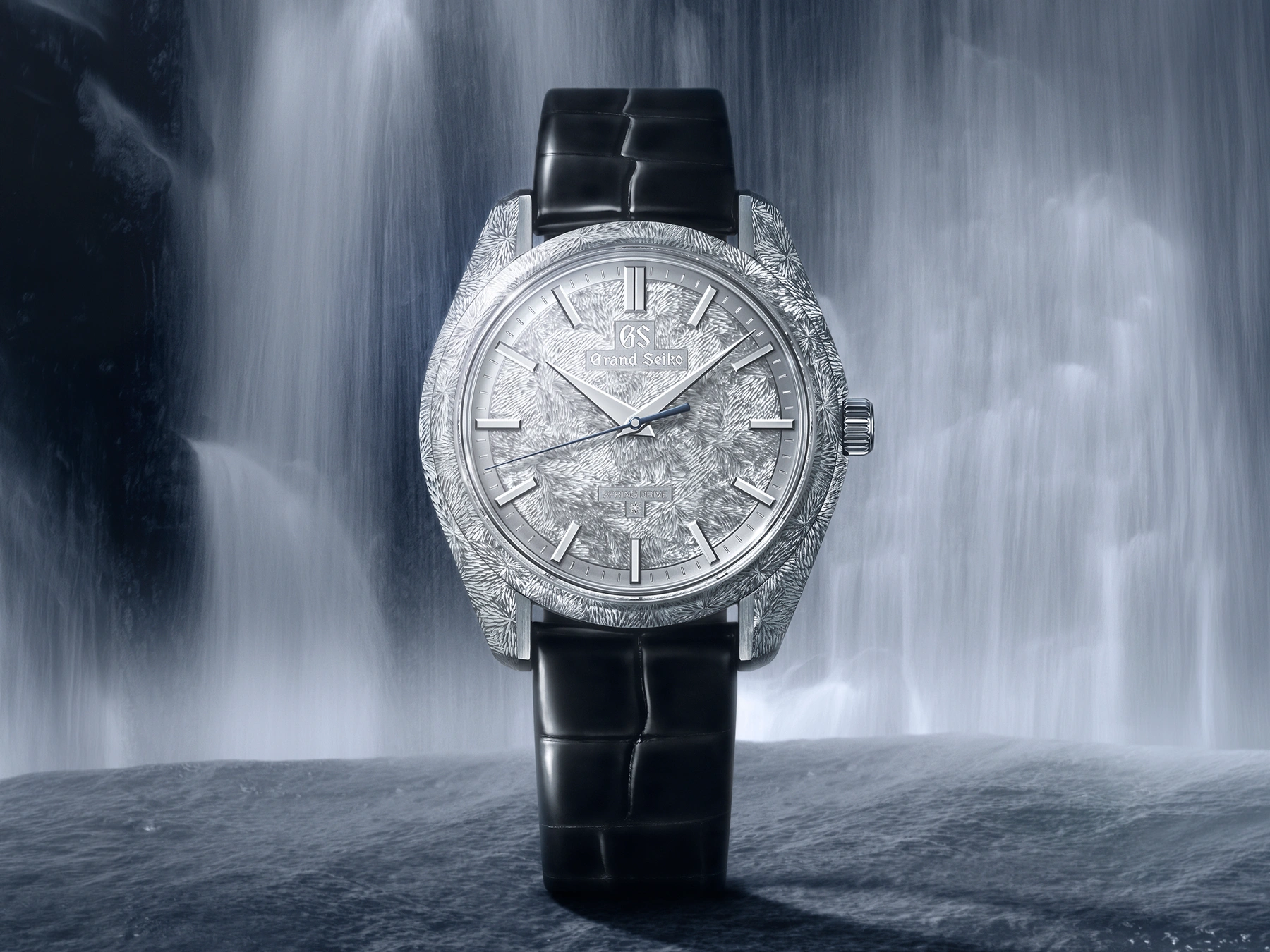
Among them, the Ref. SBGZ011, a limited edition of 50 pieces and clad in platinum from bezel to dial, has a spectacular motif inspired by the Tateshina waterfall in the Shinshu region. The freehand engraved lines run irregularly across the case and dial, like spring water released from the ground, though some may relate it to the foliage of the forest, fields of wheat, or even finger prints. No matter what anyone thinks, this is a watch that demonstrates Grand Seiko’s confidence in design today, especially due to the contrasting precision of the Zaratsu-polished, 44GS-style platinum case and the abstract irregularity of the decorative technique applied.
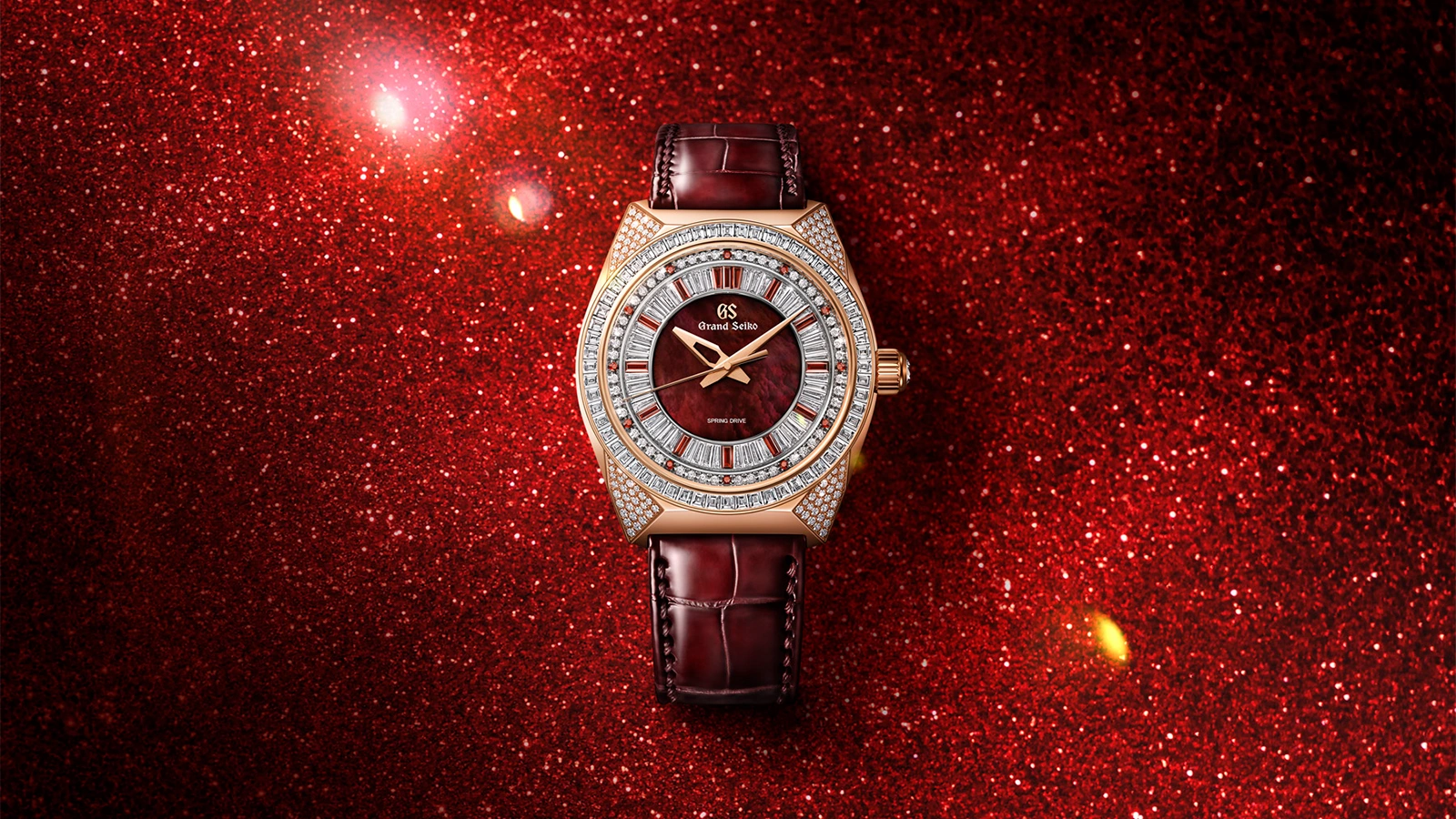
The Grand Seiko Masterpiece Ref. SBGD228 in rose gold with solitaire-, baguette-, and trapezoid-cut diamonds and garnets. (Credit: Grand Seiko)
A second Masterpiece collection model, SBGD228, also features the same Spring Drive movement on a rose gold case set with diamonds and garnets on the dial, bezel, and parts of the case. Nicknamed the “Red Lion”, the hour and minute chapter rings (set with gemstones) flare out from the red dial centre like a lion’s mane, boldly captivating potential owners and onlookers with the same passionate charisma and presence. Both models could not be more different in design, and they reveal a parent company that is confident of its work and values and where they align with collectors.

The Grand Seiko Ref. SBGC001 Spring Drive Chronograph GMT. (Credit: Grand Seiko)
Just 20 years ago, Grand Seiko had a very different identity. It had just released its first Spring Drive movement, the caliber 9R65, a project that took 20 years 600 prototypes to accomplish. Positioning itself as the leaders in precision fine watchmaking, the brand emphasised its engineering and performance. It attracted a niche clientele who enjoyed obsession over details such bezel angles, index designs, and the best technique to set their watch to the second for precise performance. The designs of its watches oscillated between information overload and simplicity in harmonious form.
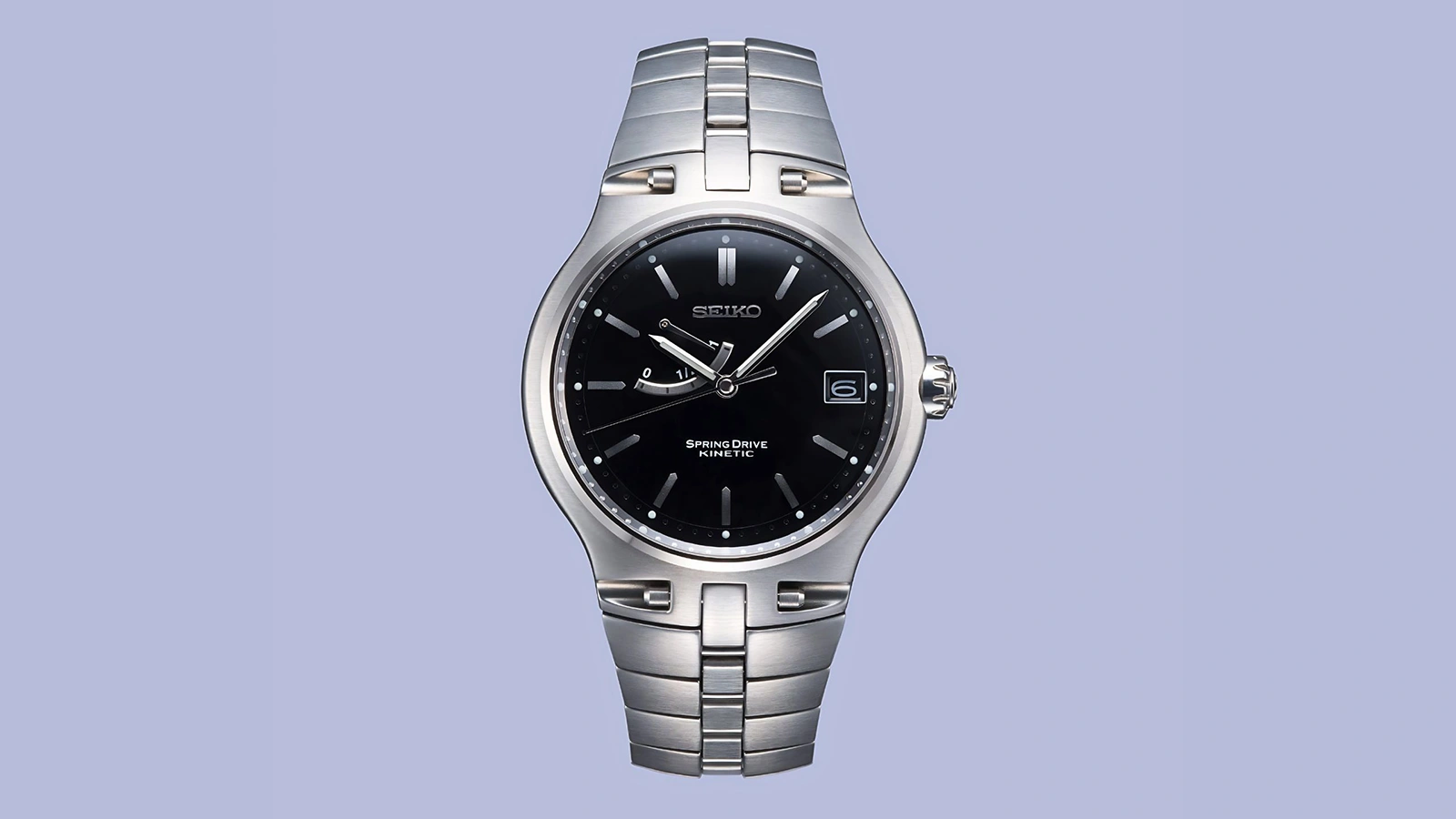
The Seiko Spring Drive Ref. SBWA001 debuted the first Spring Drive movement commercially. (Credit: Grand Seiko)
The first Spring Drive model released in 1999 was the Seiko Ref. SBWA001, an integrated bracelet model with a curvilinear design that would draw great interest from collectors today. (Perhaps a limited-edition model for 2027, to celebrate Spring Drive’s 30th anniversary? Or its 50th since Mr Yoshikazu Akahane’s concept was born?) In 2007, the first Grand Seiko Spring Drive Chronograph Ref. SBGC001 was presented by designer Shinchiro Kubo. It was powered by a new calibre 9R86 and stayed true to the Grand Seiko Style, but its dial was overwhelming to read.
Quiet Achievers

The Grand Seiko Ref. SLGW005 is a re-creation of the 45GS, which featured a high-frequency movement that topped the 1968 Geneva Observatory competition. (Credit: Grand Seiko)
Grand Seiko’s high-achieving and understated identity goes back to its founding. At the time, Japanese watchmaking was uncommon outside of the country; to demonstrate their quality, its watches were sent to Geneva for observatory certifications and competitions. Chronometer-standard movements have a maximum deviation of -4/+6 seconds daily; Grand Seiko’s own limits were one second less at -3/+5 seconds. By the end of the sixties, the brand was sweeping competitions, losing out only to quartz movements. Select models featured a ‘VFA’ label, for ‘Very Fine Adjustment’ that indicated an accuracy of one minute per month (or two minutes for smaller movements dedicated to women).

The Grand Seiko 19GS VFA was a compact square-cased watch for ladies, with a very finely adjusted movement accuracy of 2 minutes per month. (Credit: Grand Seiko)
Its success comes from three Japanese philosophies: kaizen, or incremental refinement; shuhari, the process of mastering a craft; and shoshin, a practice of returning to curiosity from one’s expertise. Learning equally from success and failures, Grand Seiko’s watchmakers iteratively applied knowledge to the next movement for greater success, and its designers released a multitude of references to discover what clients desired. The impact of its kaizen can be observed in watchmakers at Grand Seiko’s Shizukuishi studio, who casually adjust balance springs that have been distorted by overeager journalists back to isochrony with nothing more than a pair of tweezers (no loupe needed).

Quartz crystals grown at Grand Seiko’s Shinshu studio undergo voltage testing over three months to ensure their precision in timekeeping. (Credit: Grand Seiko)
While Swiss watchmakers struggled with the emergence of quartz wristwatches, Grand Seiko leaned in to the technology instead and began growing their own quartz oscillators. That expertise gave birth to the Spring Drive concept in 1977 – a gear train driven by a rotor wheel, which generates electrical power from the mainspring for the integrated chip, quartz oscillator, and electromagnetic brake regulating it. It continued funding Spring Drive research for over 20 years without a commercial release, an effort few companies would have committed. Spring Drive is unique in the industry and has numerous advantages over either quartz or mechanical movements: the regulator does not require lubrication, and it does not need battery replacements.
Invisible Details

The Grand Seiko Ref. SLGW002 (below) and SLGW003 (above) are equipped with the calibre 9SA4, which has the motif of a wagtail bird pecking at the winding gear. (Credit: Grand Seiko)
Grand Seiko icons like the 19GS, 44GS, and 61GS are the foundations of the brand’s modern design language. The four design rules of the Grand Seiko Style are based on the 44GS, but the work of its design and movement development teams lie in hidden, often invisible details. The Evolution 9 collection is the culmination of these curated edits. Grand Seiko designer Akira Yoshida explained how the Evolution 9 case is structured to have a lower centre of gravity so it stays seated on the wrist of its wearer, and bracelet links are slightly shortened to fit all wrist sizes well. Beyond that, the development of its own Spron alloy for springs, hardened titanium, and even the click of the mainspring’s winding is painstakingly designed to create an experience when you wear the watch.

The Grand Seiko Ref. SLGB025 Evolution 9 Spring Drive U.F.A. Ushio 300 Diver unveiled at Watches and Wonders Geneva has a stamped dial that is inspired by the tide and colour of the coastal waters around the Japanese archipelago, rich with phytoplankton. (Credit: Grand Seiko)
Embedded in each and every Grand Seiko watch is a slice of Japanese culture and tradition, in a subtle manner. Its seasonal dials reference colours or styles relating to an aspect of Japanese heritage, like dusk light on a monastery floor or the colour and texture of a cherry blossom. The Ushio 300 Diver which was introduced at Watches and Wonders features a stamped dial inspired by the tides of Japan’s. coastal waters. Its graduated green dial references the dark teal hue of the surrounding seas, rich with phytoplankton that is a source of life for marine life and oxygen for the world. Seeing it evokes a sense of calm and tranquil joy.

The Grand Seiko Masterpiece Ref. SBGZ011 is hand-engraved and comes with two leather straps, one featuring metallic accents that resemble splashes of water on the rocks of the Tateshina Waterfall. (Credit: Grand Seiko)
This is reflected even more in the Masterpiece collection. The Micro Artist Studio’s artisans in Shinshu often draw upon the landscape of the region to guide their handcrafted decorative work, such as engraving, lacquering, and micro-sculpture. It is a welcoming experience to strap on a Grand Seiko; beyond its precision and performance, it is a poetic encounter with Japan itself. That is what distinguishes Grand Seiko and how it has transformed from an insider’s brand into a globally beloved watchmaker: an attention to detail that’s culturally rich and fascinating to discover.
If you are curious about Grand Seiko’s timepieces and its history, head to one of our boutiques or schedule an appointment with a sales representative today.
观点推荐
阅读所有观点-

- 新闻
Franck Muller Celebrates The Art of Skeletonisation
2026年10月22日
-

- 新闻
Bell & Ross BR-03 Space Mission
2026年10月20日
-

- 时计知识
Motoring-Inspired Watches That Carry the Adrenaline Beyond the Track
2026年10月9日
-

- 新闻
Patek Philippe’s Gondolo Ladies First Jewelry Watches Offer A New Expression Of Feminine Refinement
2026年10月5日
-

- 新闻
H. Moser & Cie. Off Grid: The Digital Watch For Watchmaking Enthusiasts
2026年9月29日
-

- 品牌焦点
Blancpain Six Masterpieces
2026年9月18日