
- 品牌焦点
Patek Philippe Sets New Milestones in 2026 With Its First Automaton Wristwatch
2026年5月28日

At the 2026 Watches and Wonders Geneva exhibition, Patek Philippe left audiences spellbound with the introduction of 65 limited-edition timepieces featuring Rare Handcrafts and 24 new models. The novelties include four limited-edition Nautilus timepieces to commemorate its 50th anniversary, several Annual Calendar models (which turns 30 this year), and one bold new invention: an automaton wristwatch, its first in the watchmaker’s modern history.

The Ref. 784 pocket watch by Louis Cottier features the same on-demand display of time and dial motif as the Patek Philippe Ref. 5249R-001. (Credit: Patek Philippe)
The Fox and the Crow
Nearly 70 years ago, Louis Cottier designed a pocket watch, the Ref. 784, with an on-demand display of time, with its dial depicting a scene from The Fox and the Crow by La Fontaine. Cottier is best known for his development of the world time complication, which Patek Philippe commissioned him to produce serially. The pocket watch was acquired by the Patek Philippe Museum and has been revived in wristwatch form, involving the Rare Handcraft of micro-engraving. Ref. 5249R-001 is the watchmaker’s first automaton wristwatch, with two arc counters for the hours (left) and minutes (right), as well as a small decorative star display that shows the running seconds at 6 o’clock.

The dial of the Patek Philippe Ref. 5249R-001 Automaton with Hours and Minutes on Demand features two arc counters for the hours and minutes display, with a small diamond-shaped running seconds at 6 o’clock. (Credit: Patek Philippe)
Set on a rose gold dial in matara brown with an opaline finish, the display is instinctively easy to comprehend. The fox’s snout and paw indicate the hours from ‘7’ to ’11’ and ’12’ to ‘6’, and the cheese in the crow’s beak indicates the minutes. They default to an upright position when stationary. Upon activating the pusher at 2 o’clock, they spring into action, moving to indicate the current time. The logo and hour and minute scales are transferred on rhodium-plated yellow gold plates. Each of the gold appliques on the dial are hand-engraved in the intaglio style and made more realistic with shadowing using an oxidation process. The running seconds counter is in white gold and mirror-polished, set with a solitaire diamond at the centre.

The Patek Philippe Ref. 5249R-001 is housed in an Officer-style case with a hinged caseback and powered by the Caliber 31-260 PS HMD AU (for petite seconds, hours and minutes on demand, and automaton respectively). (Credit: Patek Philippe)
The ultra-thin automatic movement base features an off-centre platinum micro-rotor for more winding potential and is used in other references such as the Ref. 5236P Inline Perpetual Calendar. Patek Philippe designed a patented disengaging clutch mechanism to ensure the automaton module isn’t damaged when the time has to be set. Effort is also taken to ensure that the automatons’ movements are fluid and dampen the shock to the movement when activated.
The debut of an automaton introduces a new segment to Patek Philippe’s clients and strengthens the link between its Rare Handcrafts and Grand Complications collections. It’s a watch that celebrates high artistry and high watchmaking on the dial itself.
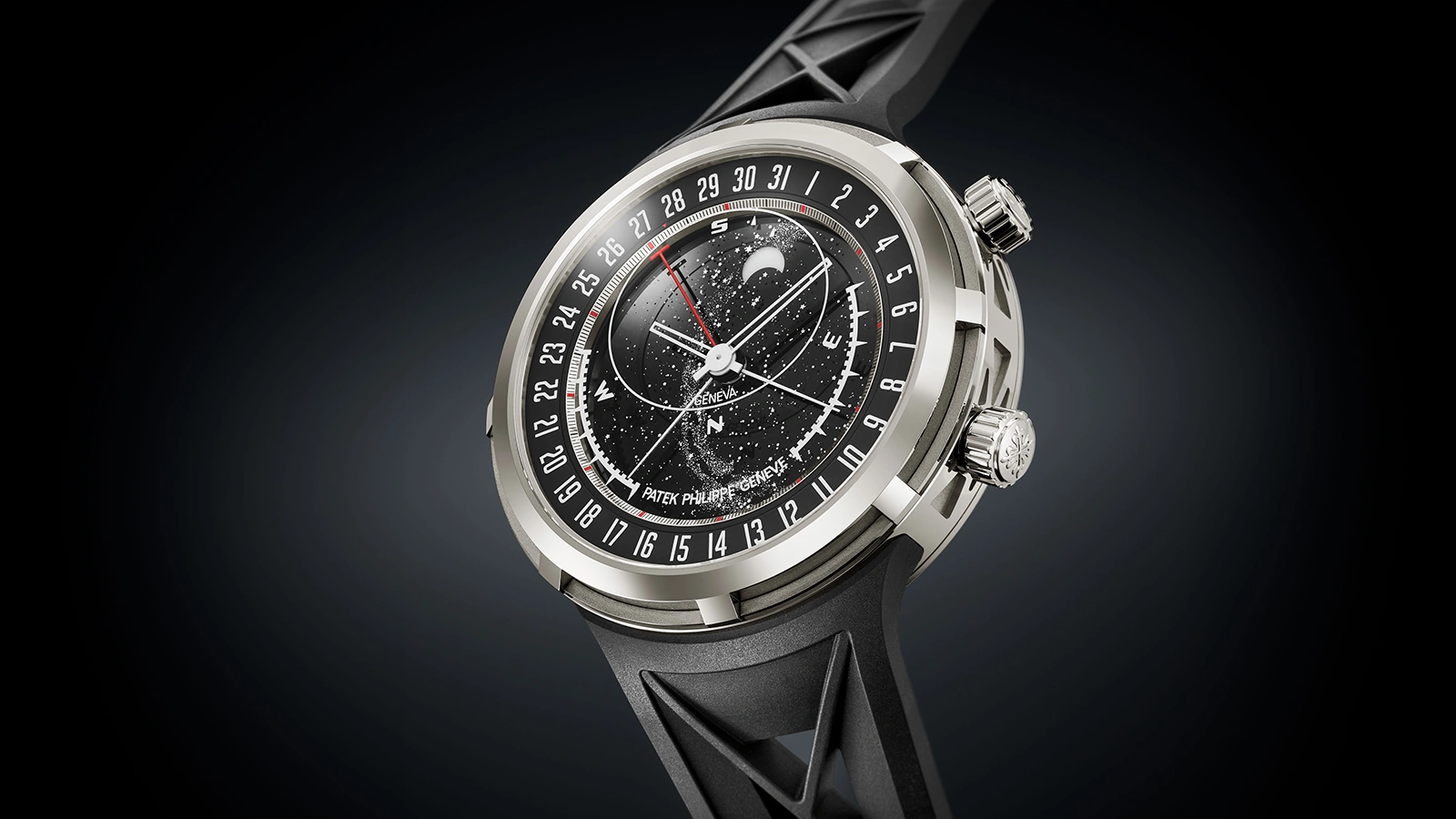
The Patek Philippe Ref. 6105G-001 Celestial with Sunrise and Sunset expresses this astronomical complication in a neo-futurist design language. (Credit: Patek Philippe)
The Celestial of Tomorrow
Watch enthusiasts may have observed two distinct Patek Philippe design languages that have coalesced in the last two decades. The first tends towards the classic or Bauhaus-inspired modern classic, paying tribute to the rich history of watchmaking. The second draws inspiration from the modern world with modernist or sleek futurist-inspired elements, which are appreciated by a new generation of younger collectors. Never has this duality been more clearly expressed than in the Ref. 6105G-001 Celestial with Sunrise and Sunset.

The Patek Philippe Ref. 6105G-001 depicts the astronomical sky with sunrise and sunset information that adjusts to daylight savings time. (Credit: Patek Philippe)
The astronomical skychart is a challenging complication to display, because there are multiple layers of information that are interconnected. Derived from the Sky Moon Tourbillon Ref. 5002, the Ref. 5102P, which debuted in 2002, was the first of the Celestial series. The gold dial presented a rotating display of the Northern Hemisphere sky, following the motion of the stars and Moon throughout the course of the year. The gold Moon display also revealed its phase, and the entire sky chart was produced using metallised sapphire crystal discs over three layers. An oval ring printed on the top layer revealed the visible sky from Geneva. This model was succeeded by the Ref. 6102, with a gemset version, the Ref. 6104, emerging two years later.

The Patek Philippe Caliber 240 C LU CL LCSO has 426 parts assembled in a 7.93mm thick movement. The sky chart is accurate to 0.08 seconds per day, a remarkable achievement. (Credit: Patek Philippe)
To understand just how phenomenal the Celestial complication is, here are a few data points for reference. The watchmaker analysed 25 trillion gearing ratio combinations to create the most precise skychart, which is accurate to 0.08 seconds per day. The moon phase display is accurate to 0.05 seconds per day, or 1 day per 1,073 years. As the sapphire crystal disc displaying the star map follows the sidereal day of 23 hours and 56 minutes, that means the watch movement must manage these differences, while keeping them in sync with the current time.

The design of the Patek Philippe Ref. 6105G-001 Celestial with Sunrise and Sunset is distinct from its siblings, with a futuristic, spaceflight-inspired language. (Credit: Patek Philippe)
The Celestial series is typically housed in Patek Philippe’s classic Calatrava– or Officer-style cases, and feature details such as stepped or trapezoid lugs and decorative engraving work on the caseband. The Ref. 6105G-001 looks to the future instead of the past, exploring a neo-futuristic design language as if one was observing this sky through a porthole on a space station. The angular bezel locks onto the caseband, styled like a docking adapter of a space shuttle. The caseback is closed, with a series of concentric rings joined at cardinal points and centered around Patek Philippe’s Calatrava cross emblem. One can almost imagine the jet engine blasting out fiery Calatrava flame patterns as it blasts off. The case band is skeletonised with a crossbar motif, like a rotating exterior frame of a space station to simulate gravity on board. The composite watch strap follows the same motif, directly fixed to the lugless case.
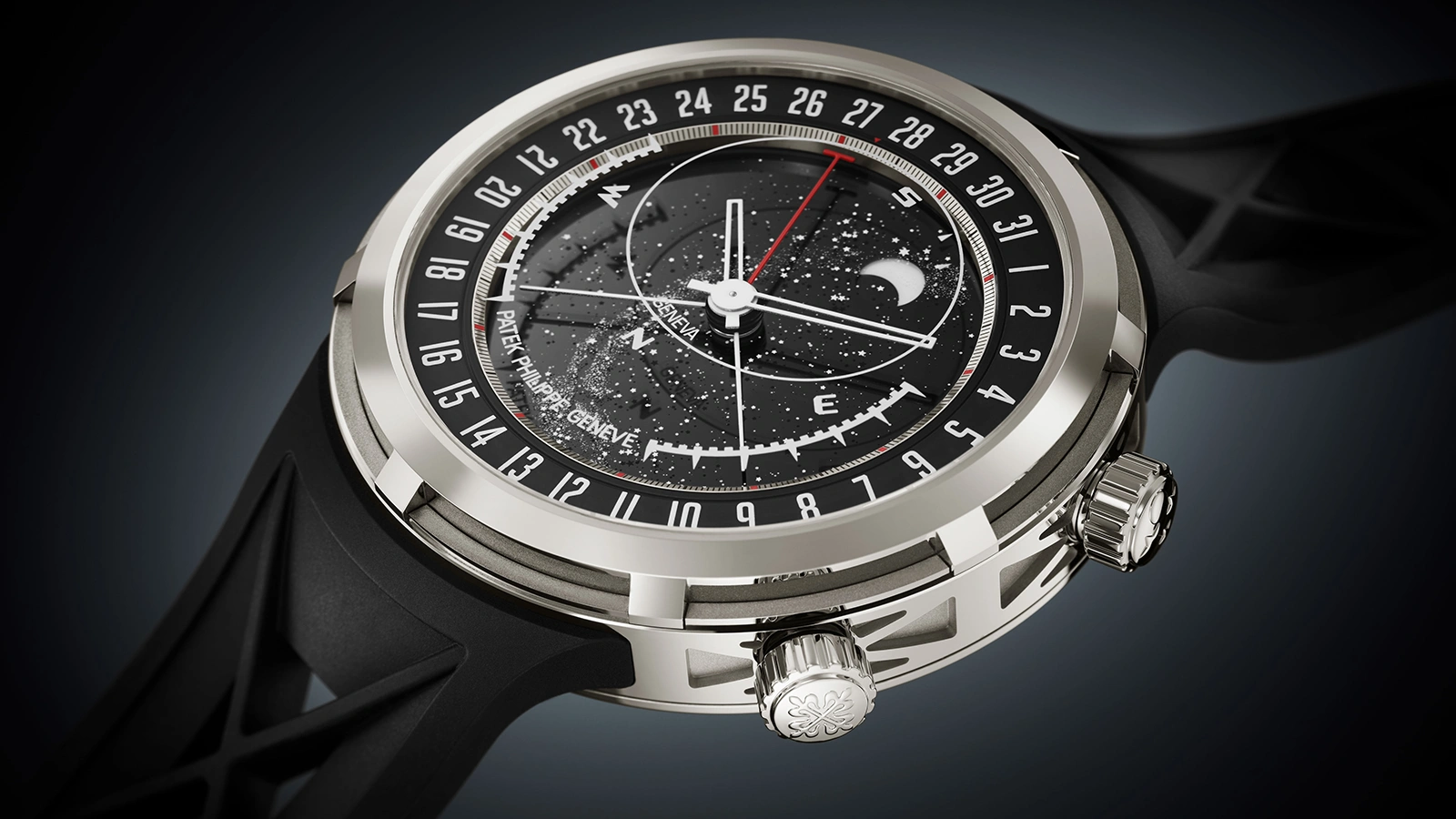
The Patek Philippe Ref. 6105G-001 Celestial with Sunrise and Sunset adds the equation of time complication to the watch with two counters that tap on the date disc for displaying sunrise and sunset times. (Credit: Patek Philippe)
But beyond the watch’s design, the Caliber 240 C LU CL LCSO also adds a new function. The Ref. 6105G-001 indicates sunrise and sunset times, with a patented system for adjusting for daylight savings time. The sunrise and sunset displays utilise the date disc with two hands that measure the equation of time, the difference between mean and apparent solar time. A corrector to adjust for daylight savings works by shifting the date disc back and forth, cleverly adjusting the scale rather than the hands. This corrector also shifts the date hand to ensure accuracy. For the collector who grew up informed by space exploits and Hollywood translations of science fiction, the Ref. 6105G-001 is the new style of classic watchmaking.
These two novelties are not the only new releases by Patek Philippe, but they represent the dualities of the company: One that reflects on its history and shows its relevance today, and one that considers what its future may hold. Both are equally mesmerising.
To learn more about these timepieces, head to one of our boutiques or reach out to our sales representatives to arrange for an appointment.
观点推荐
阅读所有观点-

- 高登精选
Motoring-Inspired Watches That Carry the Adrenaline Beyond the Track
2026年10月9日
-

- 新闻
Patek Philippe’s Gondolo Ladies First Jewelry Watches Offer A New Expression Of Feminine Refinement
2026年10月5日
-

- 新闻
H. Moser & Cie. Off Grid: The Digital Watch For Watchmaking Enthusiasts
2026年9月29日
-

- 品牌焦点
Blancpain Six Masterpieces
2026年9月18日
-

- 新闻
H. Moser & Cie. Streamliner Tourbillon Skeleton Ceramic Alpine Limited Edition: A New Chapter, A New Material
2026年9月14日
-

- 品牌焦点
Why Watch Size Matters (But Not the Way You Think)
2026年9月11日