
- 品牌焦点
OMEGA Celebrates 60 Years Since NASA Qualification
2025年4月29日

On the 1st of March 1965, NASA declared the OMEGA Speedmaster to be “Flight Qualified for all Manned Space Missions.” This pivotal day was the official beginning of OMEGA’s extraordinary journey beyond Earth, which has since included every Moon landing in history and many of the greatest missions of our time.
The NASA qualification is synonymous with OMEGA’s pioneering spirit and excellence in design. 60 years after the approval was announced, the brand is looking back to that hopeful era of human adventure, and celebrating the moment that its watches became part of the story.

Credit: OMEGA
The Background
In 1962, US President, John F. Kennedy, stood in front of an audience at Rice University and famously declared, “We choose to go to the Moon.” Most ambitious of all, he promised to achieve that goal in the very same decade.
The USA’s race into space was ignited.
Project Mercury was the country’s first human spaceflight programme, and became known for its brave group of pilots named The Mercury Seven. When the programme ended in 1963, the NASA astronauts approached their Operations Director, Deke Slayton, and asked to be issued with a reliable watch for future missions.
The watches were required as a backup. If the astronauts lost the capability of their digital timers onboard the spacecraft, the only thing they would have to rely on would be the mechanical timepieces they wore. Therefore, quality was essential.
NASA was already re-evaluating its equipment for the upcoming Gemini and Apollo missions, so in 1964, Slayton issued a request for “high-quality chronographs” and forwarded it to a number of different watch brands.
Of all those brands who received Deke Slayton’s letter, only four responded – including OMEGA. Each company was asked to send “three wristworn chronographs”, which would be tested under the most intense examinations imaginable.

Credit: OMEGA
The Testing
Any piece of hardware that went on the space vehicles had to be qualified by the safety, reliability and quality controllers at NASA.
Engineer, James Ragan, was the man in charge of testing the watches. During his 36-year aerospace career, one of his vital responsibilities was to examine and certify the astronaut chronographs used on NASA’s manned missions.
When James Ragan received the watches from the four brands, he excluded one straight away, because it wasn’t a capable wristwatch like NASA had specified.
In the end, watches from three different brands were tested. To succeed – each watch had to pass all 11 tests.

Credit: OMEGA
1) High Temperature Test
After enduring 48 hours at 70° C, the watches then faced 30 minutes at 93° in a partial vacuum. It was at this stage, in the thermal vacuum, that the watches from two other brands failed. The OMEGA Speedmaster was the only watch still surviving.
2) Low temperature Test
The watch spent 4 hours in an environment of -18° C.
3) Vacuum Test
The watch was heated in a vacuum chamber and then immediately cooled to -18° C for several cycles.
4) Humidity Test
An environment of 95% humidity was created with temperatures ranging from 25° C to 70° C. The watch was required to survive it during ten 24-hour cycles.
5) Corrosion Test
The watch faced 48 hours in an atmosphere of oxygen at 70° C.

Credit: OMEGA
6) Shock-Resistance Tests
Replicating the severity of space travel, the watch faced six 40 G shocks in six different directions.
7) Acceleration Test
The watch endured a progressive acceleration to 7.25 G for about five minutes and then to 16 G for 30 seconds in three axes.
8) Low Pressure Test
The watch was subjected to a pressure of 10-6 atmospheres at 70° C for 90 minutes, then at 93° C for 30 minutes.
9) High Pressure Test
The watch was subjected to an air pressure of 1.6 atmospheres for 60 minutes.
10) Vibration Test
To simulate the extremes of a spacecraft launch, the watch faced random vibrations in three axes between 5 and 2,000 Hz with an acceleration of 8.8 G.
11) Sound Test
To ensure reliability against noise, the watch was subjected to 130 decibels at frequencies from 40 to 10,000 Hz for 30 minutes.

Credit: OMEGA
The Astronaut Approved Result
The OMEGA Speedmaster ST 105.003 passed all 11 tests with success. This was the exact same model available to customers in stores.
The watches from other brands, however, were eliminated during the high temperature test. On one brand’s watch, the large seconds hand warped and was binding against the other hands. On another brand’s watch, the crystal of the chronograph warped and came away from the case.
Speaking about the Speedmaster’s success, James Ragan said, “Even I was surprised that I could get any watches through those tests. The environments were really made for pieces of hardware that you mount on vehicles. It was difficult. It was the most extreme testing you could do to a piece of hardware.”
But there was one final test for qualification, and it was perhaps the most important of all. The watches also needed to be personally approved by the astronauts themselves.
Ragan gave the crews the Speedmaster and other watches to examine and evaluate. Not knowing the results of the tests, the astronauts came back and unanimously chose the Speedmaster as their preferred model, due to the better accuracy, reliability, readability and ease of operation.
Ragan later said, “It made my life a lot easier. I was able to go to the programmes office and say, it’s passed the tests and the astronauts want it.”

Credit: OMEGA
What Happened Next?
Just three weeks after the qualification was granted, on the 23rd of March, 1965, the Speedmaster ST 105.003 officially went into space for the first time on the wrists of Virgil “Gus” Grissom and John Young during their Gemini 3 mission. The only modification to the watches was the addition of a long Velcro strap that could be worn over the space suits.
Beyond Gemini 3, the Speedmaster and its various updates became an invaluable tool for the crews aboard each of NASA’s manned missions. Famously, it was worn by Ed White during the first American spacewalk in 1965 and also the crew of Apollo 8, who saw the “far side of the Moon” for the first time in 1968.
As the Speedmaster continued to serve the astronauts in space, NASA got closer and closer to its major goal. Finally, on the 20th of July 1969, Apollo 11 touched down on the moon for the first time in history, fulfilling John F. Kennedy’s promise.
Neil Armstrong and Buzz Aldrin spent two and a half hours walking on the lunar surface, and in that moment, the OMEGA Speedmaster became the first watch worn on the Moon. It has returned for every Moon landing since then and long remained a critical part of NASA’s astronaut kit.
Credit: OMEGA
An Enduring Design
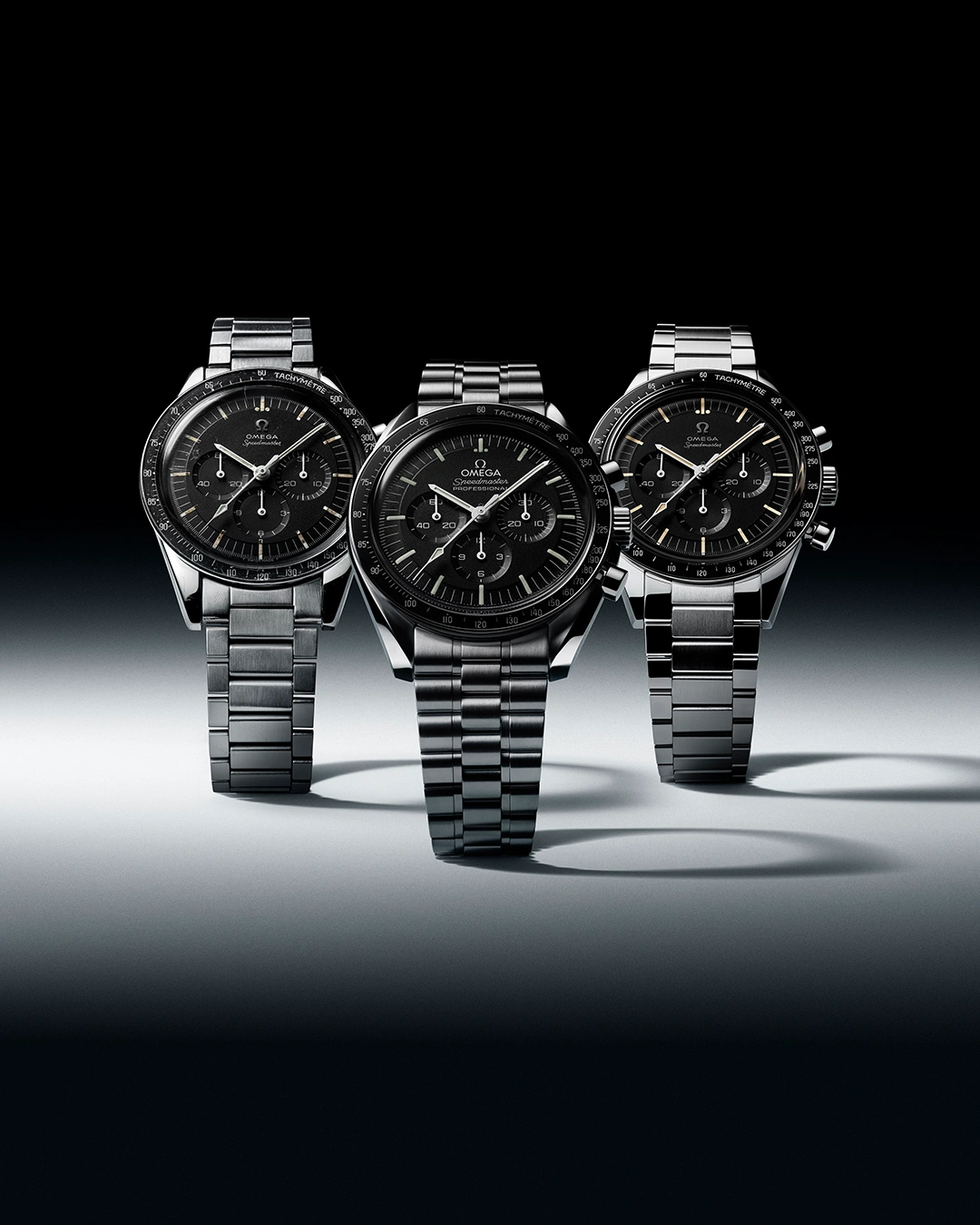
At first glance, the Speedmaster watches produced over the past 60 years appear almost unchanged. Afterall, why adapt something that is so iconic and loved? However, look a little closer, and you’ll discover the critical evolutions and similarities that are available to customers today.
Size
-

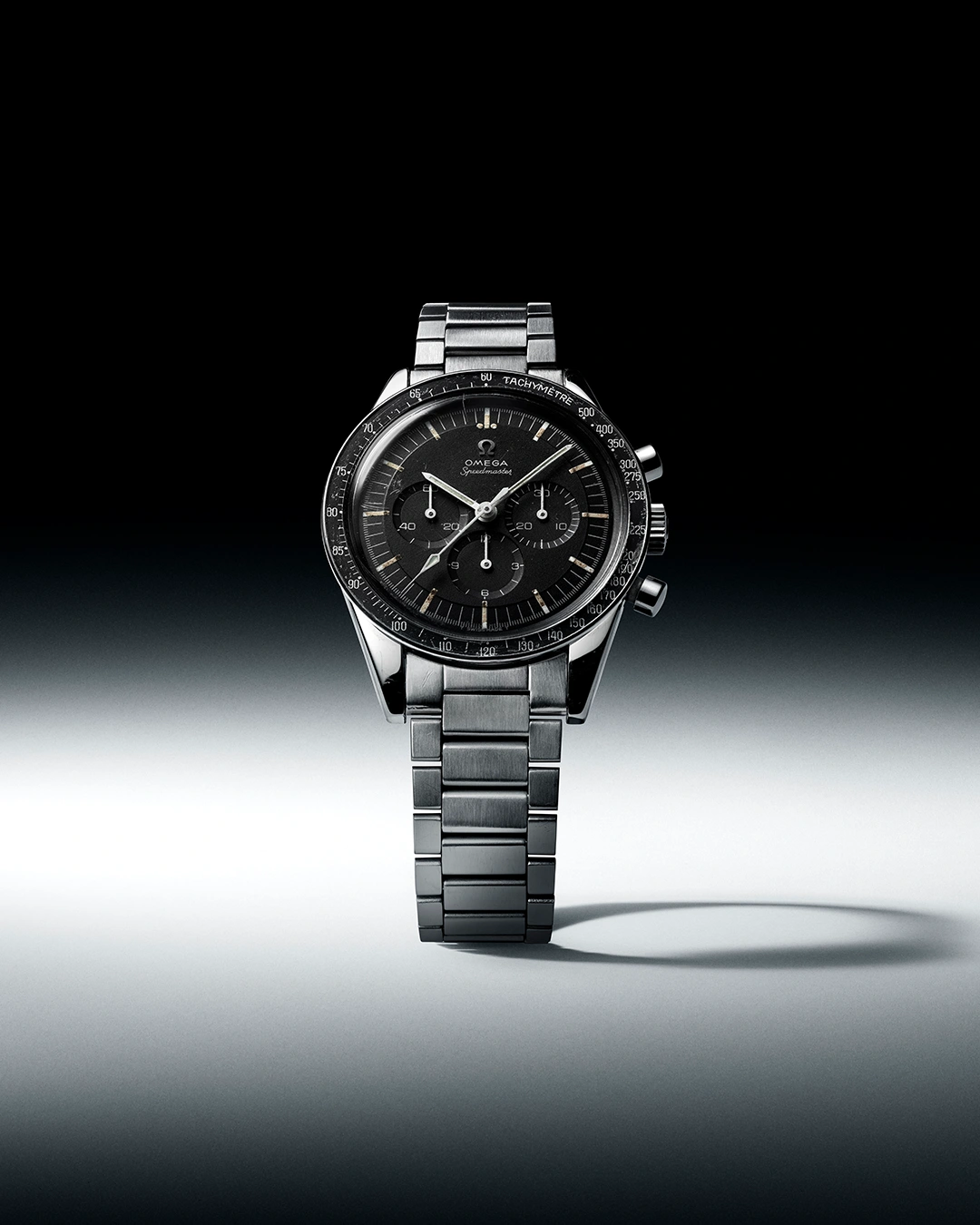
NASA Tested Watch
ST 105.003
Qualified by NASA in 1965, this model represents the Speedmaster’s 3rd generation design and is sized at 39.70 mm. (Credit: OMEGA) -
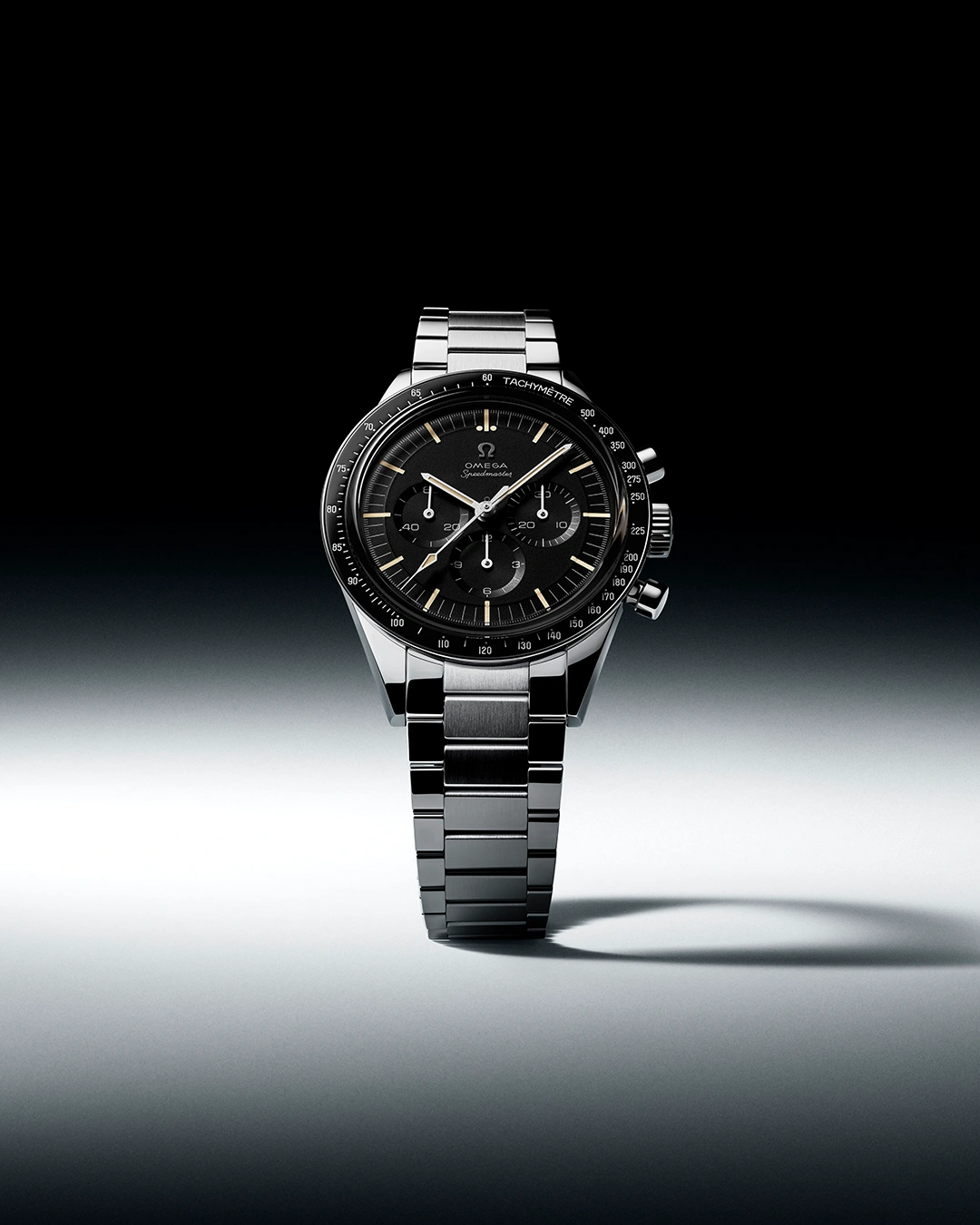
The Speedmaster Calibre 321
311.30.40.30.01.001
Inspired by the 3rd generation Speedmaster that NASA qualified in 1965, OMEGA launched this 39.70 mm choice in 2020 for modern customers – almost perfectly replicating the original style. (Credit: OMEGA) -
The Speedmaster Moonwatch
310.30.42.50.01.001
Perhaps the most iconic chronograph on Earth, today’s Speedmaster Moonwatch is 42 mm, and is inspired by the 4th generation style that Apollo 11 astronauts wore on the Moon. This latest Co- Axial Master Chronometer version was launched in 2021. (Credit: OMEGA)
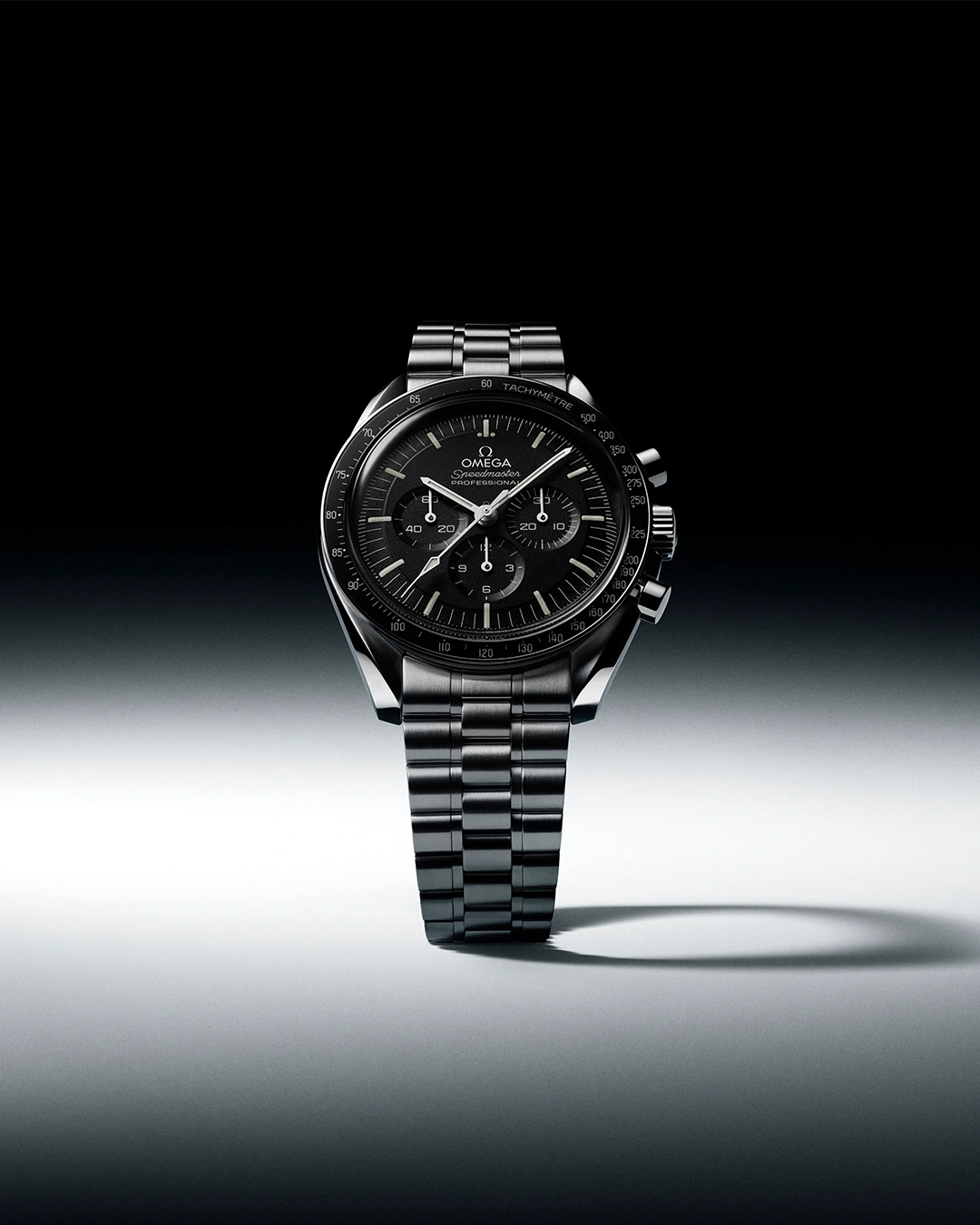
Caseback
-

NASA Tested Watch
ST 105.003
This early Speedmaster watch featured a double bevel caseback with “Speedmaster” engraved and OMEGA’s famous Seahorse emblem. (Credit: OMEGA) -
The Speedmaster Calibre 321
311.30.40.30.01.001
To let customers admire the sophisticated mechanics of the Calibre 321, OMEGA gave this model a transparent sapphire crystal caseback. (Credit: OMEGA) -
The Speedmaster Moonwatch
310.30.42.50.01.001
The caseback of the Moonwatch includes the famous words; “FLIGHT-QUALIFIED BY NASA FOR ALL MANNED SPACE MISSIONS”, as well as “THE FIRST WATCH WORN ON THE MOON”. The Seahorse emblem still retains its place at the centre. Since 2021, with the introduction of the Calibre 3861, the text “Co-Axial Master Chronometer” has also been added, highlighting the movement inside. (Credit: OMEGA)


Bracelet
-

NASA Tested Watch
ST 105.003
The Speedmaster 105.003 was delivered on several linked bracelet references, while also being presented on Velcro straps when astronauts wore it over their spacesuits. The style seen in this image
features 3 flat links per row and a protruding OMEGA vintage logo on the clasp to help with opening. (Credit: OMEGA) -
The Speedmaster Calibre 321
311.30.40.30.01.001
A modern version of the bracelet with 3 flat links has been used for the Speedmaster Calibre 321. A foldover clasp fastens it to the wrist. (Credit: OMEGA) -
The Speedmaster Moonwatch
310.30.42.50.01.001
Today’s Moonwatch bracelets are presented with five arched links per row, with a foldover clasp and an additional comfort setting. (Credit: OMEGA)


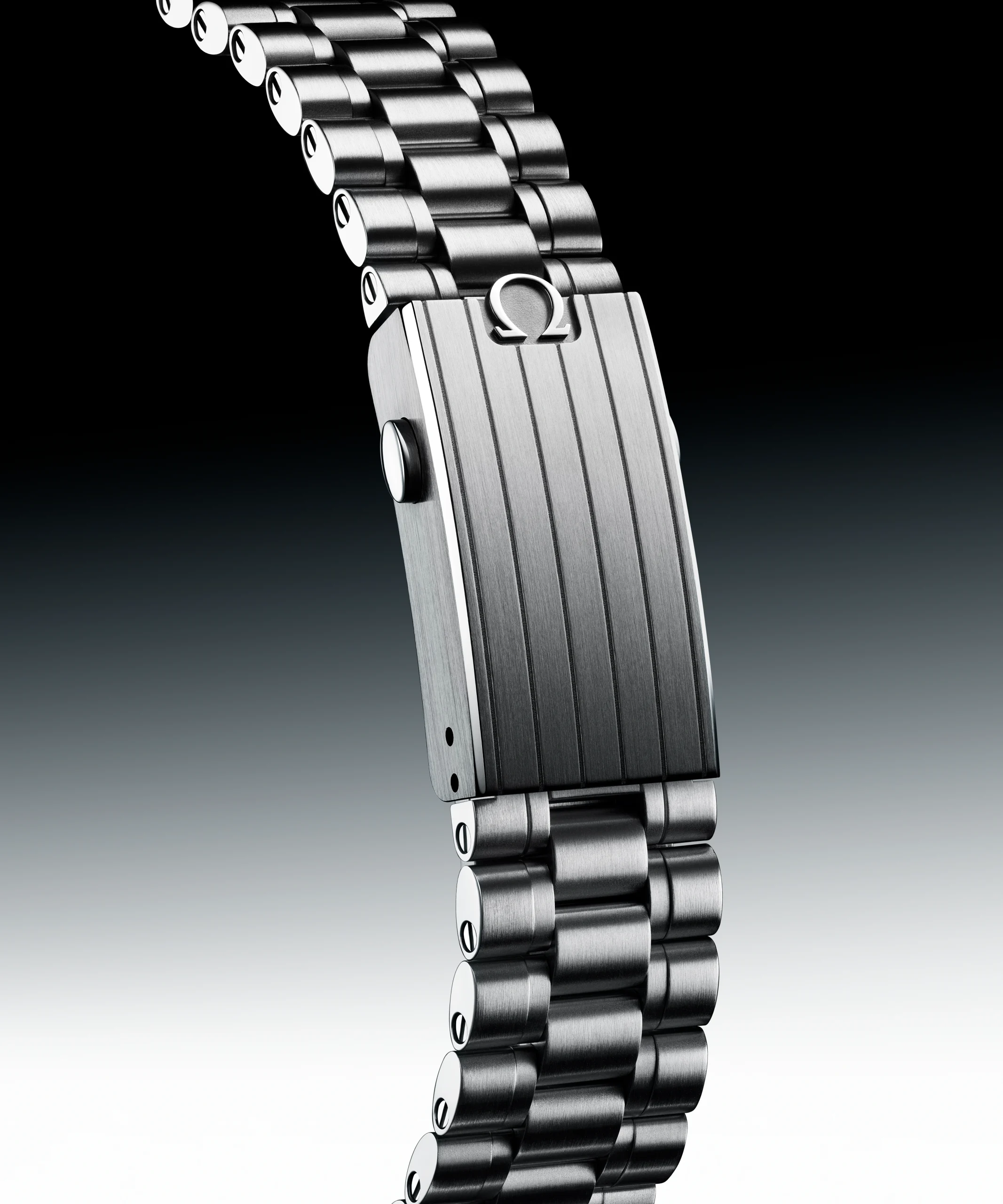
Dial
-

NASA Tested Watch
ST 105.003
While the black dial featured an applied OMEGA logo in the vintage style, it also included tritium markers for luminosity. Note especially that this was the last Speedmaster reference that did not
include the addition of the word, “Professional”. (Credit: OMEGA) -
The Speedmaster Calibre 321
311.30.40.30.01.001
This black step dial remains as true to the original as possible, with similar features including the vintage OMEGA logo and the same Speedmaster font. Naturally, to give it a necessary update, the markers are coated in modern Super-LumiNova
instead of tritium. (Credit: OMEGA) -
The Speedmaster Moonwatch
310.30.42.50.01.001
The black step dial of the Moonwatch features a transferred logo with the addition, since 1964, of the word “Professional”. From 1997, the models were upgraded with Luminova detailing for better visibility. The logo and Speedmaster font are also in keeping with today’s modern style. (Credit: OMEGA)


Tachymeter Bezel
-

NASA Tested Watch
ST 105.003
It wouldn’t be a Speedmaster without a tachymeter scale on the bezel. For dedicated fans, two small but recognizable details of the ST 105.003 are the placement of the dot over 90, and the dot diagonal to 70. (Credit: OMEGA) -
The Speedmaster Calibre 321
311.30.40.30.01.001
Naturally, the important placement of the dots hasn’t been changed for the Speedmaster Calibre 321. What’s new, however, are the materials used. Instead of the original aluminium bezel ring, OMEGA has created a bezel ring in polished black ceramic with the tachymeter scale in white enamel. (Credit: OMEGA) -
The Speedmaster Moonwatch
310.30.42.50.01.001
The Speedmaster Moonwatch features an anodised aluminium bezel ring in black, a feature that has been part of the design since the Speedmaster’s 2nd generation. Almost everything else is exactly as it was in 1964. A perfect tool for measuring speed over a known distance. Although the positioning of the 90 and 70 dots on the bezel were changed over the years, they have now been returned to their original placement as a tribute to heritage. (Credit: OMEGA)


Pushers
-
NASA Tested Watch
ST 105.003
The pushers on the NASA tested watch were considered medium size and very easy to use with thick astronaut gloves. Notably, they are without the protection of the asymmetrical case that modern versions offer. (Credit: OMEGA) -
The Speedmaster Calibre 321
311.30.40.30.01.001
The very same pushers still remain – proving that some designs are too perfect to change. (Credit: OMEGA) -
The Speedmaster Moonwatch
310.30.42.50.01.001
The most interesting feature of the Moonwatch pushers today is the protection they are given by the asymmetrical case. (Credit: OMEGA)


Case Shape
-
NASA Tested Watch
ST 105.003
The shape of the NASA-tested watch is most notable for its symmetrical shape with straight lugs. This was the last Speedmaster that came without crown guards. From this generation onwards, it
became known as the Moonwatch after its historic lunar landing. (Credit: OMEGA) -
The Speedmaster Calibre 321
311.30.40.30.01.001
The straight lugs and symmetrical case are the same as the original NASA tested watch. Just like that model, today’s tribute also includes the same brushed sides and polished upper surfaces. (Credit: OMEGA) -
The Speedmaster Moonwatch
310.30.42.50.01.001
The Moonwatch case is inspired by the 4th generation Speedmaster. It features twisted lugs, as well as an asymmetrical shape that provides protection for the crown and pushers. (Credit: OMEGA)
Calibre

Credit: OMEGA
The Speedmaster Difference
Accuracy, reliability, readability and ease of operation were the reasons given by astronauts, when asked about their preference for their Speedmaster. Indeed, the timepieces offered numerous qualities that many other watches could not.
Robust Design
When the original Speedmaster was created in 1957, it included many protective technologies used by OMEGA at the time, such the sealing powers of O-ring gaskets, and the famous “Naiad” crown. Through this, OMEGA was able to create an incredibly rugged chronograph that was hermetically sealed against the elements and whose sealing powers extended to a depth of 200 feet. Furthermore, the hesalite glass offered the advantage of flexibility, and therefore shatter-resistance, in high impact situations. The last thing an astronaut wants during a mission is tiny fragments of glass floating in the spacecraft.
Pioneering Spirit
The Speedmaster was a design pioneer. When released in 1957, it became the first watch to feature a tachymeter scale on its bezel, as opposed to the dial. This made it ideal for its intended customer – racing car drivers out on the track. Ever since then, the iconic timing scale has remained an essential and distinguishing element of the Speedmaster design.
Readability
The original Speedmaster from 1957 was engineered for racing car drivers. Therefore, the design was given an easily readable face, so that timing could be noted at a glance. Not only did this theme continue in the ST 105.003, but there was also luminosity on the baton hands and hours markers, provided by the use of tritium. For the darkest reaches of space, this distinctive readability was a critical factor.
Accuracy
By 1965, OMEGA had a superb reputation for precision, and especially for chronograph design. The brand’s first chronograph calibre with 30-minute and 12-hour counters was the 27 CHRO C12. First designed and produced in 1941, it was a movement distinguished by its use of a column wheel, a feature that was machined from a single piece and which added technical value. This led to the birth of the Calibre 321, given its name in 1949. Using the same column wheel system, it encapsulated OMEGA’s commitment to accuracy, and its expertise in ultra-fine mechanics.
Discover more OMEGA collections with Cortina Watch online, visit us at our boutiques, or contact a sales representative today to learn more.
观点推荐
阅读所有观点-

- 新闻
Franck Muller Celebrates The Art of Skeletonisation
2026年10月22日
-

- 新闻
Introducing the H. Moser & Cie. Pioneer Cylindrical Tourbillon Skeleton Aventurine: An Exclusive Creation by Saquon Barkley
2026年10月20日
-

- 新闻
Introducing Bell & Ross BR-03 Space Mission
2026年10月19日
-

- 时计知识
Moonphase Watches and the Art of Celestial Timekeeping
2026年10月12日
-

- 新闻
Bell & Ross BR-03 Green Radar Ceramic: The Iconic Radar Collection Returns for Its Fourth Iteration
2026年10月8日
-

- 新闻
One Complication, Three Personalities: H. Moser & Cie. Introduces Three New Retrograde Seconds Models
2026年10月7日