
- Cortina Curates
The Art of Watch Finishing: Perlage, Geneva Stripes & More
本文出自: Justin Ng
2026年2月27日

An art form and a quest for perfection, watch finishing encompasses meticulous and laborious techniques including perlage, Côtes de Genève, mirror polishing and more.
The ethereal qualities that make luxury watches the pinnacle of watchmaking are embodied by the finishing and decorative touches. The process from start to finish spans countless man-hours, and it is endeavoured with ingenuity, dedication and pride. Master watchmakers and skilled artisans strive for perfection and refinement. It is in finishing where the art form in the art of watchmaking becomes truly emotive, personal and palpable.
The Purpose and Meaning of Finishing in Watchmaking
Perfection is a never-ending pursuit in watchmaking. However a daunting challenge it may seem, it has only served to fuel watchmakers, in creating mechanical watches that are uncompromising, precise and flawlessly finished.
Finishing is a vital process in the production of watches. The process entails decorating every part of the watch, including the case, the dial, the movement and its components, and the bracelet, in a variety of techniques to achieve the desired outcome as envisaged. Finishing extends beyond aesthetics as it also offers functional benefits.
For example: anglage. One of the most demanding decorative techniques, anglage encompasses the rounding, smoothening and polishing of the edges through bevelling or chamfering. It is usually applied to the movement’s bridges and plates. Apart from ironing out the rough edges, burs and smudges, anglage prevents corrosion from taking hold and festering. When performed by hand in a laborious and faultless manner, anglage puts an exclamation mark on the watch.
This absolute attention to detail separates the finest luxury watches from the rest, baring their artistry and craftsmanship, and marking haute horlogerie from mere timekeeping. Anglage is only an example of a bevy of finishing techniques practised in watchmaking – a topic we will explore further in this article.
Types of Finishing Techniques in Luxury Watches
Côtes de Genève (Geneva Stripes)
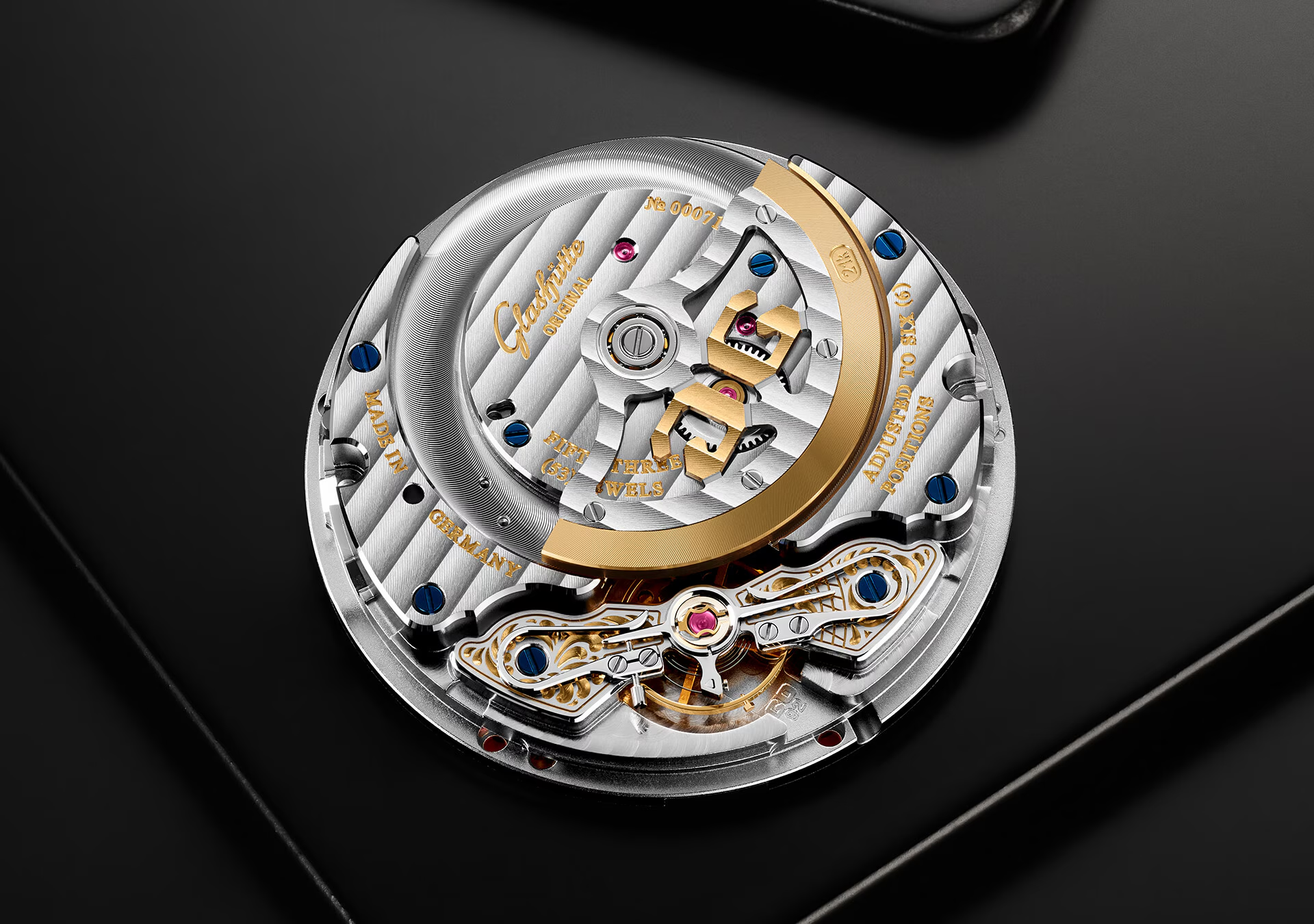
The magnificent Glashütte Original movement features the Côtes de Genève-influenced Glashütte Stripes (Credit: Glashütte Original)
Affectionately known as the Côtes de Genève, the Geneva Stripes motif creates a visually striking waves-like finish on the surface of the movement. Under an ideal lighting condition, the Côtes de Genève reflects the crest of a wave and in the trough, fine parallel lines, running the length of the movement’s mainplate, bridge and rotor. This ornamental finish can be admired through the transparent caseback, signalling the watch’s provenance and pedigree. This finish is a hallmark of Swiss Made watches and one of the requirements for watches to earn the prestigious Poinçon de Genève (Geneva Seal) certification.
The Côtes de Genève emerged in the late 19th century in Geneva, Switzerland and began to gain popularity and spread elsewhere in the 20th century when watchmakers learned of its practical and artistic values, particularly with the advent of exhibitive casebacks. During the age of pocket watches, the stripes on the surface helped trap particles and prevent them from settling on other parts of the pocket watches, which at the time often had open casebacks exposed to the elements. Moreover, early wrist watches were made in traditional ateliers – and unlike today’s modern, sterile studios – where dust was a concern and bane to perfection.
Watchmakers have clearly fallen in love with the Côtes de Genève, and despite today’s stringent manufacturing practice put in place, they continue to lavish these distinctive stripes on their finest movements as a testament to its enduring power. Since its introduction, the Côtes de Genève have taken on new forms as the iconic stripes inspired similar motifs found in other famous watchmaking cradles of the world, including Glashütte, Germany, where it is known as the Glashütte Stripes.
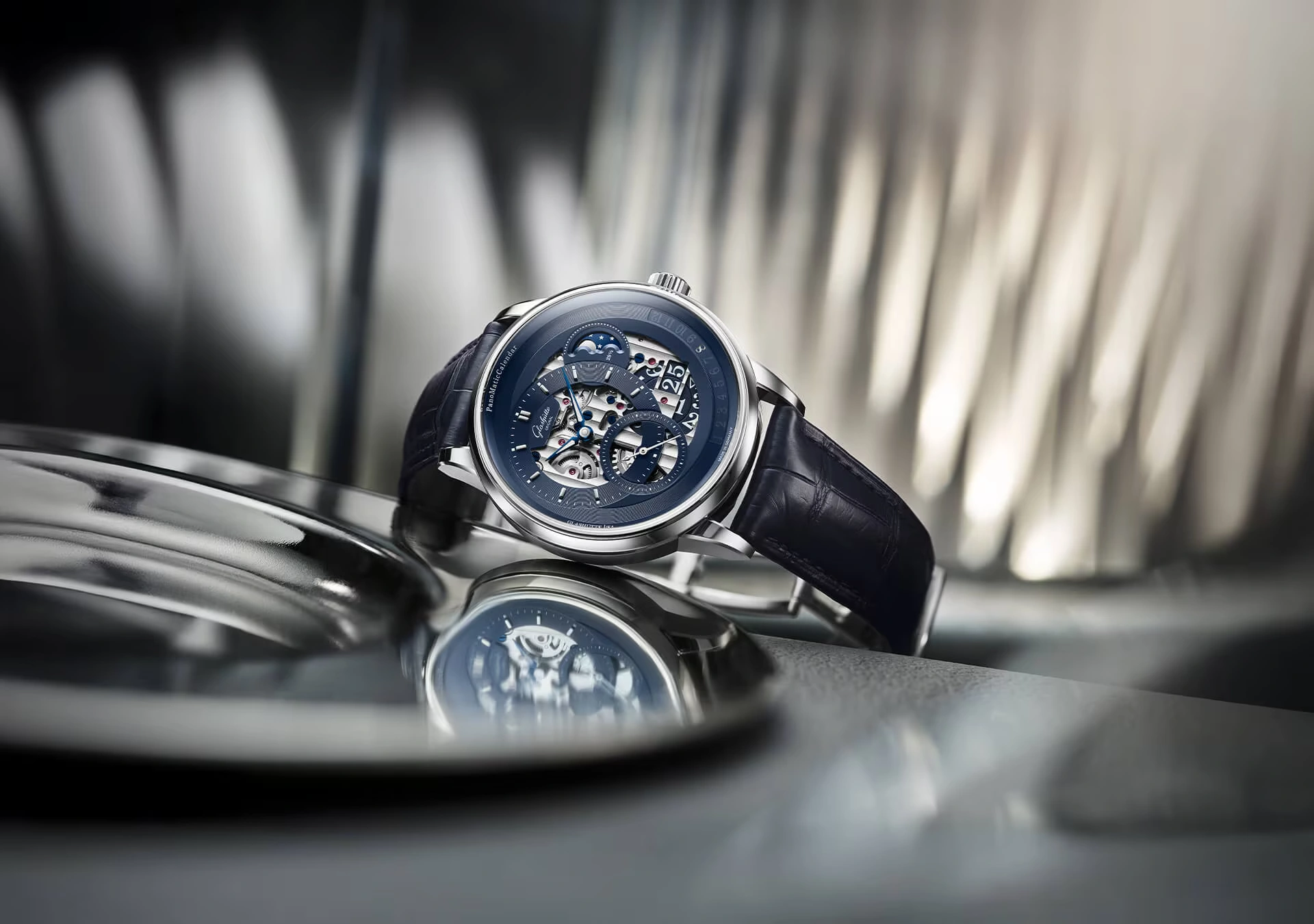
Limited to 150 pieces worldwide, the Glashütte Original PanoMaticCalendar makes a powerful statement. (Credit: Glashütte Original)
Recalling the serenity of twilight, Glashütte Original PanoMaticCalendar invites collectors to gaze at its openworked dial, partially skeletonized to reveal an integrated annual calendar movement replete with the marque’s iconic Glashütte Stripes. Reliable and precise, it is complemented with a gorgeous moonphase indicator, cleverly positioned off-centre at 2 o’clock.
Elevating its luxe factor is a 42 mm platinum case whose silvery sheen brings out the depth and richness of the carefully considered navy blue colour. The transparent caseback showcases the 100-hour power reserve manufacture movement whose Glashütte Stripes echo those on the dial side. Along with the exclusive hand-engraved balance cock, a nod to its Glashütte provenance, this timepiece epitomizes technical sophistication and perfect harmony.
Mirror Polishing (Poli Miroir) & Black Polishing (Poli Noir)
Polishing is a finishing technique used extensively in watchmaking. It can be delineated into poli mirroir (mirror polishing) and poli noir (black polishing). In mirror polishing, the surface is treated in such a unique way that light is captured and reflected off the surface as though it is a mirror. This challenging technique demands perfection as flaws such as blotches, scratches and unevenness can cause distortion to the reflection.
On the other hand, black polishing endows the surface with a deceptive appearance. When viewed from a perpendicular position, the surface turns dark like a polished black onyx but instantly returns to a mirror-like finish when viewed from other angles. This captivating peculiarity requires the experience of a skilled artisan and an even greater number of man-hours.
As a whole, polishing by hand is an arduous process as parts that benefit from this treatment tend to be small but critical to keeping excellent time, such as levers, screw heads and tourbillon cages. It is performed in concert with other finishing techniques like anglage, in order to create a component that is both functional and enchanting. Any imperfection results in a component being discarded and artisans have to restart the whole chain of process from the very beginning – a reminder that Haute Horlogerie operates at an unforgiving and exact field.
-

The exceptional Grand Seiko Caliber 9SA5 exhibits several types of finishing, including the black-polished screw heads. (Credit: Grand Seiko)
-

The mirror-polished hammer of a minute repeater juxtaposes against the unpolished mainplate. (Credit: Blancpain)


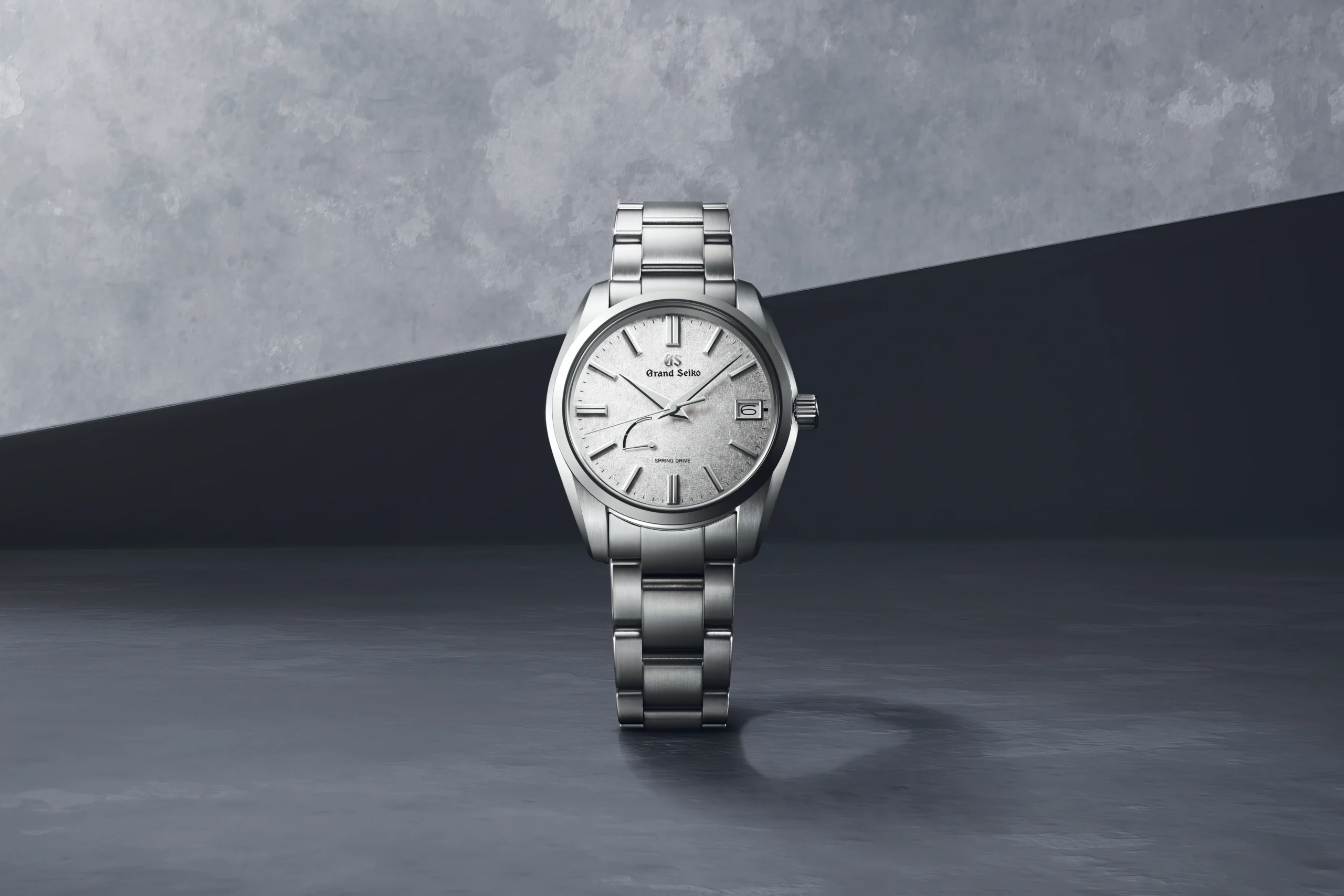
Inspired by morning frost, Grand Seiko pairs its exclusive Zaratsu-polished case with a frosted white dial on the SBGA465. (Credit: Grand Seiko)
Grand Seiko embodies the Japanese spirit of industry, precision and perfection, producing the SBGA465 from its Heritage Collection to pay homage to the picturesque sceneries of Japan. Central to Grand Seiko, Zaratsu polishing is performed on the watch case to maintain its smooth and sharp ridge lines. This watch features Grand Seiko’s exceptional Caliber 9R65 and its proprietary Spring Drive mechanism.
With precision falling within +/- 15 seconds per month, this exclusive mechanical movement is the result of Grand Seiko’s commitment to advanced functionality and exquisite craftsmanship. One of the brand’s specialities is the frosted finish, where watch dials are imbued with unique motifs drawn from the natural and seasonal changes surrounding its watchmaking studios. Every Grand Seiko watch is a reflection of its artisans’ sense of their place in nature.
Perlage (Circular Graining)
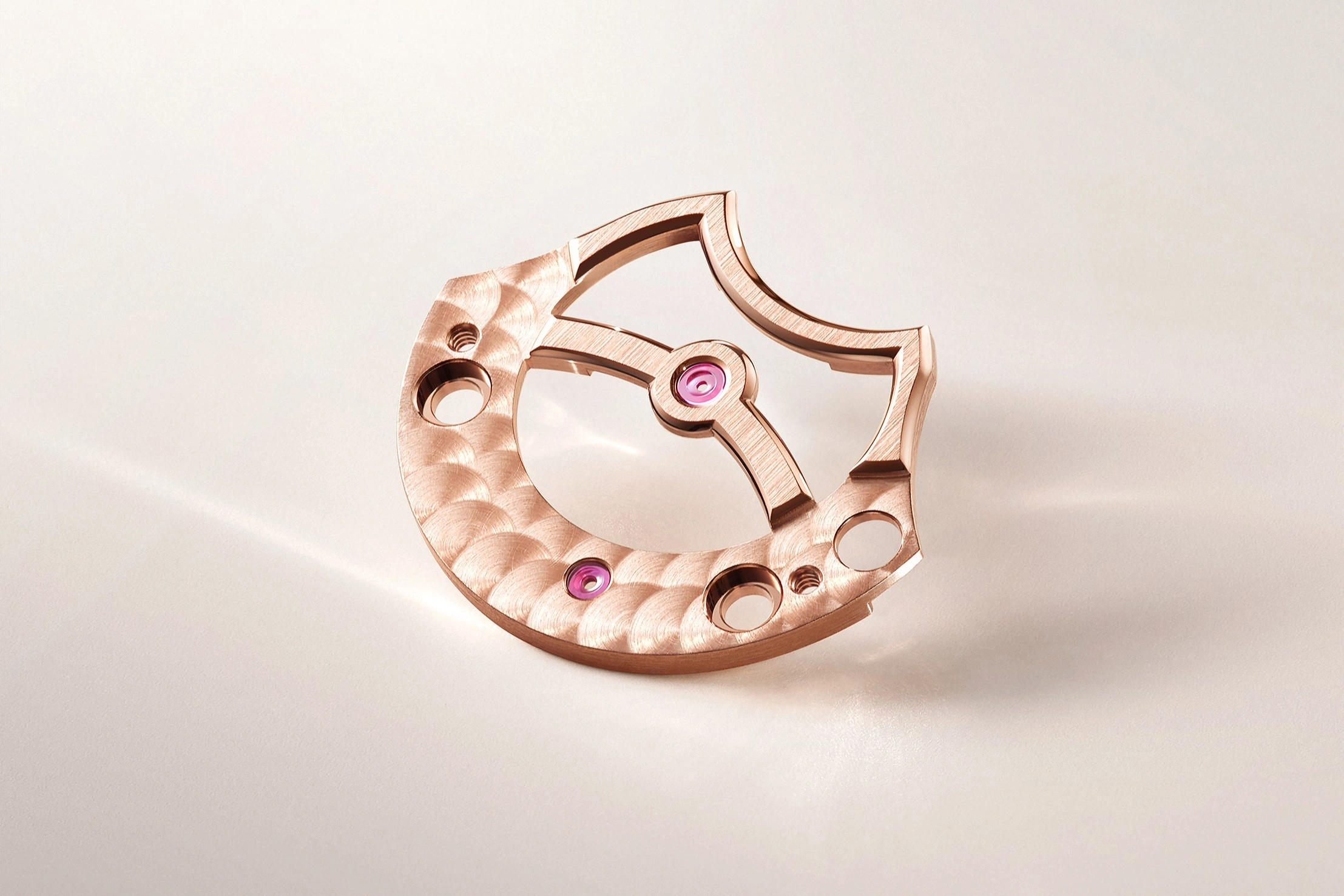
Perlage is customarily used on a wider, flatter surface, alongside other finishing techniques for greater contrast. (Credit: Blancpain)
Often concealed entirely within the movement or partially exposed on the recesses of the mainplate, perlage (circular graining) is an attractive pattern. It consists of multiple small, overlapping swirls on a flat surface. Reducing glare and reflection that might arise on the flat surface while simultaneously preventing potential corrosion, perlage requires finesse and exactness to ensure all circles are uniformed and fit within the designated area.
Skilled artisans must ascertain the diameter of each swirl and the gap between them. This judgement calls upon experience and a keen eye to ensure each placement is done just right. Produced using a small rotating stem treated with a fine abrasive, the hypnotizing perlage evokes harmony, beauty and flair.

The Blancpain Villeret Quantième Complet Phases de Lune is an exquisite watch demonstrating the Manufacture’s complete know-how. (Credit: Blancpain)
Elegant and refined, the Blancpain Villeret Quantième Complet Phases de Lune enthralls purists with its timeless aesthetics and an in-house movement, decorated according to Haute Horlogerie tenets and traditions. The latest edition is a romantic evolution of an icon, preserving its distinctive silhouette while elevating it with modern touches.
Accented with gold, its opaline dial is enriched with redesigned hands, 18-ct gold Roman numeral indices, the emblematic “JB” symbol, large apertures and an expressive moonphase indication. At once sculpted and sensual, the 40-mm case is fitted with discreet under-lug correctors, patented in 2005, operable with a quick press of the finger. Slimmer than its predecessors, the watch teases a thinner bezel, a larger crown and a slender profile. It is a complete calendar blessed with artisanal value.
Frosted Finish

The Grand Seiko Caliber 9RA5 is finished with a frosted effect achieved via a neutral-toned sandblast coating. (Credit: Grand Seiko)
Mesmerising, granular and three-dimensional, frosting gives the watch a unique appearance. Thanks to the ingenious process, no two frosted effects are identical, making all watches featuring the frosted finish one of a kind. The frosted finish can be distinguished by its textural visage, where sprinkles or granules blanket specific parts of the watch, most commonly the dial, the case and the bracelet. Depending on the degree of reflection and the diameter of the granules, as well as the material of choice, the highly versatile frosted finish can evoke a bygone era or something futuristic.
Frosting can be achieved through a variety of techniques such as abrasive blasting using materials like sand, glass beads and ceramics, or with chemicals. It can also be accomplished using a diamond cutter, where the surface is delicately engraved to produce a sparkling or matte finish.
Tremblage is a traditional yet sophisticated engraving technique, where the artisan spends hours on end to produce thousands of tiny reliefs on the metal surface by hand to bring forth a glistening effect.
Another historical technique, Grenaillage was pioneered in the 1800s. It was foremost created as an anti-corrosion method, where a brass base was brushed with aluminium powder to create a powdered matte surface, before it was coated with a gold-mercury slurry. The part would then be heated. Once mercury evaporated, it left behind a gold-coated surface producing a pleasant sheen while offering a protective shield against corrosion.
However in modern times, galvanizing is preferred over Grenaillage. It begins with hot dipping or electro-galvanizing the base, usually the dial of a watch, to form an anti-corrosion layer before it is sandblasted to reproduce the industrial impression of Grenaillage. The galvanic part can also be engraved or texturized to accomplish a different motif.

H. Moser & Cie. infuses its signature fumé dial with a frosted finish on the Streamliner Flyback Chronograph Automatic Frozen collection. (Credit: H. Moser & Cie.)
Boasting a sleek design, the Streamliner Flyback Chronograph Automatic Frozen collection available with Midnight Blue and Matrix Green fumé dials is H. Moser & Cie.’s unique take on the futuristic chronograph. Quintessentially Moser, the frosted fumé dial steals attention with its striking gradient colour and glitters. It is an evolution of a signature from the brand known for its bold visions, bridging traditional labour-intensive craftsmanship with the avantgarde and the contemporary.
To accomplish this stunning finish, artisans first have to engrave and stamp on the dial plate before applying a tinted lacquer. The result is a dial that glistens like snow in the sunlight when seen from a certain angle. The transparent caseback showcases the intricate Calibre HMC 907 featuring a variety of demanding hand finishing, affirming H. Moser & Cie’s status as the avant-gardist of Haute Horlogerie.
Hand Engraving & Skeletonization

When combined with other finishing techniques, an audacious skeletonized movement offers an unrivalled primordial appeal. (Credit: Franck Muller)
Engraving is an ornamental art form used extensively in watchmaking either to carve a particular motif onto a surface or to remove excess materials from the bridges or the mainplate of a movement, in order to present an openworked or a skeletonized interpretation of the same movement. Hang engraving and skeletonization are customarily performed together with audacity and precision.
Hand engraving leaves little room for error as master engravers work on free hand, using a range of tools at their disposal to create reliefs and shapes. The carved surfaces and parts are subsequently treated with other finishing techniques such as anglage and polishing to produce the final work. However a slight mishap in the process can instantly undo days if not weeks of labour, making hand engraving all the more painstaking.
Skeletonization opens up the inner workings of the watch to wider appreciation, introducing collectors to the wondrous world of mechanical beauty. It transforms watches into sculptures and their calibres into architecture.

Beyond extensive skeletonization, the Franck Muller Vanguard Curvex Cut Flower taps into the fine craft of gemsetting. (Credit: Franck Muller)
As one of the leading independent watch brands, Franck Muller is renowned for its repertoire of technical complications and extraordinary craftsmanship. The Vanguard Curvex Cut Flower weaves gemsetting into watchmaking, softening the intense skeletonization with a delicate bouquet. Its refined skeletonized movement is transformed into a blooming garden by the dextrous hands of the skilled craftsmen.
Each petal is an invitation to explore the inner workings of the in-house movement, where 153 parts have been meticulously engraved, decorated and assembled to permit light to illuminate the diamond-swathed masterpiece. The skeletonized bridges double as trellises for the elegant floral motif, encapsulating grace and strength in equal proportions, with the faceted gemstones resonating the sensuality of the chamfered architecture.
The Mark of True Horological Artistry
Haute Horlogerie represents an ecosystem of ancestral and modern finishing techniques, each designed to complement one another. Their diversity and practice proves that watchmaking is an undisputable art form. At the pinnacle of watchmaking, craftsmanship is emotional, harmonious and tangible. A watch travels step by step from the hands of artisans to the wrist of a collector, telling a story of precision, creativity and perfection. Its intricate details are a testament to the brand’s unwavering commitment to craftsmanship and the watchmaker’s unquestionable know-how.
A leading luxury watch retailer in Asia, Cortina Watch is home to the beautifully finished luxury watches showcased above. Come and discover the pinnacle of horological artistry with us today, and let us find you the perfect watch.
观点推荐
阅读所有观点-

- 新闻
Franck Muller Celebrates The Art of Skeletonisation
2026年10月22日
-

- 新闻
Introducing the H. Moser & Cie. Pioneer Cylindrical Tourbillon Skeleton Aventurine: An Exclusive Creation by Saquon Barkley
2026年10月20日
-

- 新闻
Introducing Bell & Ross BR-03 Space Mission
2026年10月19日
-

- 时计知识
Moonphase Watches and the Art of Celestial Timekeeping
2026年10月12日
-

- 新闻
Bell & Ross BR-03 Green Radar Ceramic: The Iconic Radar Collection Returns for Its Fourth Iteration
2026年10月8日
-

- 新闻
One Complication, Three Personalities: H. Moser & Cie. Introduces Three New Retrograde Seconds Models
2026年10月7日