
- 品牌焦点
Watches and Wonders 2025: Patek Philippe New Novelties
2025年4月1日

Patek Philippe presents fifteen new models brimming with creativity and savoir-faire. Timed for the grand annual rendezvous of Watches & Wonders 2025, the Genevan manufacture is unveiling a splendid array of new models, strengthening every segment of its vast collection. It affirms its technical mastery, particularly with three new movements equipping exceptional pieces: a self-winding Quadruple Complication for connoisseurs, a desk clock with perpetual calendar and weekly calendar endowed with a 31-day power reserve, and a new Calatrava with instantaneous day and date displays and an 8-day power reserve. This 2025 vintage is also notable for subtle new aesthetic interpretations combining the quest for timeless elegance with extraordinary attention to fine workmanship.
By combining their talents, Antoine Norbert de Patek and Jean Adrien Philippe devoted themselves to an ambitious vocation: designing and making the “finest watches in the world”, in terms of both technique and aesthetic. For the four generations of the Stern family presiding over the manufacture’s destiny since 1932, this passion for excellence has remained the keyword, and the fifth generation, taking shape today, will have exactly the same mission: to guarantee the brand’s continuity over the long term, its independence and its outstanding creative potential, a regards both the movements and the exterior features. The fifteen new introductions presented in this spring of 2025 illustrate, yet again, this unique alliance of tradition and innovation –while always respecting the ultra-strict principles of the Patek Philippe Seal.
Innovative Grand Complications
The first expertise to be honored is that of the Grand Complications, one of the fields in which Patek Philippe has reined supreme since the founding of the manufacture in 1839.
This year 2025 sees the current collection welcoming an exceptional watch destined for connoisseurs, the Quadruple Complication Reference 5308G-001. Presented as a world first in a limited edition in platinum at the Patek Philippe Grand Exhibition “Watch Art” Tokyo in 2023, this self-winding timepiece unites a minute repeater, a split-seconds chronograph and an instantaneous perpetual calendar with aperture displays. Its new caliber R CHR 27 PS QI movement is particularly notable for its optimized performances and two patented innovations concerning the split-seconds mechanism. This feat of miniaturization and energy management is housed in an elegant white-gold case framing a ice-blue sunburst dial.
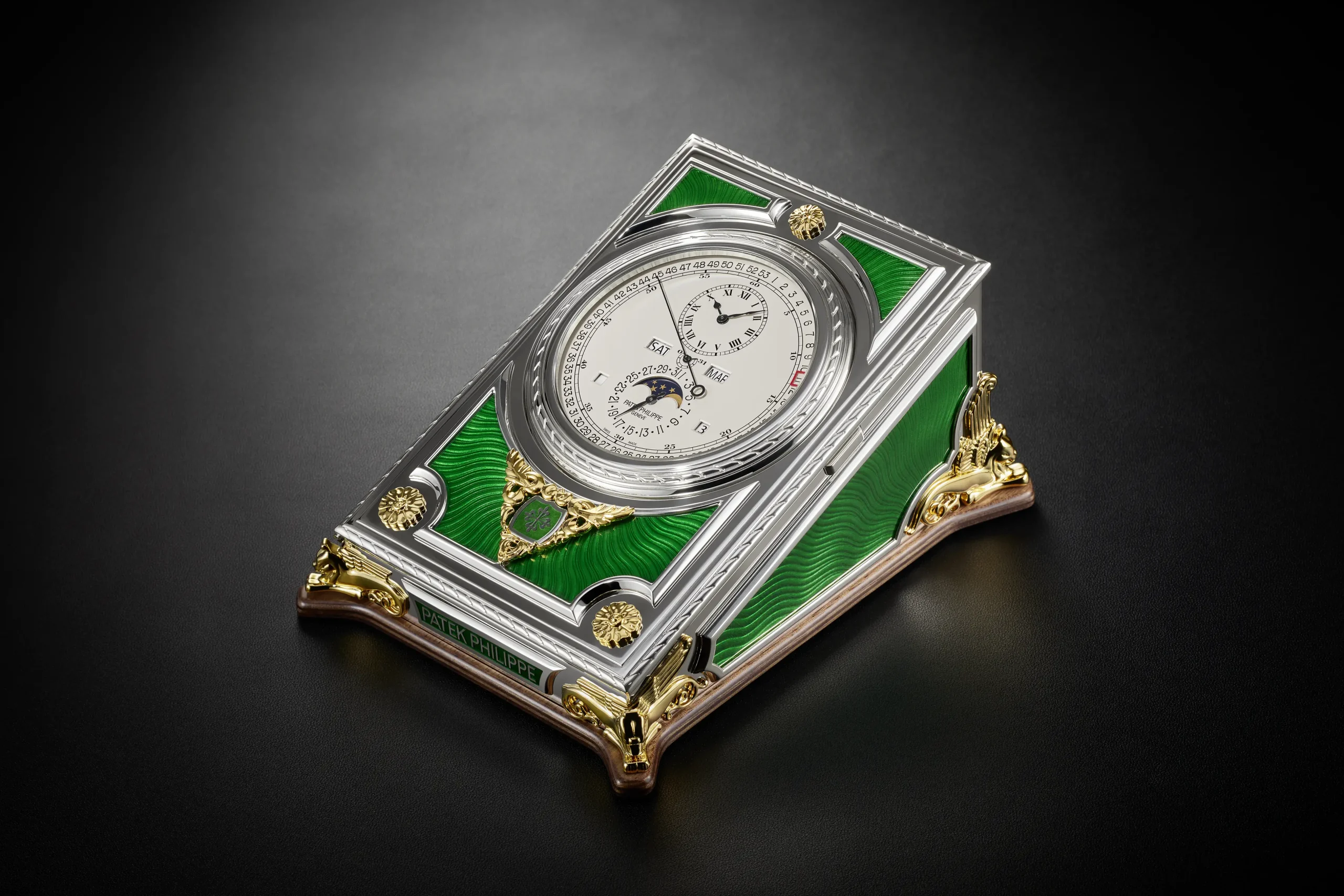
Patek Philippe will also present a surprise return to the tradition of the desk clock. Inspired by models created in the 1920s and 1930s, the new desk clock with perpetual calendar and weekly calendar Reference 27000M-001 features a completely new manually wound high-performance caliber, the subject of nine patent applications, with a 31-day power reserve, rate accuracy within a range of + 1 to – 1 seconds per 24 hours, and ease of operation worthy of a timepiece conceived in the twenty-first century. The cabinet in 925 silver is embellished with panels in green Grand Feu flinqué enamel over a swirling guilloché motif. Prior to the clock’s entry into the collection, Patek Philippe donated a unique preview model to the charitable auction Only Watch in 2021.
The perpetual calendar with retrograde date hand features among Patek Philippe’s most sought-after models. The manufacture has now reinterpreted this emblematic Grand Complication in a new version in white gold with an original modern style, its sapphire crystal dial with gray metallization offering a veiled glimpse of the watch’s mechanical heart. The bezel is adorned with the famous Clous de Paris or hobnail guilloché motif – one of the most beautiful symbols of the Patek Philippe style. Beating within this Perpetual Calendar Retrograde Date Reference 6159G-001 is the caliber 26-330 S QR self-winding movement, which may be admired through a sapphire-crystal case back.
Another flagship model, the split-seconds chronograph Reference 5370, brings out its first version in rose gold, harmonizing with a dial in brown Grand Feu enamel and subsidiary dials and a tachymeter scale in beige champlevé enamel. The caliber CHR 29-535 PS combines its traditional architecture (manually wound, column wheel, toothed-wheel horizontal clutch) with seven patented innovations, including one for the reworked split-seconds mechanism. This new Split-Seconds Chronograph Reference 5370R-001 is worn on an alligator-leather strap in shiny dark chestnut brown, endowed with a new patented three-prong fold-over clasp introduced this year on several models in the collection.
A splendid surprise also for feminine devotees of Grand Complications: the Twenty~4 collection is welcoming its very first complication, namely a perpetual calendar. Thanks to the caliber 240 Q ultra-thin self-winding movement the case is as elegantly slim as ever. The calendar indications are displayed by hands in three subsidiary dials accompanied by an aperture for the moon phase, together composing one of the most recognizable of the Patek Philippe perpetual-calendar faces. The first round Twenty~4 that is not gem-set, this perpetual calendar offers a choice of two versions in rose gold: Reference 7340/1R-001 with a silvered dial adorned with a double vertical and horizontal satin-brushed finish recalling the sheen of wild shantung silk, and Reference 7340/1R-010, its olive-green sunburst dial both modern and refined.
-

Patek Philippe Grand Complications Reference 5308G-001. (Credit: Patek Philippe)
-

Patek Philippe Grand Complications Reference 27000M-001. (Credit: Patek Philippe)
-
Patek Philippe Grand Complications Reference 6159G-001. (Credit: Patek Philippe)
-
Patek Philippe Grand Complications Reference 5370R-001. (Credit: Patek Philippe)
-
Patek Philippe Twenty~4 Reference 7340/1R-010. (Credit: Patek Philippe)
-
Patek Philippe Twenty~4 Reference 7340/1R-001. (Credit: Patek Philippe)



A wide array of complications useful in daily life
The manufacture is also extending its range of complications useful in daily life, a field in which it is already well positioned, whether in terms of calendar watches or travel watches, with mechanisms offering optimal ease of use and legibility.
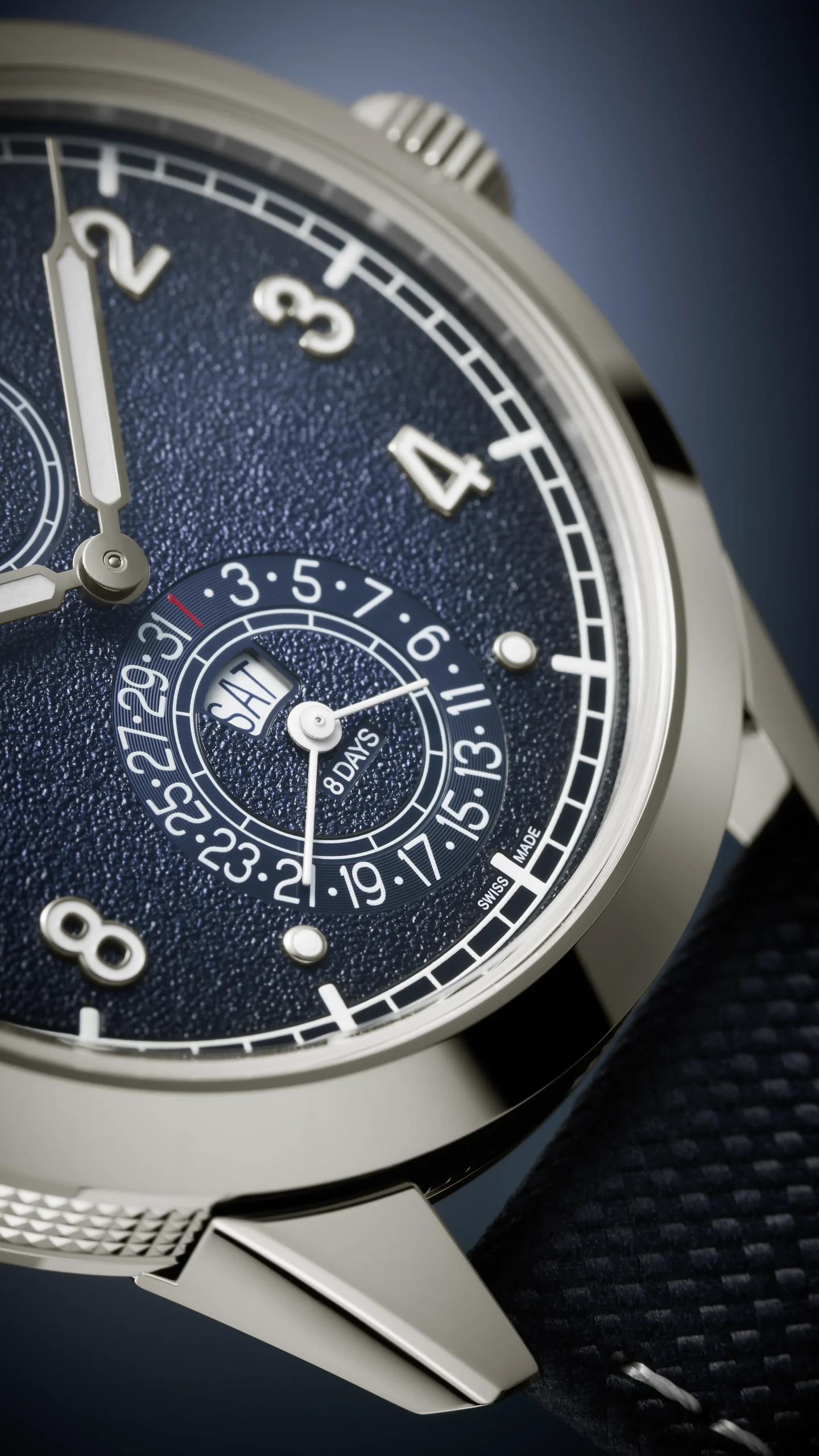
In 2025 the spotlight is on the Calatrava 8 Day Reference 5328G-001, equipped with instantaneous displays of the day (by an aperture) and the date (by a hand) at 6 o’clock and a large power reserve of eight days, indicated at 12 o’clock. The new caliber 31-505 8J PS IRM CI J manually wound movement unites a classic architecture with several technical innovations, including a Pulsomax® escapement in Silinvar®. The two barrels connected in series guarantee that the watch will function with perfect precision for eight full days, with a ninth day “in reserve”. Characterized by its contemporary aesthetic, this timepiece comes in a white-gold case, its caseband adorned with the Clous de Paris or hobnail guilloché motif, framing a blue dial presenting its displays in a modern, original style on a vertical axis.
The renowned Annual Calendar, invented and patented by Patek Philippe in 1996, offers a new model in rose gold that is the first non gemset version for this reference, with a 38 mm diameter that suits every wrist. The warm sheen of rose gold combines elegantly with a dial in chestnut-brown adorned with a double vertical and horizontal satin-brushed “shantung” finish and a calfskin leather strap embossed with a “denim” motif. Beating at the heart of this Annual Calendar Reference 4946R-001 is the caliber 26-330 S QA LU self-winding movement, displaying the day, date and month, and requiring only one manual correction per year, at the end of the month of February.
In the new Calatrava Pilot Travel Time Reference 5524G-010 in white gold, Patek Philippe reinterprets another of its great successes –of aeronautic inspiration –by endowing it with the vintage charm of a dial in ivory lacquer, worn on a strap in a composite material, in khaki green embossed with a textile motif. This original and elegant travel watch is powered by the caliber 26-330 S C FUS self-winding movement, notable for the ease of use of its system for displaying a second time zone. The date display by a hand at the 6 o’clock position adjusts automatically to the local time, backwards or forwards as required. The two time-zone pushers feature a patented screw-down safety system preventing any risk of accidentally putting the local-time function out of order.
-
Patek Philippe Complications Reference 5328G-001. (Credit: Patek Philippe)
-
Patek Philippe Complications Reference 5524G-010. (Credit: Patek Philippe)
-
Patek Philippe Complications Reference 4946R-001. (Credit: Patek Philippe)


New takes on style and elegance
The choice of so-called “simple watches”) also continues to grow, with designs full of character perfectly set off by their impeccable finish, down to the smallest detail.
Quintessence of timeless elegance, the Calatrava collection offers a new model in platinum enriched with the vintage touch of a dial in rose-gilt opaline with a pure, understated design. This Calatrava Reference 6196P-001, its polished case adorned with satin-brushed flanks, is notable for its smooth beveled bezel and slender tapering lugs forming a harmonious link to the strap in shiny-chocolate alligator leather. The caliber 30-255 PS manually wound movement measures out the time. Its extremely slender profile combines with a 65-hour power reserve and a “stop-second” function enabling the time to be set to the nearest second.
The Cubitus, an innovative expression of the “elegant sporty” style, was launched in October 2024. It offers a new medium size of 40 mm in diameter adapting to every wrist and available in two versions: Cubitus Reference 7128/1G-001 in white gold with a blue-gray sunburst dial; and Cubitus Reference 7128/1R-001 in rose gold with a brown sunburst dial. The bold, unique geometry of the case, a square with rounded corners and an elegant profile, is emphasized by a play of “vertical satin-brushed” and “polished” finishes. The caliber 26-330 S C self-winding movement, equipped with a stop-seconds function, has a central rotor in 21K gold adorned with the same horizontal relief pattern as the dial –a signature feature of the Cubitus models. The gold bracelet is fitted with a lockable adjustment system and a patented Patek Philippe fold-over clasp secured by four independent catches.
Patek Philippe plays on color in two new versions of the Ladies’ Nautilus with a quartz movement and a case in white gold measuring 32 mm in diameter. The dial, adorned with the pattern of little waves typical of this collection, is lacquered in an elegant shade of azure blue. The case catches the eye with its alternating satin-brushed and polished finishes. A row of 46 brilliant-cut diamonds (0.8 ct) illuminates the bezel. The Ladies’ Nautilus Reference 7010G-013 is distinguished by its strap in a composite material matching the dial, with a textile motif and a Nautilus fold-over clasp in white gold. The Ladies’ Nautilus Reference 7010/1G-013 is worn on a bracelet in white gold fitted with a lockable adjustment system and a Patek Philippe patented fold-over clasp secured by four independent catches.
This new Patek Philippe vintage is crowned by a splendid testimony to the jeweler’s skill and creativity in this area. The designers of the new Nautilus Haute Joaillerie Reference 5811/1460G-001 played artistically on the shapes of the precious stones to emphasize the iconic design of the Nautilus. A row of baguette-cut diamonds brings out the rounded octagon of the bezel, while rows of brilliant-cut diamonds adorn the dial. Baguette-cut diamonds enrich the central links of the bracelet, while the main links present perfectly regular rows of brilliant-cut diamonds. In total, this piece is set with 1,285 brilliant-cut diamonds (6.43 ct) and 195 baguette-cut diamonds (13.27 ct). This Haute Joaillerie version of an iconic timepiece is powered by the caliber 26-330 S self-winding movement with “stop seconds”.
-
Patek Philippe Calatrava Reference 6196P-001. (Credit: Patek Philippe)
-

Patek Philippe Cubitus Reference 7128/1G-001. (Credit: Patek Philippe)
-
Patek Philippe Cubitus Reference 7128/1R-001. (Credit: Patek Philippe)
-

Patek Philippe Ladies’ Nautilus Reference 7010G-013. (Credit: Patek Philippe)
-
Patek Philippe Ladies’ Nautilus Reference 7010/1G-013. (Credit: Patek Philippe)
-
Patek Philippe Nautilus Haute Joaillerie Reference 5811/1460G-001. (Credit: Patek Philippe)


Reference 27000M-001: Patek Philippe reinvents the desk clock with a completely new high-performance movement

Credit: Patek Philippe
The manufacture unites tradition and innovation in a desk clock offering both a perpetual calendar and a weekly calendar, equipped with a brand new manually wound caliber with a 31-day power reserve, rate accuracy within a range of +/– 1 second per 24 hours and ease of use worthy of a 21st century timepiece. This jewel of technical and engineering prowess, in silver, also stands out by the timeless refinement of its exterior, enriched with green Grand Feu flinqué enameling.
The early decades of the twentieth century were a period of intense creativity for Patek Philippe. As devotees with a passion for technical excellence and innovation, the great American collectors spurred the manufacture’s zest for invention by seeking out and acquiring the most sophisticated timepieces. This outstanding expertise was especially manifest in the pocket watches, exemplified by the famous “Graves” (1933), which remained, until 1989 and the creation of the Calibre 89, the world’s most complicated portable timepiece, with 24 complications. Patek Philippe also produced wristwatches with highly refined movements and exterior features for this demanding clientele. But another sector of horology also benefited from this pioneering spirit: that of the desk clock. In 1923, the manufacture delivered to James Ward Packard, a famous carmaker, a desk clock with perpetual calendar remarkable for its eight-day power reserve and its silver case with applied ornaments in yellow gold and winged lions in gilt bronze. In 1927, New York banker Henry Graves Junior (for whom the “Graves” was destined) took delivery of another desk clock of the same type, with modified displays and a personalized exterior. These two pieces now feature among the treasures in the Patek Philippe Museum in Geneva (“Packard” desk clock » No. P-140, “Graves” desk clock No. P-1270).

Credit: Patek Philippe
A new high-performance movement
Patek Philippe is renewing its links with this golden age of the desk clock with a fresh interpretation of the piece destined for James Ward Packard. True to its “tradition of innovation”, the manufacture charged its designers with developing a completely new manually wound caliber offering a power reserve of 31 days, a rate accuracy of +/– 1 second per 24 hours and an ease of operation worthy of a twenty-first century movement. Product of seven years’ development, the rectangular caliber 86-135 PEND S IRM Q SE, stamped with the Patek Philippe Seal, comprises 912 parts, of which almost half concern the perpetual calendar. Its development led to the filing of nine patent applications for innovations and optimizations, notably aimed at strengthening long-term reliability, reducing the energy consumption of the perpetual calendar, enhancing ease of use, and securing the functions against any inadvertent mishandling.
A “precision regulator”
The 31-day power reserve is ensured by three going barrels connected in series. To guarantee a variation in rate of no more than +/– 1 second per 24 hours, the engineers devised a true “precision regulator”, incorporated at the heart of the movement, with a patented constant-force mechanism making it possible to maintain the stable amplitude of the balance from the first day of the power reserve to the last, for a full month. At the center of the dial, a discreet power-reserve indicator shows whether the mechanism needs rewinding.

Credit: Patek Philippe
Jumping seconds and weekly calendar
In terms of the functions, Patek Philippe has introduced two new features compared with the “Packard” clock. The first consists of a “jumping seconds” hand (or “independent seconds” hand) making one jump per second in the manner of the old regulators. The second is a weekly calendar –a useful function whereby the read-out is made easier by the rotating aperture displaying the number of the current week on a scale at the periphery of the dial. For the other indications, the manufacture has retained the hour and minutes display in a small eccentric subsidiary dial at 12 o’clock, the moon-phase aperture at 6 o’clock and the day and month displays in apertures at 9 o’clock and 3 o’clock. The date display by a hand –a hand from the center on the “Packard” –was moved to the subsidiary dial at 6 o’clock and two small apertures at 7.30 et 4.30 displaying, respectively, the day/night indication and the leap-year cycle – two pieces of information essential when adjusting the calendar. Transfer printed in black, these various indications stand out with superb legibility on the silvery opaline dial.
A mechanical dashboard
While retaining the overall shape of the “Packard” clock (albeit on a larger scale) the designers of the new Reference 27000M-001 innovated by endowing it with a genuine mechanical dashbord in American walnut wood veneer, housed beneath a hinged bonnet opening from the right. This modern system of a control console means that adjustments become intuitive, simple and practical –in compliance with Patek Philippe’s user-centric philosophy.

Credit: Patek Philippe
Under the bonnet, in the upper left-hand corner, a casing fitted with a patented ejection system houses the winding and setting key –an artistically worked piece comprising several parts. In the upper right-hand corner are the two openings enabling the key to access the winding and setting squares. Another opening, located at six o’clock beneath the bezel, provides access to the square that stops the seconds, enabling the time to be set to the nearest second. Once these operations have been completed, the clock can function without being rewound for a full month, thanks to its 31-day power reserve.
Corrector pushers
Below the dial, the designers incorporated five push-piece correctors. These pushers adorned with a letter or a symbol enable the user to adjust the perpetual calendar indications by simple pressure with a finger: from left to right, the week (Week), the day (Day), the moon phase (crescent moon) the month (Month) and the date (Calendar). The corrector pushers required that the movement integrate a complex system of intermediate wheels to ensure their exact alignment along the same arc.

Credit: Patek Philippe
An exclusive aesthetic
For the exterior features of the new desk clock Reference 27000M-001, Patek Philippe drew inspiration from the lavish ornaments on the historic model of 1923, interpreting these in a refined, timeless style. Panels of green Grand Feu flinqué enamel over a swirling guilloché pattern adorn a cabinet crafted in 925 silver. Similarly to the watch dials, these panels were counter-enameled to ensure that they remained perfectly level. This technique represents a formidable challenge, since the elements are large and risk becoming deformed during firing. Very few enamellers master the complex technique of enameling on silver, a metal whose melting point, lower than that of gold (890°C versus 980°C), is close to the temperatures customary when firing enamel (from 800°C to 900°C).
The border of the upper panel and the bezel present an engraved cord motif. The observer may also recognize, in the form of appliques in vermeil (silver gilt) decorative elements borrowed from the historic clock: the three rosettes located in the corners and at 12 o’clock, the acanthus scrollwork surrounding the Calatrava cross, and the four winged lions enthroned on the clock’s feet.
Prior to the clock’s entry in the current collection, Patek Philippe donated a unique preview version (Reference 27001M-001) with American walnut veneers for sale at the charitable auction Only Watch 2021, where it went under the hammer for 9.5 million Swiss francs.
Reference 5308G-001: A new Quadruple Complication for connoisseurs
Having made its global debut as a limited edition in platinum on the occasion of the Patek Philippe Grand Exhibition “Watch Art” Tokyo in 2023 (5308P-010), Reference 5308 is entering the manufacture’s current collection. A true feat of miniaturization and energy management, this self- winding Quadruple Complication unites a minute repeater, a split-seconds chronograph endowed with two new patented mechanisms and an instantaneous perpetual calendar with aperture displays. The new caliber R CHR 27 PS QI movement with optimized performances greets the world in an elegant white-gold case with pierced lugs, harmonizing with an-ice-blue sunburst dial.
In 2008, Patek Philippe reaffirmed its supreme mastery of the Grand Complications by launching as a feature of its regular collection Reference 5207, an innovative timepiece uniting a minute repeater, a tourbillon and an instantaneous perpetual calendar with aperture displays whose original concept was confirmed by two patents (caliber R TO 27 PS QI). With its modern design, enhanced by a sporty touch, this wristwatch was the first of a new breed of Grand Complication in regular production, intended for daily wear.
In 2011, the manufacture continued this saga of exceptional pieces by presenting Reference 5208, a self-winding watch combining a minute repeater, a mono-pusher chronograph and an instantaneous perpetual calendar with aperture displays. The first Patek Philippe Triple Complication wristwatch to include a chronograph, Reference 5208 also stood out as one of the rare ultra-complicated watches to be self-winding. To enable the caliber R CH 27 PS QI movement to fulfill all its functions precisely and reliably, the manufacture’s engineers had to innovate, notably by placing the chronograph mechanism between the base movement (with minute repeater) and the perpetual calendar module –which proved an extremely complex task. In 2017, a unique version of this Triple Complication in titanium (5208T-010), donated to the charitable auction Only Watch, went under the hammer for 6.2 million Swiss francs.

Credit: Patek Philippe
From the Triple to the Quadruple Complication
Yet again, Patek Philippe has chosen to push back the frontiers of the great watchmaking art, by endowing this timepiece with a new additional function, and no minor one at that: a split-seconds, or rattrapante, (rattraper: to catch up) mechanism: an exceptional device that ranks–alongside the minute repeater and the tourbillon – as one of the top three most difficult horological complications to produce. It takes a highly sophisticated mecanism to control a second sweep chronograph hand that can be stopped in order to measure an intermediate time (or keep a reference time) and then released so that it overtakes the other sweep seconds hand in a fraction of a second and the two superimposed hands continue to circle the dial as one. Destined for devotees of haute horlogerie, the new self-winding Reference 5308 thus unites four complications of which three (minute repeater, instantaneous perpetual calendar and the split-seconds function) are already considered Grand Complications in their own right.
A true feat of miniaturization and mastery of the forces to which the tiny parts are subjected, it stands out by the extreme complexity and density of its construction –notably the four concentric sweep hands with their particularly long staffs–while respecting all the directives of the Patek Philippe Seal, including the criteria for rate accuracy, strengthened in 2024: variations in rate must now lie within a range of -1 to +2 seconds per 24 hours.

Credit: Patek Philippe
A new caliber with optimized performances
The addition (between the base movement and the chronograph module) of a split-seconds mechanism, a voracious consumer of energy, represented a formidable challenge for the manufacture’s engineers. In particular, the specifications required that the volume of the new movement remain as compact as possible, with minimum extra thickness. Mission accomplished: despite the 80 parts needed to add the split-seconds function (799, compared with 719 on the caliber R CH 27 PS QI), the new caliber R CHR 27 PS QI saw an increase in thickness of only 1.93 mm (12.28 mm versus 10.35). For optimal integration of the split-seconds function (which consumes as much energy as the chronograph mechanism when the latter is running), the designers decided to boost the movement’s performance by taking action at several levels. The barrel spring torque was increased by means of a strip spring in a thicker, tougher material and a smaller barrel arbor –making it possible to keep an identical spring length, number of turns and power reserve (minimum 38 hours – maximum 48 hours with the chronograph stopped). This
increase in the barrel torque to manage the split-seconds mechanism made it necessary, by chain reaction, to increase the inertia of the balance so as to ensure better rate stability by avoiding “knocking” phenomena (shocks in the escapement, when the amplitude of the balance is too high). As regards the off-center mini-rotor in 22K gold, this was replaced by a mini-rotor in platinum –a metal whose greater mass made it possible to increase the winding power and thus rewind without encumbering the new barrel.

Credit: Patek Philippe
A new patented system, eliminating friction of the chronograph wheel
To reduce energy consumption, the designers also turned their attention to the split-seconds
chronograph by developing two innovations for which they have filed patent applications. The first
concerns the coupling system. In a horizontal-clutch chronograph, the connection between the seconds wheel and the chronograph wheel (which carries the sweep seconds hand) is made via the clutch wheel actuated by the clutch lever. To avoid any vibration of the sweep hand, the usual chronograph wheels are equipped with a friction spring that exerts a slight braking effect –which consumes energy. Patek Philippe has eliminated that friction by replacing the usual conventionally toothed clutch wheel with an innovative system of backlash-compensation wheel. Manufactured by the LIGA process (lithography, electroplating and molding) this nickel phosphorus component presents an avant-garde design with long slotted teeth, each incorporating a tiny strip spring 18 microns thick that grips the teeth of the chronograph wheel, thus removing any risk of the sweep second hand’s vibrating – with no need for adjustment. A meeting of tradition and innovation that perfectly reflects the Patek Philippe spirit. This principle recalls that of the patented anti-backlash wheel driving the seconds pinion, launched in 2019 in the new self-winding base caliber 26-330 (introduced in the Calatrava Weekly Calendar Reference 5212A-001). Furthermore, the profile of the teeth and the strip springs was entirely revised for optimal adaptation to a horizontal-clutch chronograph mechanism, with a view to enhanced performance and reliability.

Credit: Patek Philippe
A new patented mechanism for isolating the split-seconds hand
The second patented innovation concerns the split-seconds mechanism, located beneath the chronograph module. In conventional split-seconds mechanisms, when the split-seconds hand is stopped (the jaws of the clamps close) for the read-out of an intermediate time, the split-seconds lever continues to rotate around the chronograph heart-piece –creating friction that consumes energy. In the new system developed by Patek Philippe, an isolator mechanism enables this lever to be raised, separating it from the chronograph mobile. This prevents the stopping of the split-seconds mobile from influencing the amplitude of the balance –and thus the reliability of the movement, as well as its power reserve when the chronograph is engaged. Patek Philippe has already designed systems for isolating the split-seconds lever, for the manually wound caliber CHR 29-535 PS Q in 2012 (split-seconds chronograph and perpetual calendar Reference 5204) and caliber CHR 29-535 PS in 2015 (split-seconds chronograph Reference 5370). On the new Reference 5308G-001, the entire construction was revised to reduce the thickness of the isolator mechanism as much as possible, by means of a concentric dual-lever operating mode.
A mono-pusher split-seconds chronograph
The monopusher chronograph with column wheel and horizontal clutch, distinguished by its particularly slender construction, displays 60-minute and 12-hour counters at 3 o’clock and 9 o’clock respectively. Its single pusher at 2 o’clock enables the user to actuate the start, stop and re-set functions successively (a 3-step chronograph). The split-seconds hand, equipped with its own column wheel, is operated by the pusher at 4 o’clock. A single pressure stops the split-seconds hand; a second pressure re-starts it, whereupon it catches up with the running sweep hand. This process of stopping and re-starting the split-seconds hand may be repeated at will while the chronograph sweep-seconds hand is in action. At the end of the timing event, the user actuates the pusher at 2 o’clock to stop the two hands conjointly and reset them to zero.

Credit: Patek Philippe
A minute repeater chiming on two gongs
The minute repeater chiming on two classic gongs offers the legendary sound quality of the Patek Philippe chiming watches –Grand Complications that are the fruit of an expertise reserved for the elite of master watchmakers. This highly sophisticated system of tiny racks, snails, hammers and gongs, actuated by the slide-piece set into caseband at 9 o’clock, strikes, on demand, the hours on the low-pitch gong, the quarters by alternating strokes (high and low pitch) and the minutes elapsed since the last quarter on the high-pitch gong. It takes great experience, dexterity and a perfectly trained musical ear to obtain that “Patek Philippe sound” sought after by connoisseurs. Thierry Stern, president of the manufacture, personally listens to the chime of each minute repeater watch emerging from the workshops, before deciding whether it can be delivered to its lucky owner.
The sophistication of an instantaneous perpetual calendar with aperture displays
The instantaneous perpetual calendar with aperture displays, a feat reserved for a very select number of timepieces, benefits from the same exclusive mechanism, distinguished by two patents, introduced in 2008 in Reference 5207, and found again in 2011 in Reference 5208. This system, which alone accounts for 220 of the 799 parts comprising the movement, enables the jumps of the indications in 30 milliseconds in the four day/date/month/leap year apertures, even with a residual power reserve of ten hours. The task was made still more complex by the use of disk displays, since the mechanism must set in motion much greater masses than would a display by hands. The instantaneous display demands perfect energy control, to retain the disks and then release them in one go. A large lever comprising 15 parts, some of them mobile (first patent) ensures a precise jump of all the displays at the same instant. A design with two complementary jumper springs acting in opposite directions (second patent) ensures that the energy deployed for each change remains constant, despite large differences in the displacement angles –from the jump of one day at the end of months with 31 days to the jump of four days at the end of the month of February in non-leap years. This avoids any incomplete jumps caused by lack of power or by indications’ jumping too far owing to surplus energy.

Credit: Patek Philippe
A Ice-blue sunburst dial combining elegance and legibility
The new Quadruple Complication Reference 5308G-001 features an elegant Ice-blue sunburst dial presenting faceted applied hour markers and faceted dauphine-style hands, all in white gold with blue metallization. The accent is on legibility, ensuring that the thirteen indications controlled by the caliber R CHR 27 PS QI movement stand out clearly. The perpetual calendar’s day, date and month displays appear in three apertures arranged along an arc between 10 o’clock and 2 o’clock, in an inlaid frame of white gold with blue metallization –with a slightly larger aperture for the date, the most important piece of information. Completing these calendar displays are two round apertures for the day/night indication at 8 o’clock and the leap-year cycle at 4 o’clock, both indispensable when setting the calendar.
A white-gold case with skeletonized or open worked lugs
To house this exceptional mechanism, Patek Philippe chose white gold. Endowed with the same design and diameter (42 mm) as Reference 5208, this classic, understated case, hand polished throughout, is distinguished by its concave bezel and skeletonized lugs. The watch is delivered with two interchangeable case backs, one in sapphire crystal, the other in white gold. Its refined allure continues through to an alligator-leather strap in shiny navy blue equipped with a new, patented triple-blade fold-over clasp in white gold, ensuring comfort and security.
Calatrava 8 Days Reference 5328G-001: A new movement with instantaneous day/date displays and an 8-day power reserve
Patek Philippe is enriching its range of complications useful in everyday life with a new Calatrava model endowed with instantaneous displays of the day (in an aperture) and the date (by hand) at 6 o’clock and a large power reserve of eight days indicated at 12 o’clock. Equipped with the new manually wound caliber 31-505 8J PS IRM CI J, this timepiece with its decidedly modern aesthetic combines a case in white gold, its caseband adorned with the “Clous de Paris” or hobnail guilloché motif, with a blue dial on which the displays are arranged in an original, highly legible manner on a vertical axis.
Even though they do not appear in the classic catalogue of horological complications, the large power reserves are genuine technical feats, especially in the confined space of a wristwatch. The difficulty is not just that, once wound, the watch must be able to function longer than the usual timepiece, but also –and especially –that it must retain its rate accuracy and stability for the duration of this increased autonomy.
The Patek Philippe engineers have risen brilliantly to this challenge on a number of occasions. In 2000, the manufacture marked the dawn of the third millennium with the 10 Day Power Reserve Reference 5100, a limited edition of 3000 watches, endowed with a rectangular case inspired by the famous “Manta Ray” Reference 2554 of 1954. The world’s first chronometer wristwatch with a power reserve of 240
hours, this manually wound timepiece heralded a trend that others have followed. In 2003, the regular collection welcomed “ 10 Day Tourbillon” Reference 5101P, a platinum watch with a manually wound “form” movement and a rectangular case with tiered flanks inspired by the Art Deco period. A new interpretation of this retro-modern design came out six years later, in rose gold. The year 2013 saw the unveiling of the Gondolo “8 Days, Day & Date Indication” Reference 5200, with a rectangular caliber 28-20 REC 8J PS IRM C J manually wound movement with instantaneously jumping day and date –an additional challenge in terms of energy.

Credit: Patek Philippe
Earlier, in the 1920s to 1930s, Patek Philippe had created three notable perpetual calendar desk clocks endowed with an eight-day power reserve; a tradition reenergized this spring by the new desk clock with perpetual calendar and weekly calendar, Reference 27000M-001, offering a 31-day power reserve.
A new alliance of tradition and innovation
Patek Philippe is increasing the momentum with a new Calatrava equipped with a new manually wound movement. The product of five years’ development, caliber 31-505 8J PS IRM CI J takes up the base architecture of the rectangular caliber 28-20 REC 8J PS IRM C J launched in 2013 in the Gondolo 8 Days, Day & Date Indication Reference 5200, but with a round shape designed to fit perfectly into a Calatrava-style case. True to the Patek Philippe pioneering spirit, this movement also presents several technical optimizations and innovations, particularly related to energy management and the instantaneous jumps of the day and the date. It was also designed to ensure autonomy of eight full days, with a ninth reserve day flagged in red on the arched indicator at 12 o’clock. The watch continues to function during this ninth day, but risks becoming less accurate, since the amplitude will decrease. To ensure optimal performance it is therefore advisable to rewind at the end of the eighth day at the latest (the movement will stop completely at the end of the ninth day).

Credit: Patek Philippe
An exclusive Pulsomax® escapement.
The challenges posed by the new caliber 31-505 8J PS IRM CI J called particularly for a state-of-the-art regulating organ. This movement is distinguished by its exclusive Pulsomax® escapement with an escape wheel and lever made of Silinvar®, a silicon derivative with unrivaled physical and mechanical qualities (lightness, hardness, resistance to magnetism, etc.). Developed as part of the “Patek Philippe Advanced Research” program, the Pulsomax® escapement is distinguished by its superior performance, achieved in particular thanks to the unique geometry of the escape wheel and lever and the machining precision provided by the DRIE process (Deep Reactive Ion Etching). Its optimized performances and long-term reliability, combined with those of the Spiromax® balance spring in Silinvar®(another “Patek Philippe Advanced Research” development) are valuable assets in guaranteeing a large power reserve of eight days. Following the Annual Calendar Regulator Reference 5235 in 2011 (caliber 31-260 REG QA), the 1/10th of a second monopusher chronograph Reference 5470P-001 in 2022 (caliber CH 29-535 PS 1/10) and the Reference 5200 Gondolo “8 Days, Day & Date Indication” in 2013 (caliber 28-20 REC 8J PS IRM C J), the new Calatrava Reference 5328G-001 is the fourth Patek Philippe model in the current collection to be endowed with a Pulsomax® escapement.
Two series-coupled barrels
This watch’s large power reserve is ensured by two barrels series coupled barrel allowing enough energy to be stored for the movement to function precisely for eight full days, with a 9th reserve day. The first barrel is fitted with a slip spring. When the user winds the movement, the two barrels charge simultaneously. As the main barrel discharges, the auxiliary barrel transmits its energy to it, recharging it, according to the principle of communicating vessels.
Credit: Patek Philippe
Instantaneous day and date jumps
For the instant-jump day and date mechanism, Patek Philippe returned to the principle introduced in the Cubitus Instantaneous Grand Date, Day and Moon Phases Reference 5822P-001, unveiled in October 2024 (self-winding caliber 240 PS CI J LU) –with a 24-hour wheel comprising a cam fitted with a dual-function spring. This system, already patented for Reference 5822P-001, and returning on this new Reference 5328G-001, makes it possible to overcome a higher torque, while guaranteeing precise jumps. Each night, at midnight, the large lever equipped with two beaks falls on the 24-hour cam, and in falling, engages direct with the day star and the date star. The two indications then jump simultaneously and instantaneously, thanks to the energy accumulated throughout the day. The day display is performed by a disk that was lightened and pierced to reduce its weight and its inertia at the moment of the jump – and thereby avoid any undesirable double jump. The date is indicated by a hand positioned on a counter concentric with the small seconds at 6 o’clock. Thanks to the beveled shape of the dual-function spring, the new caliber 31-505 8J PS IRM CI J makes it possible to set the time at any hour of the day or night, backwards or forwards, even during the passage of midnight, with no risk of damaging the movement. Furthermore, the caliber is equipped with a “stop-seconds” function (when the crown is pulled out)
enabling the time to be set to the nearest second. The date requires correction five times a year, on the first day of the months of March, May, June, October and December, using the corrector positioned on the caseband between 3 o’clock and 4 o’clock.
An elegant blue dial with a unique face
In addition to its special functions and increased autonomy, the new Calatrava 8 Days Reference 5328G-001 stands out by its originality as regards the displays. The power reserve indication, transfer printed along an arc (is visible on a subdial at 12 o’clock, while the day aperture, the date hand and the subsidiary seconds dial form a group at 6 o’clock. This arrangement along a vertical axis, particularly legible, also endows the watch with a unique personality. The textured dial in blue with a black gradient rim presents syringe-style applied numerals and hour and minute hands, all in white gold, emphasized by a white luminescent coating.

Credit: Patek Philippe
A case with a Clous de Paris guilloché caseband
The caseband of the round case in white gold is decorated with guilloché work in the Clous de Paris or hobnail pattern. This emblematic decoration first entered the Calatrava collection on the bezel of
Reference 96D in 1934 and returned to the spotlight in 1985 on the famous Reference 3919, one of the most beautiful symbols of the Patek Philippe style, which remained in production for more than 20 years. Today, the Clous de Paris motif lends its special aura to a variety of models in the current collection, whether adorning the bezel (Calatrava Reference 6119), the caseband (World Time Minute Repeater 5531, Grandmaster Chime Reference 6300, Annual Calendar Travel Time Reference 5326, Calatrava Reference 5226) or even the dial (Grandmaster Chime Reference (6300), not to mention the Rare Handcrafts models. A refined detail: similarly to References 5326 & 5226, the new Calatrava 8 Days Reference 5328G-001 features an unusual case construction with the lugs attached to the back, enabling the Clous de Paris decoration to wrap elegantly around the entire caseband. A sapphire-crystal case back affords a private view of the architecture of the new manually wound caliber with its Pulsomax® escapement, and of its painstakingly hand-finished parts.
Two interchangeable straps
The new Calatrava 8 Days Reference 5328G-001 is delivered with two straps, one in blue calfskin leather with a textile pattern and cream stitching (originally fitted), the other in grained taupe calfskin leather (additional strap). It is equipped with a new patented triple-blade fold-over clasp that improves safety and comfort and facilitates the interchangeability of the straps by allowing this change to be carried out quickly and easily, without tools.
Patent taken over from caliber 240 PS CI J LU (Reference 5822P-001, 2024)
• Cam winding wheel with dual-function spring (European patent application EP4312083)
Designed for the driving of the cam by the 24-hour wheel, this system of a winding wheel with a dual-function spring makes it possible to overcome a higher friction force (torque) while guaranteeing the perfect precision of the date jump at midnight. A disconnecting system equipped with a flexible finger-piece that retracts when the 24-hour cam hits the beak of the large lever also enables the user to adjust the time at any moment, backwards or forwards, even during the passage of midnight, without risk of damaging the movement.
Discover more Patek Phillipe collections with Cortina Watch online, visit us at our boutiques, or contact a sales representative today to learn more.
观点推荐
阅读所有观点-

- 品牌焦点
Why Watch Size Matters (But Not the Way You Think)
2026年9月9日
-

- 高登精选
Cortina Curates Local: 與玻璃藝術家陳建志共譜中秋琉光故事
2026年9月4日
-

- 新闻
Chronomaster Solo Sport: Distilling the Essence of High Frequency
2026年9月2日
-
- 新闻
The Navitimer That Became A Miles Davis Signature
2026年9月2日
-

- 新闻
Streamliner Tourbillon Skeleton Ceramic Alpine Limited Edition: A New Chapter, A New Material
2026年9月2日
-

- 新闻
TAG Heuer Monza Flyback Chronograph: Fifty Years on the Racing Line
2026年9月1日