

- Brand Spotlight
- New Release
Patek Philippe’s 2025 Grand Complications Keeps Things Simple
26 Jun 2025
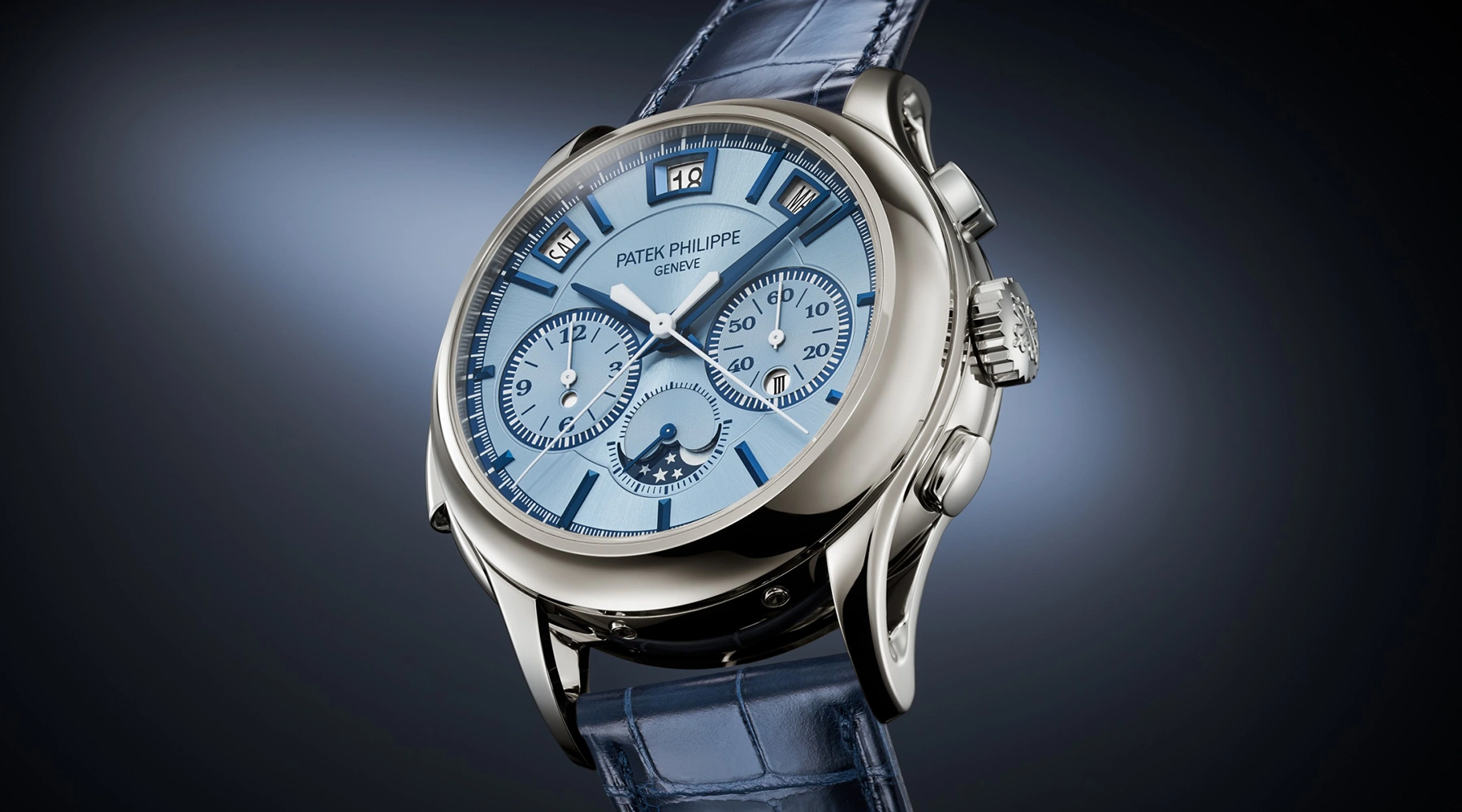
Two years ago at Patek Philippe’s Watch Art Grand Exhibition 2023 in Tokyo, it premiered a limited-edition dedicated to the event, which one-upped the Ref. 5208 Triple Complication with an extra function – a split-seconds chronograph. Since the release was limited only to the host country, collectors have been waiting for the reference to emerge in Patek Philippe’s catalog. Now it has appeared as the Ref. 5308G, a successor to the Ref. 5208, featuring a minute repeater, split-seconds chronograph, and instantaneous perpetual calendar.
The Patek Philippe Ref. 5308G-001 Quadruple Complication

The Patek Philippe Ref. 5308G-001 Quadruple Complication builds on the Ref. 5208, using its Caliber R CH 27 PS QI as a starting point for the new Caliber R CHR 27 PS QI. (Credit: Patek Philippe)
Adding a split-seconds chronograph function to the existing Patek Philippe Caliber R CH 27 PS QI used in the Ref. 5208 is a major challenge because of the added energy resources needed to drive the splitting of the elapsed seconds, and its further rejoining during an event timing. This typically doubles the chronograph’s resource use in a movement. Patek Philippe’s research team had to achieve this without a significant dip in the amplitude of the balance which would not only affect the chronograph, but overall timekeeping. A second challenge was ensuring that two horizontally coupled chronograph seconds wheels would mesh smoothly with the timekeeping gear train to prevent any “bounce” or backlash both during the split, and when running together. To start, the team worked on a new barrel arbor that could support a strong mainspring. With a thicker spring, this provides greater torque and provides more power to the system, guaranteeing an autonomy of up to 48 hours with a split-seconds chronograph. To improve winding efficiency, a platinum micro-rotor is used instead of gold.

The Patek Philippe Caliber R CHR 27 PS QI uses the instantaneous jump from the Caliber 240 PS CI J LU (for the Ref. 5822P Cubitus with Instantaneous Grand Date, Day, and Moon Phases) to switch all of its displays within 30 milliseconds. (Credit: Patek Philippe)
The instantaneous perpetual calendar jump uses a snail cam to store up energy throughout the day, in order to power all of its jump operations at midnight, within a 30-millisecond operation. It’s so rapid that it cannot be seen with the naked eye, but the module consists of interlinked levers, each with a safety mechanism to prevent double jumps or adjustment of the calendar when it is occurring. The astronomical calendar has a moonphase indication that is accurate to 122 years, and the displays for the calendar run across the top of the dial in an arc with blue metallised white gold frames.

The isolating clamp solution developed by Patek Philippe for the split-seconds chronograph function, can be seen just under the two discs for the weekday and month of the perpetual calendar. It’s ingeniously designed to eliminate energy use from the isolating mechanism of the split-seconds chronograph. (Credit: Patek Philippe)
The split-seconds chronograph uses a highly impressive and inventive solution to reduce the thickness of Patek Philippe’s isolator found in its CHR 29-535 PS and PS Q movements. The isolator lever (colloquially called the ‘octopus’) has been shrunk down thanks to a dual-lever system that engages the isolator clamp and raises the split-seconds lever from the heart cam of the chronograph. The bi-directional lever means that it can be activated at any position, and is powered solely by the triggering of the split-seconds pusher on the crown. This therefore relieves any additional energy required to add the complication, and only adds 1.93mm of thickness to the movement compared with the Caliber R CH 27 PS QI. Additionally, a newly designed clutch wheel that has long slotted teeth with a spring strip that ensures smooth meshing of the chronograph wheels with the gear train. That includes scenarios when the teeth of the chronograph seconds wheel initially engage between the spring and tooth of the backlash compensation wheel. Its flexibility, produced using LIGA manufacturing ensures it adjusts to the optimal meshing under any circumstances.

The monochromatic blue aesthetic of the Patek Philippe Ref. 5308G-001 and its use of the trendy ice blue colour on the dial differ from the rather classically handsome looks of the Ref. 5208G. (Credit: Patek Philippe)
The watchmaker has also modernised its colour palette for the Grand Complication, with a very contemporary blue-on-blue monochromatic schema with ice blue for the dial and counters, a darker blue for accents and indexes, and midnight blue for the moon phase display. The chronograph’s hands are in a stark white to distinguish them from the timekeeping; together with the polished case and skeletonised lugs, the fresh coat of paint on the new façade looks great.

The Patek Philippe Ref. 27000M-001 Complicated Desk Clock with Rare Handcrafts has a sterling silver case with green flinqué Grand Feu enamel. It features a perpetual calendar with week display and a 31-day power reserve accurate to +/-1 second a day. (Credit: Patek Philippe)
The Desk Clock with the heart of a wristwatch
Patek Philippe regularly presents table clocks that emphasise its mastery of Rare Handcrafts; these are typically quartz-regulated and solar-powered to ensure they run consistently without demanding repeated winding. This year, they have instead created a desk clock, inspired by the pieces they created for Henry Graves and James Packard in the 1920s. The Ref. 27000M-001 contains a mechanical, manually-wound movement that has a remarkable month-long power reserve. What’s more impressive is its accuracy, maintaining a +/- 1 second/day across the entire of its power reserve.

The Patek Philippe Caliber 86-135 PEND S IRM Q SE manually-winding movement is essentially a watch-sized precision regulator powered by three massive barrels connected in series. (Credit: Patek Philippe)
Instead of designing a movement that would only be used for the desk clock, Patek Philippe developed a watch-sized precision regulator caliber, that is driven by three going barrels that are connected in series outside of the regulator movement. The power drawn from these barrels is managed via a constant-force mechanism that releases energy to the regulator by the minute. This ensures that consistent power is delivered whether the barrel spring is fully wound, or nearly unwound.

The Patek Philippe Ref. 27000M-001 Complicated Desk Clock with Rare Handcrafts has a silvery opaline dial with black transfer print, central seconds and a power reserve indication in the centre of the dial. (Credit: Patek Philippe)
The dial is styled like a regulator with a separate display for the seconds, that is displayed in a deadbeat or jumping style, a first for the watchmaker. A small power reserve display lies at the centre of the dial, with weekday, and month windows adjacent to it. Below is a counter for the date and moon phase displays, and two small windows for day/night and leap year. There is also a 52/53 week display with a red indication on the periphery of the clock face, similar to the Ref. 5212A’s dial. What’s most interesting about the clock movement is its configuration for adjusting the perpetual calendar or setting and winding time. A clock key unlocks the winding and time-setting functions, with the stop seconds separately set from the time display via a keyhole at 6 o’clock. The dashboard below the clock face has a row of pushers below to set the Week, Day, Moonphase, Month and Calendar date.

The Patek Philippe Ref. 27000M-001 Complicated Desk Clock with Rare Handcrafts has hand-guilloched sterling silver panels with green flinqué enamelling. (Credit: Patek Philippe)
One of the challenges of this clock is the use of sterling silver for the case, combined with Grand Feu flinqué enamelling. Silver has a close melting point of 800°C, and temperatures above this are needed for a great firing in the kiln. To prevent deformation, counter-enamelling was done on the reverse of the panels. The translucent green enhances the guilloché work done on the clock’s cabinet, which is further detailed with winged lions, rosettes, and scrollwork around the Calatrava cross. Gold and green create a royal presence for the clock.

The Patek Philippe Ref. 5328G-001 Calatrava 8-Day in a white gold case with hobnail guilloche caseband and textured blue dial with black-gradient rim. Two calfskin strap options are offered with this watch. (Credit: Patek Philippe)
Emphasising Precision
How many ways can the instantaneous jumping calendar system developed for the Ref. 5822P-001 Cubitus with Instantaneous Grande Date, Day, and Moon Phases be adapted into? Patek Philippe’s new movements explore its broad potential from complex perpetual calendars to simple day-date displays in the Ref. 5328G-001 Calatrava 8-Day, which has a date counter with weekday window and a generous power reserve of up to 216 hours.

The Patek Philippe Refs. 5200G Gondolo 8 Days, Day and Date, 5328G-001 Calatrava 8-Day, and 5100G Gondolo 10 Day Power Reserve, from left to right. (Credit: Patek Philippe)
Twenty-five years ago, Patek Philippe developed its first wristwatch with exceptionally long power reserve, the Ref. 5100 Gondolo with 10-Day Power Reserve and with chronometer standard accuracy. This was especially challenging as the Gondolo calls for a fitted rectangular movement to match its case. The Ref. 5100 was succeeded by the Ref. 5200 in 2013 with instant jumping day and date, powered by the Caliber 28-20 REC 8J PS IRM C J with eight days of autonomy. With the Ref. 5328G-001, it shows just how much has changed within the watchmaker, and how consistent it is, across a quarter of a century.

The Patek Philippe Ref. 5328G-001 Calatrava 8-Day reveals the Silinvar-composed Pulsomax escapement of the Caliber 31-505 8J PS IRM CI J through its exhibition case back. (Credit: Patek Philippe)
The Caliber 28-20 REC 8J PS IRM C J shares a lot with the new Caliber 31-505 8J PS IRM CI J, including its Pulsomax escapement and Spiromax hairspring in Silinvar. The Pulsomax escapement is designed to be highly efficient, supporting the instant jump system that drives a large lever with a snail cam and spring system mounted on a 24-hour wheel. This stores up power throughout the day to deliver the rapid jumps at midnight flawlessly. The new caliber also offers 24 hours more power reserve, while ensuring that the precision of the Ref. 5328G-001 is kept at -1/+2 seconds a day, a significant improvement over the 28-20’s -3/+2 seconds range.

The Patek Philippe Ref. 5328G-001 Calatrava 8-Day retains the dial format of the Ref. 5200 in a modern Calatrava form. (Credit: Patek Philippe)
Like its earlier rectangular siblings, the Ref. 5328G shows all its information along the vertical axis, with the power reserve on top and date counter coupled with weekday window and running seconds below. The textured blue dial keeps to the Ref. 5326G-001 Calatrava Pilot Travel Time’s vintage camera-inspired finish, with a black-gradient rim, applied luminous Arabic hours and stylised syringe-hands. The caseband features a hobnail guilloché pattern and lugs that are attached on the back of the case. It also comes with two straps, in blue calfskin with a fabric texture and in grained taupe calfskin, fitted on a new patented clasp that makes it easier to swap out one for the other.
To find out more about Patek Philippe’s novelties for 2025, head to one of our boutiques and have a chat with our retail experts. Discover how purposeful innovation ensures Patek Philippe’s watches last for lifetimes.
Related Insights
View All Insights-

- Watch Knowledge
The Latest Aviation-Inspired Watches to Rule the Skies
09 Sep 2026
-

- Brand Spotlight
Why Watch Size Matters (But Not the Way You Think)
09 Sep 2026
-
- News
Streamliner Tourbillon Skeleton Ceramic Alpine Limited Edition: A New Chapter, A New Material
09 Sep 2026
-

- Watch Knowledge
Unveiling the Minute Repeater Watch
09 Sep 2026
-

- Brand Spotlight
Cartier’s Shift Towards Smaller Dials
08 Sep 2026
-

- Cortina Curates
Cortina Curates Local: The Art of Stillness by Taiwanese Glass Artist Chen Chien-Chih
08 Sep 2026