

- Brand Spotlight
Philippe Stern Laid the Groundwork for Patek Philippe’s Dynamic Revival
Written by: Darren Ho
19 Jun 2026
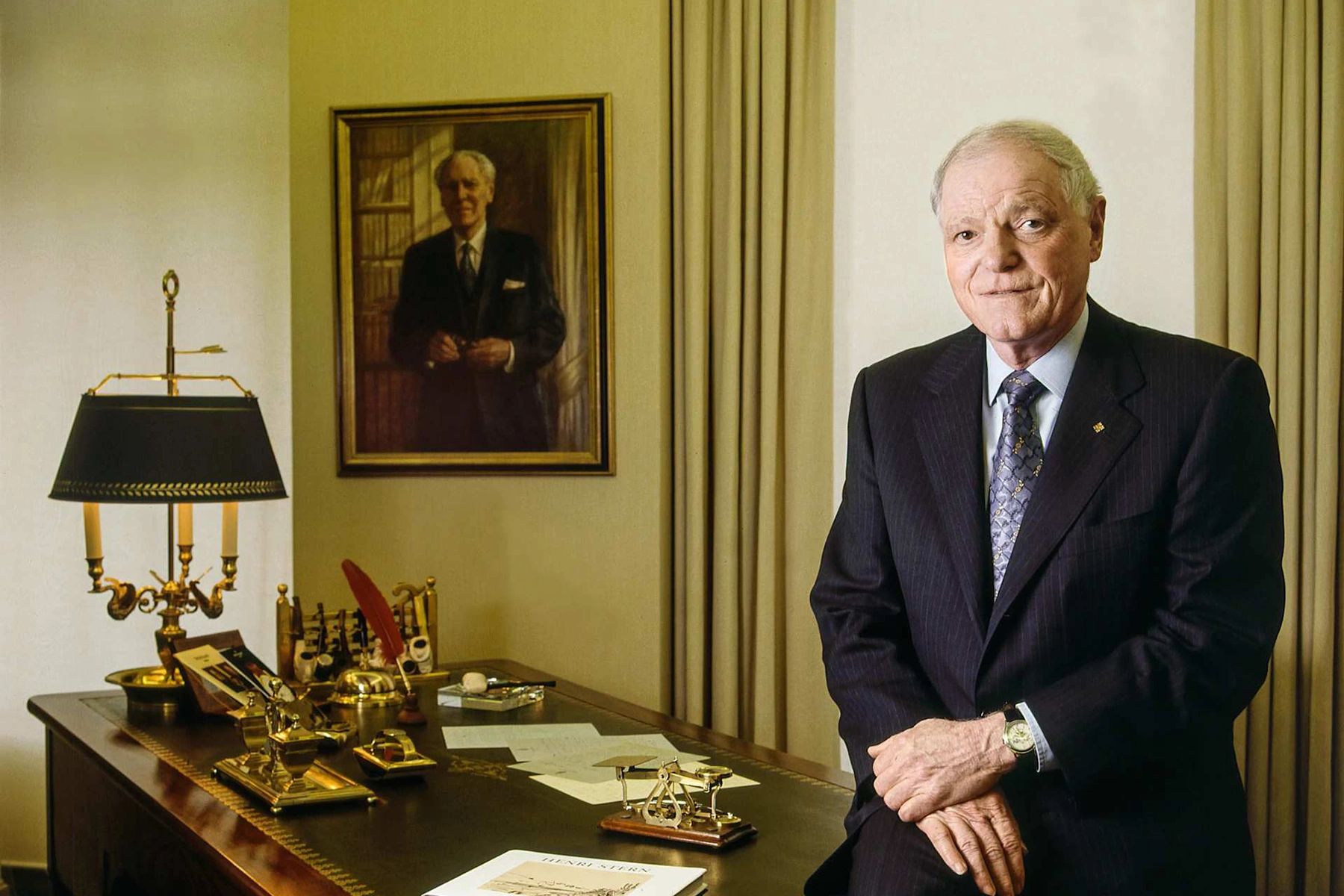
The watch industry is in mourning at the passing of Mr. Philippe Stern. Condolences and tributes have been flowing across media platforms. It is indeed a sorrowful moment for the Stern family and the late Mr. Stern’s closest peers. To the onlooker and watch enthusiast, his accomplishments during his leadership of Patek Philippe, introducing an era of modernism while strengthening its foundations and identity as a watchmaking pioneer, are staggering.
In East Asian culture, there is an old adage on family businesses – it is more a caution on the dangers of adhering only to tradition and resting on one’s laurels. Mr. Philippe Stern was certainly not such an individual. He stepped into the role of General Director just as the industry faced its most dramatic crisis, developing capabilities within Patek Philippe that has enabled it to thrive in the digital era today.
Values Worth Preserving

Mr. Philippe Stern in his younger days, pictured with his father, Mr. Henri Stern.
The Stern family has upheld one tradition across generations, that any family member who intends to join the business must work their way up and acquire some knowledge of each department. This is not merely an exercise in humility, but to appreciate that the core resource of the company are its people and their expertise. Philippe Stern started out working in the Henri Stern Watch Agency, the distribution subsidiary for Patek Philippe in the United States. He returned to Geneva in 1966 where he was placed across every department. From managing supply chains to handling customers in after-sales care, he acquired an overview of how each division interacted, and how executive decision-making impacted them.
-

A series of original Patek Philippe designs signed by Jean-Daniel Rubeli, part of a collection auctioned off in 2010 by Antiquorum
-
A “Chronometrio Gondolo” pocket watch by Patek Philippe, commissioned by Gondolo & Laboriau exclusively.


The Sixties were indeed roaring for Patek Philippe, the result of a highly hands-on approach by Henri Stern after he took over from Jean Pfister. With Jean-Daniel Rubeli as Chef de Creation, and frequently with the personal involvement of Henri Stern, Patek Philippe presented a mix of expressive and elegantly refined watches that were also technically sophisticated. He expanded Patek Philippe’s distribution in Latin America and Asia, personally developing relationships with partners such as Mr. Anthony Lim (Cortina Watch’s founder). This model of leadership continued with Philippe Stern, even though the circumstances for the industry turned bleaker during the ’70s.

A Patek Philippe Beta 21 quartz watch.
The Swiss watch crisis of the 1970s was severe, with hundreds of businesses shutting down and one-third of professionals leaving the industry. Many perceived quartz to be detrimental to fine watchmaking; Philippe Stern did not. He recognised it for what it was – an invention that could tell time in a different way – and focused on how he could incorporate it into the company’s body of knowledge. Furthermore, he sought to preserve equipment, crafts, and the craftspeople in fields aligned with watchmaking, many of which were being lost. Patek Philippe produced Beta 21 models, using the quartz movement developed by Swiss watchmakers, in Gondolo cases. Believing in the longevity of mechanical watchmaking, Patek Philippe presented a new Caliber 240 in 1977 that was ultra-thin and highly precise. At the same time, it focused on highly decorated timepieces such as the Ref. 3880, a skeletonised Golden Ellipse hand-engraved with a floral motif and fitted with the Caliber 177 SQ (named for its 1.77mm thinness).
Exploring New Possibilities

The Patek Philippe Nautilus, drawn by Gérald Genta.
As any wise businessperson will know, there are no simple solutions to industry-wide crises. Even as demand shrank for some types of watches, it grew in others. Luxury sports watches were gaining in popularity, and a chance encounter between Philippe Stern and Gérald Genta led to the release of the Nautilus. The collection was a first for Patek Philippe in many ways, and a break from the classic, plain-dialled watches in slim gold cases that occupied most of its catalogue. It acknowledged a generational shift in lifestyle, as dress codes relaxed and people embraced sportier interests. The Nautilus was a watch that followed one from the office to the yacht club.

The Patek Philippe Ref. 3450 in yellow gold, courtesy of Monaco Le Grand Auctions.
Simultaneously, he refreshed an important Patek Philippe complication – the perpetual calendar – with the Ref. 3450 with a leap year aperture. Early versions had a red dot for the leap year, and this was subsequently printed in Roman numerals. At the same time, the Caliber 350 which had an industry-first peripheral rotor and manual winding mechanism on the case back, was presented in a Calatrava case. This quality of maintaining, and breaking from tradition is one of the reasons why Patek Philippe’s watches today continue to inspire collectors.
Establishing New Ground

The Patek Philippe Refs. 3940 Perpetual Calendar (left) and 3970 Perpetual Calendar and Chronograph (right).
The success of the Ref. 3450 set the stage for Philippe Stern to deliver an updated design language to its Grand Complications watches. These came first in the Refs. 3940 and 3970. The former was an ultra-thin perpetual calendar with analog display, powered by the Caliber 240 Q and a direct challenge to the digital display watches of the ’80s. The second was a perpetual calendar and chronograph watch, using the Lemania-based CH 27-70 Q and in a smaller case size than its predecessor, the Ref. 2499. It was a demonstration of Patek Philippe’s ability to craft finely tuned mechanical watches in a compact form (36mm diameter case and 8.5mm thick) without compromising on legibility or quality. They were also among the first high complication models utilising modern production techniques like pad printing. Even during the difficult retail environment of the 1980s, Philippe Stern persisted in developing Grand Complication models, in part to sustain its suppliers and partners.

The Patek Philippe manufacture in Plan-les-Ouates.
At the time, the manufacture was located at Rue de Pêcheries. While generous in space, Patek Philippe could not bring all of its artisans under one roof. The industry’s crisis exposed the dangers of a fragmented supply chain. To secure its future, Patek Philippe needed to expand on its capabilities. More importantly, Philippe Stern wanted the Manufacture in one space and coordinating their work. This avoided information silos and the transfer of knowledge across generations through an apprenticeship style on-boarding of employees. The establishment of its training academy and support of new watchmakers can be easily linked to the success of the industry’s up-and-coming watchmakers – many of them have spent time at Patek Philippe.

The Patek Philippe Ref. 4910/1200A Twenty~4, a modern variation of the Ref. 4910/10A which was introduced by Philippe Stern in 1999.
Ultimately, one of Philippe Stern’s crowning achievements was his belief that mechanical watchmaking should not be an exclusive interest to a select few. He sought to reach audiences where they were and developed watches that spoke to them emotionally. He democratised Patek Philippe (in as much as a watchmaker like Patek Philippe can be democratised) to everyone. The Twenty~4’s development from a jewellery-inspired quartz timepiece to the Ref. 7340/1R, an automatic perpetual calendar model, is a result of Patek Philippe’s conscious nurturing of its diverse clientele over decades. He instilled a deep respect for the Genevan watchmaker across the globe, even among those who did not share an appreciation for Patek Philippe.
There is far more to say about Mr. Philippe Stern beyond the above. The leaders of the watch industry during the ’70s have mostly passed on, after bestowing it a stronger foundation to build on. The industry is in mourning, but for Mr. Stern himself, he must surely be content with the Patek Philippe he shaped.
Related Insights
View All Insights-

- Brand Spotlight
Blancpain Six Masterpieces
18 Sep 2026
-

- News
H. Moser & Cie. Streamliner Tourbillon Skeleton Ceramic Alpine Limited Edition: A New Chapter, A New Material
14 Sep 2026
-

- Brand Spotlight
Why Watch Size Matters (But Not the Way You Think)
11 Sep 2026
-

- Cortina Curates
Cortina Curates Local: The Art of Stillness by Taiwanese Glass Artist Chen Chien-Chih
04 Sep 2026
-

- Brand Spotlight
Cartier’s Shift Towards Smaller Dials
27 Aug 2026
-

- News
Bell & Ross – BR-X5 Meteorite
27 Aug 2026