

- Brand Spotlight
Blancpain Six Masterpieces
Written by: Darren Ho
18 Sep 2026
This Blancpain watch led the way to the revival of fine mechanical watchmaking
As we anticipate the upcoming Mid-Autumn Festival, it’s a poetic reminder of how the fine watchmaking industry found its way out of the quartz crisis – thanks to Blancpain.
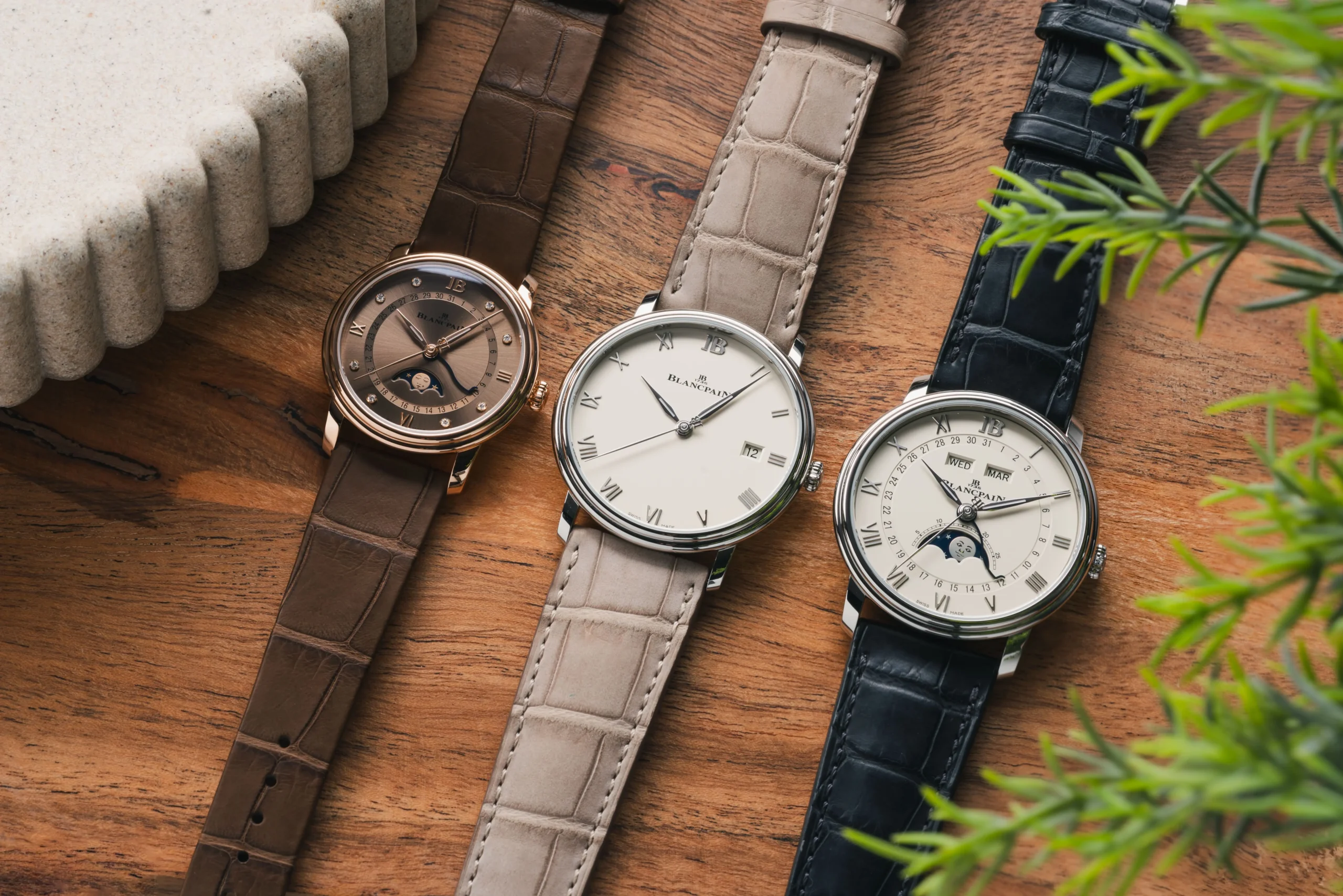
(Left to right) The Blancpain Villeret Quantième Phases de Lune in rose gold, and Villeret Ultraplate and Villeret Quantième Complet (a.k.a Quantième Complet Phases de Lune) in steel.
The vitality of the fine and high watchmaking industry today and its broad appeal among younger generations of collectors and watchmakers, is a complete turnaround from just four to five decades ago. Then, what’s commonly known as the quartz crisis decimated the industry and led many to believe fine watchmaking had been dealt a fatal blow. Watchmakers found their footing and one in particular demonstrated how mechanical watchmaking could outdo quartz-regulated timepieces. That company, the oldest existing watchmaker in the industry, proudly coined the slogan “Since 1735, there has never been a quartz Blancpain watch. And there never will be.”

The Rayville S.A. manufacture was Blancpain's corporate name in the 1950s. Blancpain joined the SSIH conglomerate and was structured into a manufacture for Omega after SSIH merged with ASUAG to form SMH. Rayville-Blancpain was sold to Jacques Piguet and Jean-Claude Biver to become Blancpain SA.
Historians of the industry will pinpoint the specifics of Blancpain’s evolution, but suffice it to say that it has long made bold moves in the industry, from appointing the first female executive to lead a Swiss watchmaking firm to inventing a whole new category of tool watches. But in the 1970s and 1980s, it changed hands numerously, until Jacques Piguet, the son of Fréderic Piguet, and Jean-Claude Biver, revived the name in 1983. Both were deeply committed to the craft of fine mechanical watchmaking and embarked on re-establishing the industry’s dominance. They began by questioning what mechanical watchmaking was capable of that quartz timepieces were not. The answer was the moonphase complication.

The Villeret Ultraplate and Quantième Complet Phases de Lune in 34mm were the first of Six Masterpieces that led Blancpain's (and the industry's) revival.
At the time, quartz movements were limited in capability and calculating complex formulas required massive computing systems. (The computers that powered the lunar landing in 1969 were the size of cabinets.) The lunar cycle requires a complex mathematical function for accuracy, an impossibility at the time. But mechanical watchmakers were more than capable of doing this. The symbolism of the Moon and its association with romance and beauty were not lost on the duo; it strengthened their argument that watchcraft was an artistry. The 34mm sized Complete Calendar Moon Phase, which displayed the day, date, and month together with the phases of the moon in a slim, compact gold and platinum case, was the industry’s answer to the advent of accessible quartz watches.

The Blancpain Villeret Ultraplate in a 40mm steel case with opaline dial. The watch pays homage to one of Blancpain's Six Masterpieces, the Villeret Ultraplate in 1984.
In fact, the Complete Calendar Moon Phase came in two sizes, a 26mm model as well as a 34mm, powered by the calibres 6395 and 6595. Calibre 6395 measured under 5mm in thickness and brought back an old tradition of the moon phase complication – the smiling moon. And that was just the beginning. The next was the Villeret Ultraplate in the following year. Ref. 0021 utilised the ultra-thin calibre 21 from Fréderic Piguet that was first introduced in the 1920s. At just 1.75mm thin, the watch measured just 5.6mm thin on the wrist, with a self-winding Ref. 0071 released soon after. The modern Villeret Ultraplate with calibre 1151 has a thicker profile at 8.70mm, with a 100-hour power reserve and full-sized oscillating rotor.

The Blancpain Villeret Quantième Perpétuel Phases de Lune in rose gold with a forest green dial is a modern interpretation of the perpetual calendar model released in 1986.
More high watchmaking accomplishments followed. Blancpain presented an ultra-thin perpetual calendar model with moon phase indication in 1986. The Ref. 5395 was based on the Fréderic Piguet calibre 95 with the 53 perpetual calendar module and was housed in a 34mm case that measured 9mm thick. A second reference, the Ref. 5495 added a leap year indication with the month counter at 12 o’clock. The Villeret Quantième Perpétuel Phases de Lune today is equipped with the calibre 5954.4, which offers a full-sized oscillating rotor with 3-day power reserve and measures just slightly thicker at 10.7mm.

The Blancpain Villeret Répétition Minutes in white gold exists today in two versions, one equipped with the calibre 35 and another with calibre 332. The latter movement also powers an automata function.
Just two years later, Blancpain offered a classic haute horlogerie complication – the minute repeater. Designed to chime the time for wearers, this was one of the smallest minute repeaters ever created. The handwound calibre 33 had a thickness (or should we say, thinness) of just 3.3mm. A self-winding calibre 35 was later introduced with a winding rotor that increased its thickness to 4.85mm. Subsequently, Blancpain refined the calibre 33 to offer a minute repeater with automata function. The calibre 332 remains a part of its catalogue today along with the calibre 35 powered self-winding minute repeater.

The Blancpain Grande Double Sonnerie was introduced in 2025 and features a novel two melody grande sonnerie with petit sonnerie and minute repeater function, flying tourbillon and retrograde perpetual calendar.
Forty years on, Blancpain continues to innovate in the realm of high complications. Last year, as part of its 290th anniversary celebrations, Blancpain introduced the Grande Double Sonnerie, which offers two melodies that can be selected to sound the quarters and hours. One is the traditional four-note Westminster chime, and a second is a melody composed by Eric Singer for Blancpain. It’s the most complex watch ever made by Blancpain, and is equipped with a flying tourbillon with a silicon balance spring – another new innovation for the brand. Available only upon request, it’s a magnificent demonstration of the possibilities that mechanical watchmaking offers to the world, both in complexity and handcraft.

The Blancpain Ref. 1186 Split-seconds Chronograph in platinum, sized at 34mm and equipped with the calibre 1186 and launched in 1989.
The final masterpieces by Blancpain came in 1988 and 1989 as the industry recovered. Ref. 1186 was the world’s first automatic split-seconds chronograph, and Blancpain’s first rattrapante. Based on Fréderic Piguet’s renowned calibre 1185 which has equipped some of the most iconic wristwatches in the world, this tiny 34mm sized wristwatch guaranteed Blancpain’s place in history. Blancpain’s austere presentation of these masterpieces gave them a refined, captivating presence, placing emphasis on the elegance of its dial designs, and their compact, ultra-slim proportions. It matched the slim appeal of the quartz watch and outshone it with quality craftsmanship and superior performance in function – something that luxury watchmaking continues to emphasise, even as quartz timepieces have become an accepted standard in fine watchmaking.

The Blancpain Villeret Tourbillon 8 Jours in red gold with diamond-set bezel, and white gold. They are equipped with the calibre 25.
The final masterpiece that Blancpain crafted in 1989 was a flying tourbillon, a brand new design on the rotating regulator. Co-developed with the ingenious Vincent Calabrese, the design utilised a single bridge that fully supported the tourbillon cage, balance wheel, and escapement from underneath. It was also a feat of micro-engineering as a ball bearing system was required for the rotating tourbillon cage. This was the thinnest tourbillon wristwatch and the first flying tourbillon which offered an unhindered view of its function. Furthermore, the 34mm sized watch held a power reserve of 8 days, and the case measured just 7.5mm thick with gemset versions reaching 8mm. The Ref. 0023 remains in Blancpain’s catalogue, though it has increased a smidge in size to just under 38mm, with the same dial format with an analogue date at 9 o’clock, and the flying tourbillon at 12 and power reserve at 6 o’clock.
Blancpain’s masterpieces live on in modern iterations, paying homage to the bold innovation and creativity that enabled the company to not simply survive the quartz crisis, but emerge stronger than ever. By the early ’90s, it was making an annual turnover of around CHF 50 million, and this led the Swatch Group to re-acquire it just a decade after it sold the company. It achieved success not by following the cultural or technological trends of the time, but by taking stock of its strengths and using them to exceed its competition. In less than a decade, it developed some of the most challenging complications in the industry to the highest standards. It paved the way for others in the industry to follow, turning a crisis in fine watchmaking into an opportunity to broaden its clientele. Discover how these six masterpieces have evolved and what other developments Blancpain has.
Related Insights
View All Insights-
- Brand Spotlight
Blancpain Six Masterpieces
18 Sep 2026
-

- News
H. Moser & Cie. Streamliner Tourbillon Skeleton Ceramic Alpine Limited Edition: A New Chapter, A New Material
14 Sep 2026
-

- Brand Spotlight
Why Watch Size Matters (But Not the Way You Think)
11 Sep 2026
-

- Cortina Curates
Cortina Curates Local: The Art of Stillness by Taiwanese Glass Artist Chen Chien-Chih
04 Sep 2026
-

- Brand Spotlight
Cartier’s Shift Towards Smaller Dials
27 Aug 2026
-

- News
Bell & Ross – BR-X5 Meteorite
27 Aug 2026