
- News
Watches and Wonders 2026: TAG Heuer New Releases
14 Apr 2026
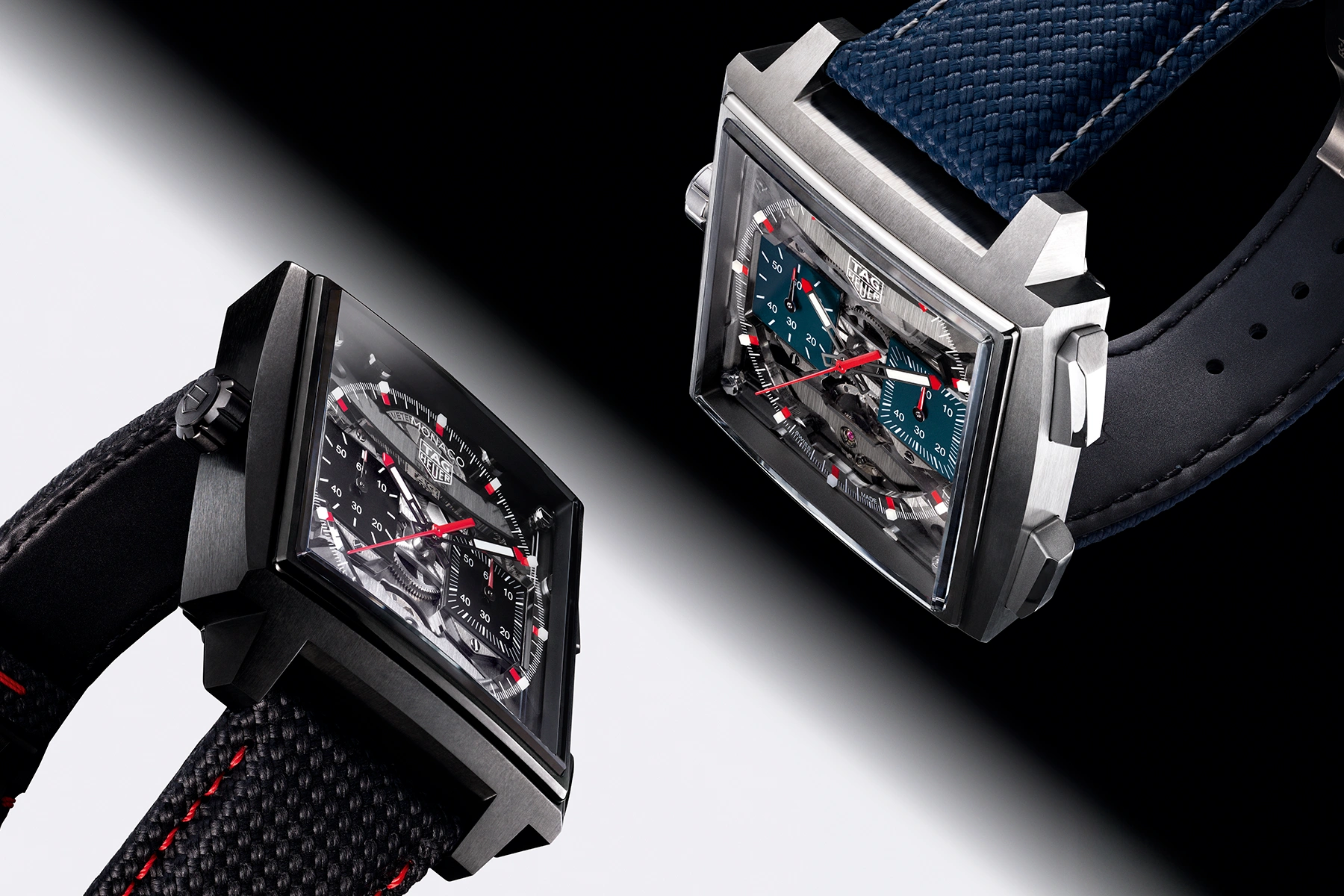
TAG Heuer Monaco Evergraph — The Chronograph Revolution
In a year celebrating the inseparable relationship between Swiss luxury watchmaker TAG Heuer and the chronograph, the moment has arrived for the Maison to reimagine this complication in a way that marks one of the most significant movements in the history of TAG Heuer.
Drawing on more than 160 years of innovation and expertise, where the chronograph runs as a red thread through TAG Heuer’s history like no other manufacturer, the TAG Heuer Monaco Evergraph stands as a pinnacle of achievement. It opens a new chapter for the Maison’s watchmaking savoir-faire, expressed through an entirely new mechanical architecture and an avant-garde interpretation of its square icon.
An Unrivalled Connection to the Chronograph

Credit: TAG Heuer
Since its founding in 1860, TAG Heuer has pioneered patented technologies that enhance the precision, durability, and reliability of timekeeping instruments.
In the 1880s, under the leadership of Edouard Heuer, a series of patented innovations, including improvements to the oscillating pinion – a proprietary keyless winding system, and hermetically sealed cases – significantly enhanced the durability and reliability of Heuer timepieces. These advances were widely noted in periodicals of the time, which frequently highlighted Heuer’s expertise in stopwatches, split-seconds mechanisms, and chronographs.
With Charles-Auguste Heuer, the early 20th century brought further milestones. The 1908 Sphygmometer introduced a patented pulsation scale on the dial. In 1911, the first dashboard chronograph appeared, an instrument line that later evolved into the celebrated Autavia of the 1930s. Then, in 1916, the Mikrograph became the first stopwatch accurate to 1/100th of a second, establishing a timing standard used at the world’s most prestigious sporting events.
The 1940s established the design codes of the modern wrist chronograph and saw the launch of the Seafarer, the first watch with tide indication. In the 1950s, a defining decision shaped the identity of the Maison, to focus exclusively on the production of chronograph timepieces, dedicating its expertise entirely to the complication.
The 1960s marked a pivotal new era for the Maison under the leadership of Jack Heuer, witnessing the birth of iconic models such as the TAG Heuer Autavia and the TAG Heuer Carrera. In 1966, the Microtimer achieved 1/1,000th-second precision, underscoring the brand’s commitment to high-frequency innovation. In 1969, this momentum culminated in two major milestones: the launch of the original TAG Heuer Monaco, which redefined watch design as the first square, water-resistant automatic chronograph, and the introduction of the Calibre 11, the world’s first commercially available automatic chronograph movement.
That same year, Heuer became the first luxury brand to appear on a Formula 1 car with Jo Siffert, initiating a motorsport legacy that expanded with Scuderia Ferrari in 1971. This partnership gave rise to the Le Mans Centigraph timekeeping device and to iconic images of drivers wearing the solid gold Carrera reference 1158, further cementing the Maison’s presence at the highest level of motor racing.
The acquisition by Techniques d’Avant Garde (TAG) in 1986 marked the birth of TAG Heuer and the launch of the Formula 1 collection. In 1989, Ayrton Senna made the S/EL chronograph part of his signature style, reinforcing the Maison’s connection to elite drivers through the decades, alongside Michael Schumacher and Mika Häkkinen, while serving as Official Timekeeper of Formula 1®.
More recent innovations pushed boundaries further with the Aquagraph, precision timing to 1/10,000th of a second at the Indianapolis 500, and radical high-frequency concepts such as the Mikrograph, Mikrotimer Flying 1000, and Mikrogirder. In 2017, the Heuer 02 marked the first in-house chronograph movement, later evolving into the Calibre TH20.
With more than a century devoted to the chronograph, it became inevitable that TAG Heuer would once again reinterpret this complication, this time through the lens of haute horlogerie. In 2024, the TAG Heuer Monaco Split-Seconds Chronograph laid the foundations for what was to follow with TAG Heuer Avant-Garde Horlogerie.
The Chronograph Revolution
What defines this story is innovation with a purpose, used as a guiding principle to to elevate the experience for the owner. The Calibre TH80-00 powering the new TAG Heuer Monaco Evergraph encapsulates this vision perfectly.
Featuring a one-of-a-kind compliant chronograph mechanism built with flexible components, which was fully developed by the TAG Heuer LAB, the Calibre TH80-00 reimagines both the functionality and the tactility of actuation of the chronograph complication. Equipped with the TH-Carbonspring oscillator, this new movement ensures magnetic resistance and precision, paired with a 5-Hertz frequency, a 70-hour power reserve, COSC certification, and a five-year warranty. Any one of these elements would represent a major milestone; combined, they mark a truly significant moment for the Maison.
The compliant chronograph mechanism itself is the most revolutionary aspect of the timepiece. It removes virtually all of the levers and springs traditionally associated with the start, stop, and reset functions and bears no resemblance to the constructions that have defined the complication since its origins. In their place are two flexible bistable components: one governing start and stop, the other reset. These components have been developed and refined over five years within the TAG Heuer LAB.
Produced using high-precision LIGA technology, these flexible bistable components enable fast, crisp transitions between positions. Thanks to the tuning of the chronograph mechanism and the precision of its manufacturing, there is no change or deviation over time in its performance. Whether on the first press of the pushers or the ten-thousandth, the chronograph always delivers the same sensation and accuracy.
Symbolizing a true chronograph revolution, the TAG Heuer Monaco Evergraph and its movement, the Calibre TH80-00, represent innovation with a purpose, offering superior durability, reliability and precision.
A Multi-Disciplinary Team Effort
This achievement is the result of five years of close collaboration between multiple stakeholders. Central to the project was Vaucher Manufacture Fleurier, the renowned movement manufacturer also involved in the making of the Calibres TH81-00 and TH81-01 found in the TAG Heuer Monaco Split-Seconds Chronograph and the TAG Heuer Carrera Split-Seconds Chronograph.
Led by TAG Heuer and developed in close partnership with Vaucher Manufacture Fleurier, the Calibre TH80-00 took shape around the revolutionary compliant chronograph mechanism developed by the TAG Heuer LAB. In addition to its open-worked architecture, the decision to adopt an inverted construction places the barrel, gear train, and TH-Carbonspring balance and escapement clearly on display from the dial side. A newly conceived automatic winding system further elevates this movement to haute horlogerie standards.
Building on the codes established with the split-seconds Calibre TH81-00, the signature checkered-flag finish appears on the back of the movement, alongside the shield-shaped oscillating weight.
An Icon Remastered

Credit: TAG Heuer
Since its launch in 1969, the TAG Heuer Monaco has stood as an icon of avant-garde design. As the first square, water-resistant chronograph powered by the first commercially available automatic chronograph movement, the Calibre 11, it remains a testament to the pioneering spirit of the Maison and a natural candidate for reinvention.
Building on the work initiated with the TAG Heuer Monaco Split-Seconds Chronograph, a new, more ergonomic design has been conceived for the TAG Heuer Monaco Evergraph, which traces its silhouette back to the original model from 1969, reference 1133. A harmonious architecture now connects the movement and the case, respecting the identity and signature codes of this emblematic model, while significantly enhancing ergonomics and presence on the wrist.
Sweeping arches hold the barrel and escapement in place, while subsidiary dials for running seconds and chronograph minutes create a profound symmetry. The transparent dial gives the impression that the indications are suspended within the case, adding an ethereal quality to the display.
With the crown positioned on the left side, a signature established in 1969 with the original Calibre 11, and new elongated pushers, attention turns to the 40mm Grade 5 titanium case, redesigned with ergonomics as a guiding principle. The square sapphire caseback ensures maximum visibility of the square movement made to perfectly fit the TAG Heuer Monaco case, while contributing to a new level of comfort on the wrist.
The tapered profiles create a visual sensation of thinness. In contrast, sharp facets along the case edges give the watch a monolithic, architectural presence, reminiscent of a piece of brutalist design on the wrist.
Presented in two distinct executions, the TAG Heuer Monaco Evergraph remains entirely contemporary while paying homage to the Maison’s rich history: a titanium version with blue accents echoing the reference 1133B made famous by Steve McQueen, and a black DLC-coated titanium version with red accents drawing inspiration from TAG Heuer’s racing DNA and signature color palette.
More than fifty years after its debut, the TAG Heuer Monaco stands as the ultimate expression of Avant- Garde Horlogerie and the natural platform for presenting a revolutionary advancement of the chronograph, TAG Heuer’s cornerstone complication. The new TAG Heuer Monaco Evergraph embodies the past, present, and future of innovation at TAG Heuer.
TAG Heuer Reinvents Its Square Icon, Introducing the New TAG Heuer Monaco Chronograph
More than half a century after its debut, the celebrated TAG Heuer Monaco enters its next chapter with a new more ergonomic design, elevating comfort and refinement, and now powered by the in-house automatic Calibre TH20-11.
Since 1969, the TAG Heuer Monaco has left an indelible mark on the watchmaking industry. As the first square, water-resistant chronograph wristwatch powered by the first commercially available automatic chronograph movement, the Calibre 11, it was unlike anything else at the time.
As a platform for avant-garde design and innovation, the TAG Heuer Monaco has always made a powerful statement throughout its history. Today, TAG Heuer redefines its square icon with an entirely new case design. Drawing inspiration from the original reference 1133 launched more than 50 years ago, this new generation enhances the TAG Heuer Monaco’s signature shape with dynamic lines, offering improved ergonomics while reinforcing its contemporary character.

Credit: TAG Heuer
A Pivotal Moment
In the mid-1960s, the world began to move away from manual-wind mechanical watches that required daily winding to power the movement. The rise of self-winding, automatic watches introduced a new level of convenience. Wearers quickly grew accustomed to the natural motion of the body providing energy to their timepieces.
For Heuer, this shift presented a challenge. The Maison was exclusively producing chronograph wristwatches, and no automatic caliber capable of recording elapsed time yet existed. In collaboration with partners across the watchmaking industry, the plan known as “Project 99” was launched to conceive and produce the first automatic chronograph movement.
Using a micro-rotor winding base caliber from Buren and a chronograph module from Dubois-Depraz, the now-celebrated Calibre 11 made its debut on 3rd March 1969 and became commercially available soon afterwards. Technical requirements related to the integration of the base movement and module meant that the crown had to be positioned on the left side of the case. This necessity was transformed into a defining feature. It served as a practical reminder that the watch no longer required daily winding, while also improving ergonomics and functionality.
Such a revolutionary movement called for an equally revolutionary timepiece. Alongside the TAG Heuer Autavia and TAG Heuer Carrera collections, which had already been introduced a few years prior but were redesigned to accommodate the new movement, a visionary and futuristic model was introduced to mark this milestone: the TAG Heuer Monaco.
A Sensitive and Faithful Reinterpretation
Since its inception, the TAG Heuer Monaco has stood apart. Its brushed and polished angular case, defined by sharp lines and striking geometry, immediately set it apart. The use of bold colours, such as vivid blue, rare in watchmaking at the time, reinforced its distinctive character. When it was unveiled in 1969, it looked like nothing else.
While the general public did not immediately embrace its revolutionary design language, avant-garde creatives such as Sammy Davis Jr., Oscar Peterson, Stanley Kubrick, and, of course, Steve McQueen were among its earliest adopters. Although its initial production run lasted only five years, its relaunch in 1997 allowed the world to fully appreciate the design language of the TAG Heuer Monaco. Today, it stands as one of TAG Heuer’s most emblematic models and a true pillar for the Maison.
However, the design reintroduced in 1997 was, in many ways, an abstraction of the original TAG Heuer Monaco. Only a few elements were carried over, most notably its square shape. When the project began to redesign the collection in the lead-up to the launch of the TAG Heuer Monaco Split-Seconds Chronograph in 2024, the decision was made to return to the origin of the story and to the reference 1133. Many of these defining elements are now present in the new TAG Heuer Monaco Chronograph.
-

Credit: TAG Heuer
-
Credit: TAG Heuer


The sharp, angular edges have been reinforced. The sapphire crystal is now closer to a true square in form, while the 39 mm case, now crafted in grade 5 titanium, extends with gently curved sides. The caseback is a masterclass in ergonomics. A smaller round central section curves toward the edges, echoing a design feature of the original while enhancing overall comfort. Extensive work has been undertaken to improve balance and wearability.
The dial has also been refined and elevated. Typography and text placement have been carefully considered to ensure absolute legibility. An interplay of shapes and applied elements enhance the overall design without detracting from clarity, while the contrasting subdials and a combination of finishes introduce depth and character. This new version is unmistakably a TAG Heuer Monaco, only more so.
Presented in three colourways, the collection includes the signature TAG Heuer Monaco blue, directly inspired by the watch famously worn by Steve McQueen in his 1971 film Le Mans. A refined sunray-brushed and lacquered dark green version draws on the codes of classic British Racing Green. Finally, an elegant black model is housed in a two-tone case of grade 5 titanium and 18K 5N rose gold. Each is paired with a racing-inspired strap featuring a newly designed grade 5 titanium folding clasp.
In-House Powered
At the heart of the watch lies one of the most significant upgrades of the TAG Heuer Monaco Chronograph, the new in-house Calibre TH20-11. Based TAG Heuer’s automatic Caliber TH20-00, which has become a staple for many chronograph timepieces of the Maison, the internal development teams have spent several years reconfiguring, refining, and testing this new movement. With an 80-hour power reserve and a five-year warranty, the Calibre TH20-11 brings the TAG Heuer Monaco Chronograph to superior levels of quality and reliability.
It now features a bi-compax layout, with subsidiary counters at three and nine o’clock and a date window at six o’clock, a configuration that pays homage to the original Calibre 11, hence its name: TH20-11. The most visible reference is the crown positioned on the left side of the case, a signature code of the TAG Heuer Monaco that remains deeply appreciated by collectors around the world.
As a whole, this new design represents a true reinvention of the TAG Heuer Monaco for the modern age. It is a watch designed to be worn by more people than ever before. Whether inspired by Steve McQueen racing at Le Mans or Max Verstappen conquering the streets at the Formula 1 Grand Prix de Monaco, the new TAG Heuer Monaco Chronograph stands as a contemporary icon, faithful to its revolutionary origins.
Discover more exciting creations from TAG Heuer at our boutiques, or online.
Related Insights
View All Insights-
- Curated by Cortina
Design-Driven Timepieces: Watches That Double as Statement Jewellery
23 Oct 2026
-

- News
Franck Muller Celebrates The Art of Skeletonisation
22 Oct 2026
-

- News
Introducing the H. Moser & Cie. Pioneer Cylindrical Tourbillon Skeleton Aventurine: An Exclusive Creation by Saquon Barkley
20 Oct 2026
-

- News
Introducing Bell & Ross BR-03 Space Mission
19 Oct 2026
-

- Watch Knowledge
Moonphase Watches and the Art of Celestial Timekeeping
12 Oct 2026
-

- News
Bell & Ross BR-03 Green Radar Ceramic: The Iconic Radar Collection Returns for Its Fourth Iteration
08 Oct 2026