
- Cortina Curates
Watches and Wonders Geneva 2026: Precision, Poetry and the Power of Design
Written by: Allyson Klass
20 Apr 2026

Record-setting ultra-thin complications, modern skeleton movements and sculptural jewellery timepieces made Watches and Wonders Geneva 2026 the most exciting edition yet.
Watchmaking’s biggest annual stage returned to Geneva’s Palexpo from April 14 to 20, with its largest edition to date bringing together 65 exhibiting brands and a programme that extended well beyond the exhibition halls into the city. The first four days of the fair were reserved for media, industry experts, and invited guests, before it was opened to the public for a wider celebration of horology.
This year also underscored the fair’s growing influence. A total of 11 new brands added further weight to an already formidable line-up, led by Audemars Piguet, which celebrates its 150th anniversary this year. Joining it were names spanning independent makers and heritage houses, including Behrens, Bianchet, B.R.M Chronographes, Charles Girardier, Corum, Credor, Favre Leuba, March LA.B, Sinn Spezialuhren and Swiss clockmaker L’Epée 1839. Together, they made this one of the most comprehensive reflections of today’s horological landscape that the fair has assembled.
The breadth of novelties reflected an industry in confident form. Ultra-thin timepieces, skeletonised movements, more compact proportions and bold colours dominated the halls, while chronographs, tourbillons and perpetual calendars led the complications front. Titanium, ceramic and ornamental gemstones emerged as standout materials, and design concepts moved in two distinct yet complementary directions – architectural minimalism on one hand and expressive métiers d’art on the other.
Beyond the timepieces, the fair’s cultural footprint continues to grow. A strong celebrity presence – including sports personalities Eileen Gu, Roger Federer, George Russell and Usain Bolt, as well as actor Patrick Dempsey and pop-R&B superstar Usher – added a layer of global visibility, highlighting watchmaking’s expanding presence within broader cultural and lifestyle conversations.
The fair’s programme ventured into more exploratory territory. The Wake Up! exhibition traced the history and evolution of the alarm clock through archival timepieces and clocks, while the LAB section spotlighted 15 start-ups and projects pushing the boundaries of horology through innovation and cutting-edge technology. Meanwhile, the city of Geneva was abuzz with fringe events, such as the Watchmaking Village, where visitors discovered introductory workshops and guided city tours. An exciting partnership with the Montreux Jazz Festival also brought a pop-up Montreux Jazz Club to Quai du Général-Guisan for five evenings, which saw live performances and DJ sets in an intimate setting.
In this first instalment of our two-part round-up, we spotlight novelties from Cartier, Chopard and Grand Seiko, alongside a special mention of BOVET, which, while not exhibiting at the fair, unveiled its latest creations during the same week, adding to the wider momentum that defines Geneva each April.

Credit: Cartier
Cartier Baignoire Watch
First appearing in 1958 and officially named in 1973, the Baignoire is one of Cartier’s most enduring jewellery watches. This new iteration takes the oval-shaped bangle design introduced in 2023 and swathes it entirely in the Clou de Paris motif – a pyramidal hobnail texture that’s been part of Cartier’s design vocabulary since the 1920s. There’s something quietly subversive about the result: The same studs typically found on leather biker jackets are rendered entirely in yellow gold here and applied to one of Cartier’s most refined jewellery watches.
The execution was not straightforward. The motif required careful rescaling and reshaping to follow the curves of the bangle bracelet and oval case without distortion. Aside from a winding crown with a sapphire cabochon, the timepiece is crafted in monochrome yellow gold. There’s no break in texture from bracelet to dial – even the push-buttons on the clasp blend seamlessly into the curve. The case measures 24.6mm by 19.3mm with a thickness of 7.5 mm, keeping it small and jewel-like on the wrist. The bangle is available in three sizes to accommodate a wider range of wrists. Polishing the finished piece entirely by hand is the final and most delicate step that requires precision to preserve the sharp definition of each hobnail point.
For those drawn to a more opulent expression, Cartier also offers a precious interpretation. Here, 100 brilliant-cut diamonds on the dial are snow set to create a shifting play of light, while the case and bangle feature 171 more diamonds in an inverted setting with softer, less pronounced tips. Together, the dazzling stones and Clou de Paris motif create a striking harmony of raised volumes across the timepiece.

Credit: Chopard
Chopard L’Heure du Diamant
The contrast at the heart of this new Chopard creation is stark and deliberate: deep black onyx set against the cool brilliance of diamonds. Inspired by an emblematic 1970 jewellery watch, the L’Heure du Diamant collection has long expressed the maison’s mastery of timepieces and jewellery and this exquisite edition stands among its most striking interpretations this year.
A variety of chalcedony prized since antiquity, onyx is shaped entirely by nature, which means no two dials are ever alike. Housed in a 30.5mm cushion-shaped case in ethical white gold, its velvety depth provides the perfect foil for the 4.4 carats of diamonds on the bezel, set using Chopard’s signature crown technique. Developed by Karl Scheufele III, this proprietary setting uses V-shaped prongs to hold each stone, which maximises the amount of light that passes through for a particularly vivid brilliance. Diamond-set indexes at 12, 3, 6 and 9 o’clock and diamond-set hands add to the sparkle across the dial.
Sitting at the heart of this timepiece is the in-house Chopard 09.01-C, a self-winding movement composed of 148 components with a 42-hour power reserve – a quiet reminder that Chopard accords equal importance to watch- and jewellery-making.

Credit: Grand Seiko
Grand Seiko Spring Drive U.F.A. Ushio 300 Diver
The claim attached to Grand Seiko’s latest dive watch is worth stating plainly: the Caliber 9RB1 within is the most accurate mainspring-powered wristwatch movement in the market, with an annual accuracy of ±20 seconds or about ±3 seconds per month. The engineering behind it is worth noting. The crystal oscillator is stabilised through a three-month ageing process before being vacuum-sealed with the integrated circuit (IC) to shield it from the influence of temperature, humidity, static electricity and light. Each oscillator’s frequency is then measured at multiple temperatures, with the resulting data programmed into the IC for precise thermo-compensation. The movement is then hand-assembled at Grand Seiko’s Shinshu Watch Studio in Nagano Prefecture.
The timepiece it powers is Grand Seiko’s smallest diver to date at 40.8mm in High-Intensity Titanium, which is approximately 30 per cent lighter than stainless steel and has a 300-metre water resistance rating. The broadly profiled lugs are deliberately designed to catch light across a wide surface, giving the watch a strong presence despite its compact footprint. The bracelet clasp features a three-step micro-adjustment offering up to 6mm of fine-tuning, along with an extension system that adds a further 18mm for wear over a diving suit. This brings the total adjustment up to 24mm.
The watch also boasts two new variations of the Ushio dial, a design that’s been part of the Grand Seiko diver’s watch since 2022. Meaning “tide” in Japanese, it’s available in blue, evoking deep ocean light, and green, which references shallow coastal waters. A 120-click bezel allows for precise adjustment, while the ceramic insert enhances scratch resistance.
Credit: BOVET
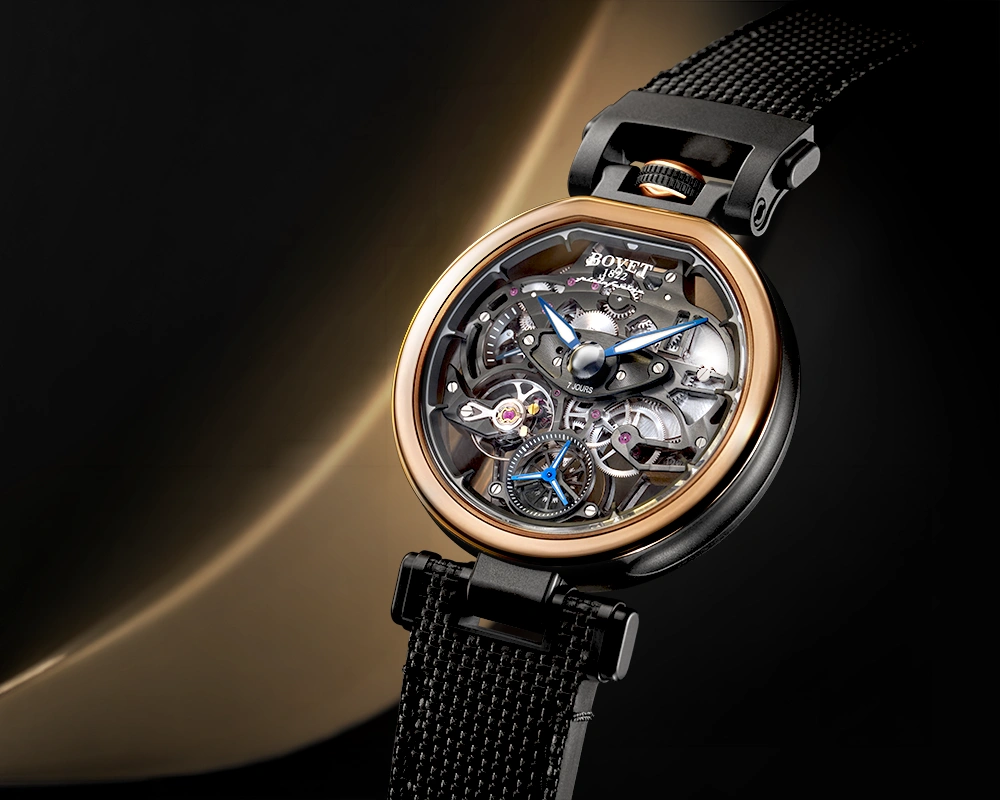
BOVET x Pininfarina Aperto 1 Bi-Color
The latest fruit of a partnership spanning 16 years, the BOVET x Pininfarina Aperto 1 Bi-Color put a luxurious spin on the traditional art of skeletonisation and exquisite finishing with its resolutely futuristic design. A 42mm case in grade 5 titanium, sandblasted to resist fingerprints, is offset by a warm red gold bezel and crown that create a refined balance between sportiness and elegance.
At its core is a brand-new hand-wound openworked manufacture calibre reduced to its bare essentials. Everything extraneous is removed, with bridges and plates merging at the centre and the entire architecture made visible through sapphire crystals on both sides. Movement components are coated in black and deep tantalum grey via CVD or PVD treatments that accentuate the skeletonised architecture beneath. With over 95 per cent of its 219 components crafted and finished in-house, BOVET’s commitment to vertical integration is matched by an equal emphasis on decoration and the human touch. At least 10 hours of hand-finishing go into the plates and bridges alone, including bead blasting, anglage, perlage, circular Côtes de Genève and polished bevels. What’s unusual is all of this is done before assembly – one slip of a tool and the component must be scrapped.
Practicality follows through to the wrist. The quick-change strap system, inspired by BOVET’s patented Amadeo mechanism, lets you swap between the two included straps in seconds without tools. Combined with a seven-day power reserve with a single barrel, this is a skeleton watch that’s made to be worn daily, not displayed or kept in the safe.
Related Insights
View All Insights-

- News
Franck Muller Celebrates The Art of Skeletonisation
22 Oct 2026
-

- News
Introducing the H. Moser & Cie. Pioneer Cylindrical Tourbillon Skeleton Aventurine: An Exclusive Creation by Saquon Barkley
20 Oct 2026
-

- News
Introducing Bell & Ross BR-03 Space Mission
19 Oct 2026
-

- Watch Knowledge
Moonphase Watches and the Art of Celestial Timekeeping
12 Oct 2026
-

- News
Bell & Ross BR-03 Green Radar Ceramic: The Iconic Radar Collection Returns for Its Fourth Iteration
08 Oct 2026
-

- News
One Complication, Three Personalities: H. Moser & Cie. Introduces Three New Retrograde Seconds Models
07 Oct 2026