

- News
The Patek Philippe Museum Celebrates 25 Years of the World’s Most Extraordinary Horological Collection
20 Nov 2026
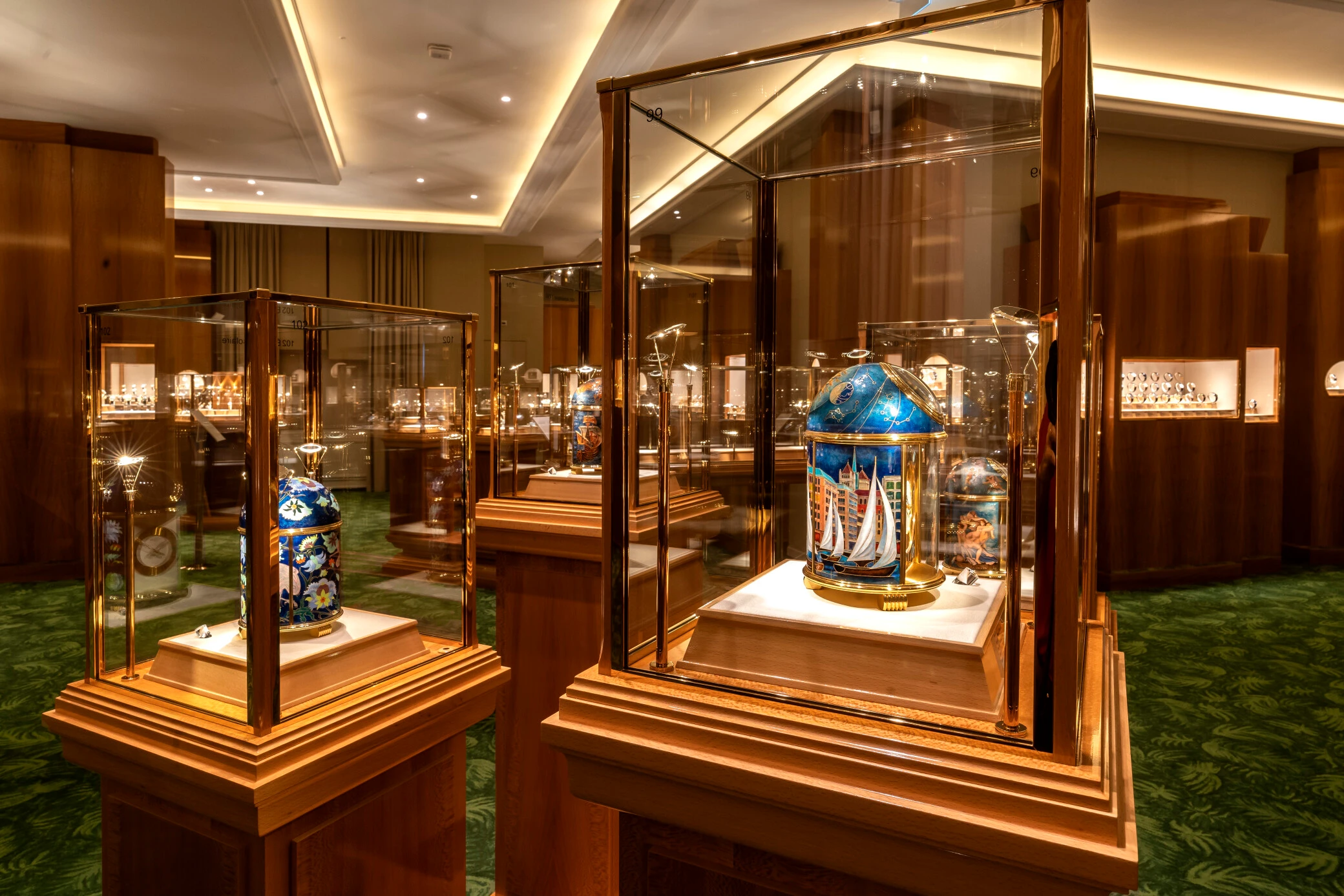
A special anniversary exhibition pays tribute to its founder, Philippe Stern, by displaying the eleven timepieces from the museum that particularly inspired him. These exceptional timepieces will delight devotees of fine watchmaking and the general public alike, alongside other rare pieces and a retrospective marking the 50th anniversary of the iconic Nautilus. The exhibition opens to the public on 13 November 2026.
Inaugurated on 9 November 2001, the Patek Philippe Museum houses one of the world’s most important and prestigious horological collections, carefully selected and organized. Some 2,500 watches, automata, precious objects and miniature portraits on enamel invite visitors on a fabulous journey through five centuries of Geneva, Swiss and European horological art, as well as offering a panoramic view of Patek Philippe’s production since 1839.
An extraordinary private collection
The Patek Philippe Museum was born of the passion of Philippe Stern, then President of the Geneva manufacture and subsequently its Honorary President, who passed away this year. Philippe Stern began collecting timepieces at an early age, initially Patek Philippe watches, particularly complicated models, but also timepieces that had left their mark on watchmaking history since the 16th century and treasures of the enameler’s art, a great Geneva specialty. He thus progressively assembled one of today’s most extraordinary horological collections. But his aim in bringing together these technical and aesthetic masterpieces was not solely to satisfy his personal tastes. He also wanted to share his love of fine watchmaking with a wider public, enhance the reputation of Geneva’s fine watchmaking tradition and ensure that this heritage would be handed down to younger generations.
The museum’s anniversary exhibition extends across several floors
On the ground floor, the exhibition pays tribute first and foremost to its founder, Philippe Stern, and to the profound motivations that led him to create this unique institution devoted to the past and present history of fine watchmaking and to the many arts and crafts, often centuries old, that contribute to it. To illustrate his passion, the museum presents, for the very first time, a special display of the eleven timepieces that inspired him the most, a personal selection unveiled in 2004 in a book devoted to the ten values of his family-owned company.
The exhibition also features two exceptional recent acquisitions that have enriched the museum’s collections. On the first and second floors, devoted respectively to the Patek Philippe Collection and the Antique Collection, the remarkable “Morehead” and “Cremsdorff” timepieces take center stage. On the third floor, an exhibition tracing 50 years of the Nautilus collection invites visitors to discover or rediscover the much-loved models of this emblematic Patek Philippe watch.
The culmination of a lifelong passion and a commitment to preservation
When he founded the museum, Philippe Stern’s hope was to “create the most beautiful and celebrated museum of horology in the world”. It represented the culmination of a passion shared by three generations of his family, and now carried forward by a fourth, with the aim of keeping these traditions alive for future generations. The 25th anniversary exhibition thus pays tribute to the man who created a magnificent setting for precious timepieces illustrating the history of fine watchmaking and that of the Manufacture: a fascinating history in which art, technology and science are intertwined.
In 2004, Patek Philippe published a book entitled “The Values of a Family Watch Company”. The unassuming title of this slender booklet belies the importance of its contents, and in that it is the very image of its author, Philippe Stern. Both the book and the exhibition present the eleven timepieces from the museum’s collections that inspired this great visionary. Together they embody the values that guided his life and his company, and which continue to play an essential role in the company’s philosophy and in the creation of its exceptional timepieces.
Museum anniversary exhibition and tribute to its founder – on the ground floor Eleven exceptional timepieces, specifically selected by Philippe Stern, embody Patek Philippe’s ten fundamental values
1. VENUS BINDING THE WINGS OF LOVE – Rarity
A pair of mirror-image heart-shaped watches in chased gold and champlevé enamel, adorned with rubies, turquoise and pearls, of rare aesthetic beauty. Paired miniature paintings on enamel, against a gold background, depict ‘Venus Binding the Wings of Love’. Three automaton functions are activated on the hour or on demand, animating a couple playing the mandolin and panpipes, with a windmill in the background. For Philippe Stern, “These watches are witnesses of the past and act as a source of inspiration in our daily quest for timeless perfection. Watchmaking, irrespective of whether it is a craft or industrial in its nature, involves a number of applied arts, and is thus in many ways a true expression of Art with a capital “A”.”
This pair of matching watches was made for the Chinese market. The caseback depicts a work by Élisabeth Vigée Le Brun (1755–1842). The enamel painting on gold is attributed to Jean-Abraham Lissignol (1749–1819). White enamel dial. Indications: central hours (XII), minutes (60) and seconds (60). Musical movement playing a melody on the hour or on demand, produced by twenty tuned teeth operated by a pinned-disc mechanism. Two barrels, one for the movement and the other for the music and automaton; key winding; cylinder escapement. Complications: quarter repeater on two gongs, music and automaton. Quarter-repeating movements, automata and musical striking mechanism, either on the hour or on demand, signed Piguet & Meylan (active 1811–1828), Geneva, circa 1815–1820 (Inv. S-133A and S-133B).
-

Inv. S-133A
-
Inv. S-133A
-
Inv. S-133A
-
Inv. S-133B
-
Inv. S-133B
-
Inv. S-133B


2. THE CROSS-SHAPED WATCH – Value
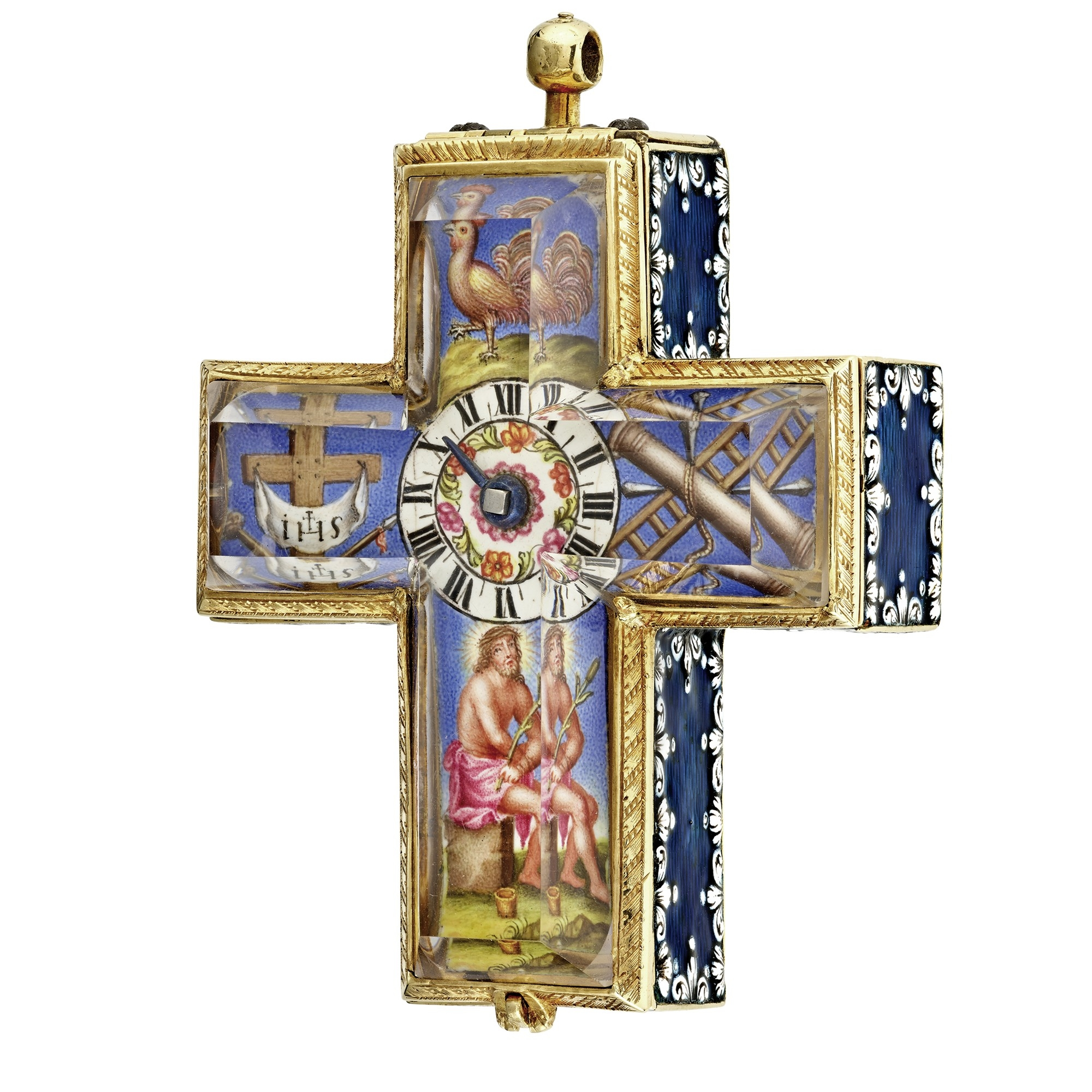
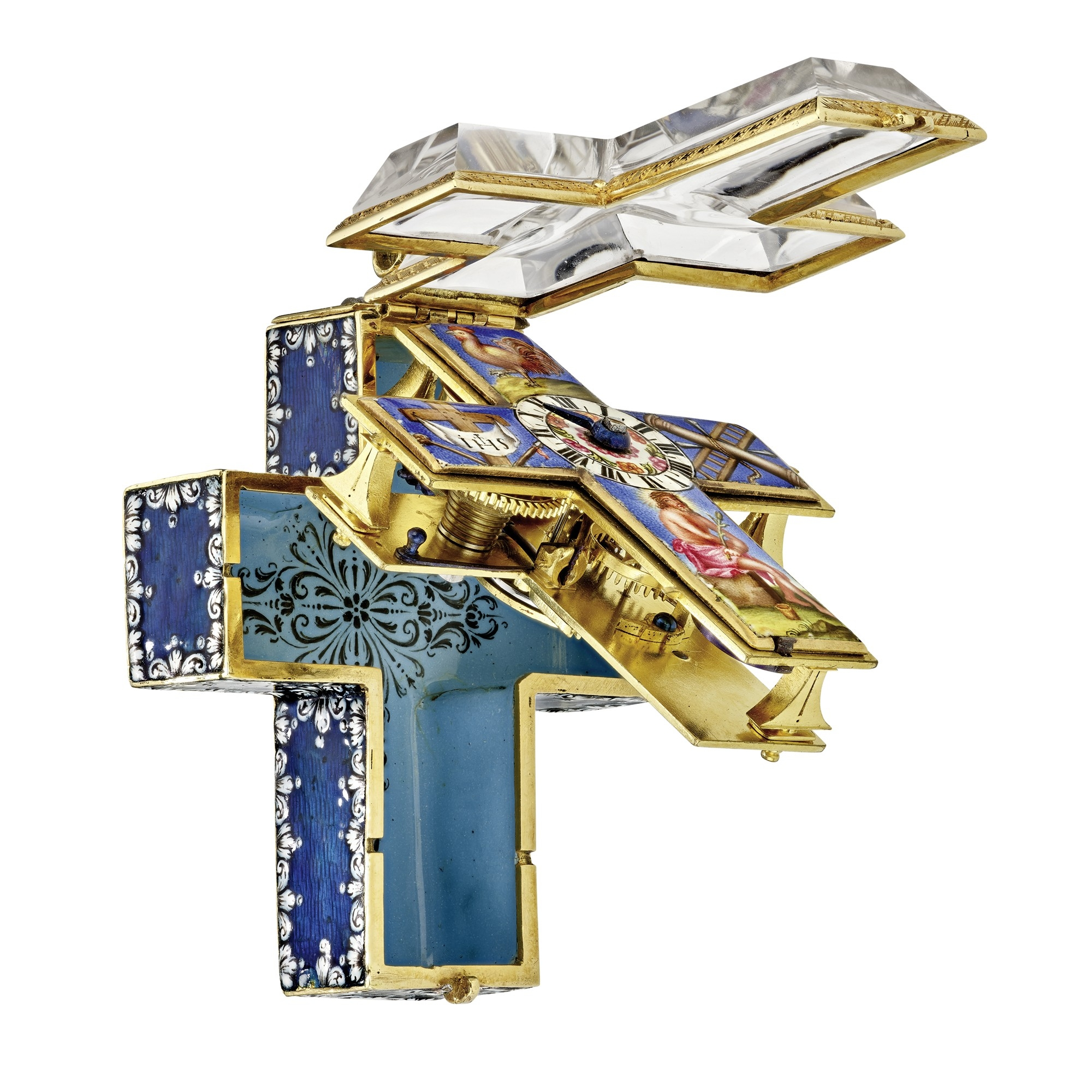
A cross-shaped watch with enamel painting on gold depicting the Crucifixion. Attributed to Pierre Huaud, Geneva, circa 1670, this piece dates from the period when Protestant craftsmen, the Huguenots that had been chased out of France, Italy and Spain, laid the foundations for what was to become Geneva’s watchmaking ‘Fabrique’ – a generic term that referred, principally in the 18th and the early 19th centuries, to the entire assembling of the watch, including watchmaking, jewelry setting, enameling and other related crafts. As Philippe Stern observed, “The ‘fabrique’ became a source of fame and glory for many watchmakers, goldsmiths and enamelers. It led to the establishment of this lucrative craft in the city on the shores of Lake Geneva, before the advent of the Industrial Age and the existence of watch manufacturers.”
The movement is signed on the backplate “Johannes van Ceulen (The Elder), The Hague, Netherlands”, circa 1675. Gold dial with enamel painting. Central hour indication (XII). ‘Fusee’ with gut string, key winding, verge escapement with balance spring (Inv. S-318).
-
Inv. S318
-
Inv. S318
3. THE MOTHER AND THE CHILD – Rarity
Painted in enamel on gold, this work reproduces a painting by the Swiss artist Jacques Alfred van Muyden showing a mother bathing her child. It is signed by Suzanne Rohr, regarded as the queen of enamel painting, who worked for Patek Philippe from 1967 to 2002 and continued after her retirement until 2017. According to Philippe Stern, “For me, this painting on enamel embodies the emotional value and strong sensation of building and handing down to future generations something of importance. Also noteworthy is the enamel painter’s skills, which we are still fortunate to benefit from to this day.”
After Alfred van Muyden (1818–1898). Yellow gold, open-face, keyless-winding dress watch, Ref. 715/20. The artist painted the original work, “Bathing the Children” (or Mother and Children), in 1859, shortly after settling near Geneva, where he was among the founders of the Society of Swiss Painters and Sculptors. Enamel painting on gold signed Suzanne Rohr, Geneva, 1969 (Inv. P-130).
-
Inv. P-130
-
Inv. P-130


P-1096 Ref 5029P
4. THE CHRONOMETER WITH MINUTE-REPEATER – Quality and Workmanship
This gentlemen’s self-winding chronometer wristwatch with minute repeater on two gongs was produced in 1997 to commemorate the inauguration of our new headquarters at Plan-les-Ouates. Philippe Stern wrote: “This watch perfectly embodies Patek Philippe’s technological and artistic know-how, and perpetuates the tradition of fine watchmaking. A true chronometer equipped with a rare complication – the minute repeater – in an Officer’s case of timeless elegance. The quest for absolute precision and the creation of the most complicated pieces in the smallest of spaces – always endeavoring to be more precise, more complex, more miniature – is the great watchmakers’ Holy Grail.”
This model was produced in a limited edition of 30 watches: ten in yellow gold, ten in rose gold and ten in platinum. The destruction of the dies and tools used to make the case guarantees that no further edition will ever be produced. At Patek Philippe’s request, a new rate certificate was created by the Swiss Official Chronometer Testing Institute (COSC), exclusively for watches bearing the Geneva Seal. This new certificate provides official recognition of the quality and precision of the movement. Platinum officer-style case with hinged back, black dial with applied white-gold Breguet numerals, subsidiary seconds dial at 6 o’clock; caliber R 27 PS, 22-carat gold micro-rotor, lever escapement and Gyromax balance. Ref. 5029 (Inv. P-1096).

P-1358 Ref 1527R
5. THE HENRI STERN WATCH – Emotion
This gentlemen’s rose-gold wristwatch, dating from 1943, was among the earliest timepieces with perpetual calendar and moon phases. It is a unique piece. Reference 1527, with its complicated movement, has a larger case than reference 1526, the perpetual calendar wristwatch in regular production at the time. The watch was especially precious to Philippe Stern: “In the spirit of family tradition and the company’s philosophy, this watch holds great emotional and sentimental value for me. Inherited from my father, who in turn had been given it by my grandfather, it not only embodies the passing down of a possession from one generation to the next, but also the unique bond between father and son.”
Rose-gold case, satin-finished silver dial with applied rose-gold Roman numerals and baton hour markers, subsidiary seconds dial at 6 o’clock, luminous rose-gold skeleton hands and balanced rose-gold subsidiary seconds hand. 1943. Ref. 1527 (Inv. P-1358).
6. CALIBRE 89 – Independence
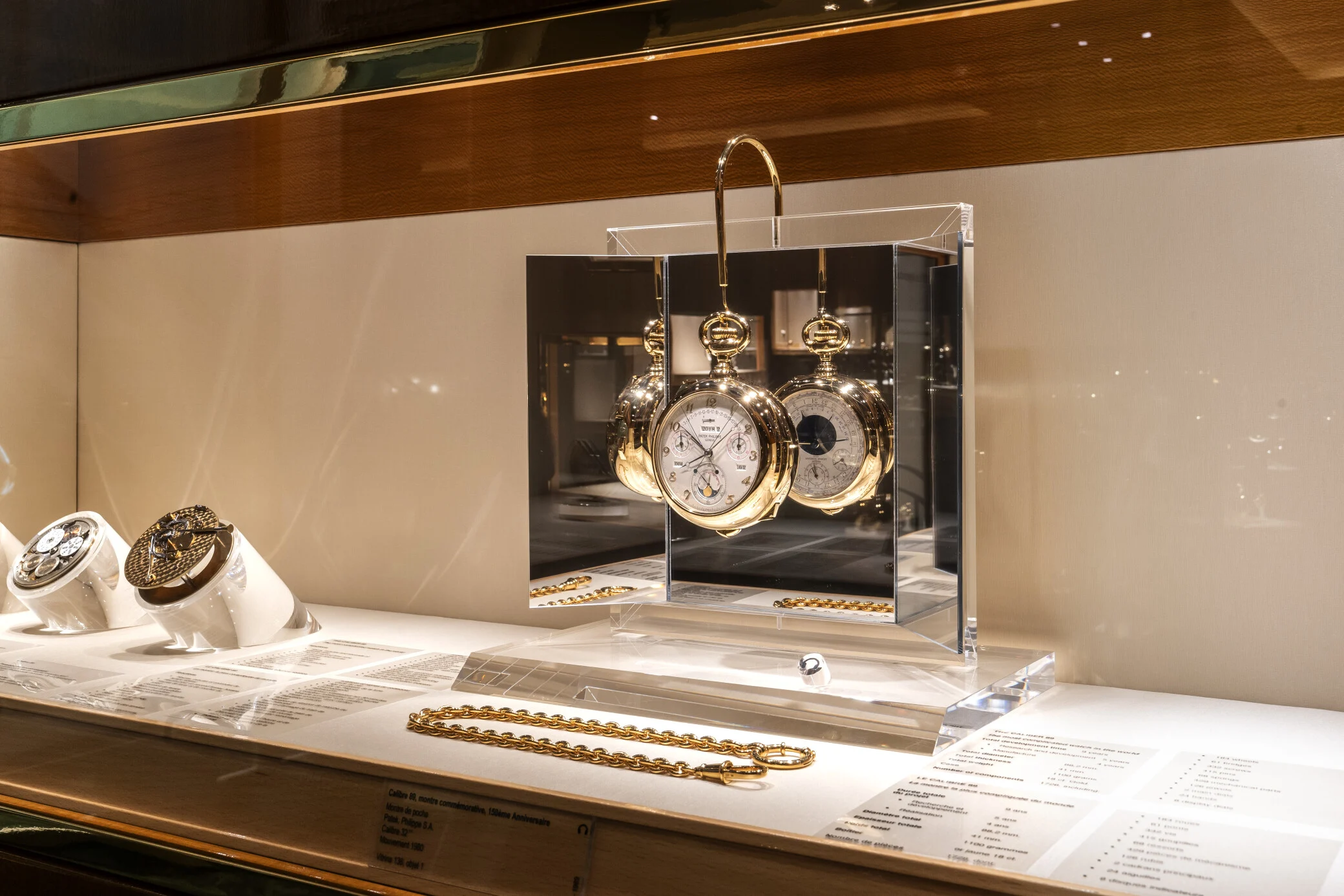
The Calibre 89 was the most complicated timepiece in the world, a record held from 1989 to 2015. In addition to displaying mean solar time (hours, minutes and seconds), it features 33 complications, including, for the very first time, a patented indication of the date of Easter. Created to celebrate Patek Philippe’s 150th anniversary, it took 9 years to complete, including 5 years of research and development and 4 years of production. Four examples were produced, in yellow gold, rose gold, white gold and platinum. The prototype is on display at the museum. For Philippe Stern, “This piece contributed to pushing the boundaries of the art of watchmaking, and for me it symbolizes the spirit of independence and the freedom to innovate that is embraced every day at Patek Philippe.”
Diameter: 89 mm. Thickness: 41 mm. Weight: 1,100 g. Number of components: 1,728, including 184 wheels, 61 bridges, 332 screws, 415 pins, 68 springs, 429 mechanical parts, 126 jewels, 2 main dials, 24 hands and 8 display dials. Ref. 1989 (Inv. P-1989).
-
P-1989 Ref.- 989 Calibre89 RECTO
-
P-1989 Ref.- 989 Calibre89 VERSO
-


7. JAMES WARD PACKARD – Innovation
This double-faced, highly complicated pocket watch, featuring ten complications including a perpetual calendar and a minute repeater, was specially commissioned for the American automobile manufacturer James Ward Packard. Delivered in 1927, it was the first Patek Philippe timepiece to feature an astronomical display. The reverse side of the watch reproduces the night sky, with 500 gold stars against a blue background, exactly as seen above Warren, Ohio, the birthplace of its illustrious owner. According to Philippe Stern, “Pursuing the tradition of their predecessors, our watchmakers have consistently created exceptional watches responding to the needs of the most demanding clients. This particular watch was specially made for James Ward Packard and demonstrates the know-how and expertise of Patek Philippe’s craftsmen in producing exclusive timepieces.”
Open-face, keyless-winding pocket watch with minute repeater on three gongs. Front: silvered dial, yellow gold case with engraved decoration. Indications and functions: mean solar time; sunrise and sunset indications; running equation of time; perpetual calendar with day of the week, month and date; moon phases and age of the moon; minute repeater on three gongs. Reverse: astronomical indications, sky chart with cardinal points and the visible sky over Warren, Ohio, USA, latitude 41°20′. 1925–1927 (Inv. P-704).
-
P-704 J.W. Packard
-
P-704 J.W. Packard
-
P-704 J.W. Packard


P-1421 Ref 5101 P
8. 10 DAYS TOURBILLON – Aesthetics
A gentlemen’s chronometer wristwatch with a ten-day power reserve and a one-minute tourbillon with lever escapement. Incorporating two complications that normally require considerable space within the confined dimensions of a rectangular wristwatch movement represents a genuine technical challenge. With its elongated rectangular form, the Art Deco-style platinum case recalls the great classics of the 1930s, while its triple-gadrooned flanks create particularly elegant lines. For Philippe Stern, “This watch epitomizes the excellence attained today by Patek Philippe. The company has always had a whole-hearted commitment to producing nothing but the very best and innovating in the art of watchmaking. It is in this spirit that, for the first time, we created a completely new timepiece combining a ten days’ power reserve with a tourbillon escapement.”
In 2003, Patek Philippe introduced its first tourbillon wristwatch capable of running for ten days without rewinding. To supply this much energy, the caliber has two barrels whose proportions were calculated to provide the greatest possible storage capacity. They are wound simultaneously according to the principle of communicating vessels. Measuring more than 50 mm in length, the curved profile of the caseband fits the wrist perfectly. The convex sapphire crystal follows the curve of the case and is cut parallel on both sides to prevent any magnifying effect. The dial is made of 18-carat gold in a “Vintage Rose” coloring. 2003. Ref. 5101 (Inv. P-1421).

P-1000 Ref. 2441J
9. THE EIFFEL TOWER – Service
Collectors nicknamed this men’s wristwatch the “Eiffel Tower”, because of the distinctive design of its flared lugs. The unusual rectangular shape of this movement was a major innovation, and watches based on this design set a new trend in the horological field. Today, collectors remain captivated by these pieces, probably reassured by the fact that our after-sales service can count on the most qualified craftsmen to restore their watches. As confirmed by Philippe Stern: “The ‘Bienfacture’ or craftsmanship of our watches is demonstrated here by the movement of this piece, the Caliber 9”’-90 introduced in 1947. For more than 20 years, it was at the forefront of Patek Philippe’s reputation.”
This watch inspired reference 5500, the Pagoda, produced in a limited edition to mark the inauguration of Patek Philippe’s new Manufacture in Plan-les-Ouates in 1997. Yellow gold case with flared rectangular shape; silvered dial with applied gold Roman numeral and baton hour markers; subsidiary seconds dial at 6 o’clock. Delivered on 29 June 1949 to the Henri Stern Watch Agency, New York. Ref. 2441 (Inv. P-1000).

P-996 Ref. 1415/1HU
10. THE WORLD TIME CHRONOGRAPH – Tradition
This ‘World Time’ gentlemen’s wristwatch with chronograph and pulsometer scale was specially made to order for Dr. P. Schmidt of Geneva. Sold to him on 2 October 1940, it is a unique piece. Philippe Stern explained: “Being a doctor he particularly requested a pulsometer. Responding to this request, we crafted this watch to the most exacting standards.”
World Time wristwatch for men indicating 24 time zones, with revolving bezel displaying the names of 33 cities, regions or countries around the world, chronograph with rectangular pushers and pulsometer. Yellow gold case, silvered dial with applied gold Breguet numerals. Rotating disc indicating day and night hours. Gold hands, hand-made by Louis Cottier. Caliber 13-130 HU. Lever escapement. Pulsometer and asthmometer scales graduated for 15 heartbeats and 5 breaths respectively. 1940. Ref. 1415-1 HU (Inv. P-996).

P-109 Ref. 784J
11. THE CROW AND THE FOX – Innovation
This dress watch features a dial with moving figures and an on-demand time display, it was inspired by the fable “The Crow and the Fox” by Jean de la Fontaine, in the tradition of the ‘bras-en-l’air’ watches produced around 1800. On demand, by simply pressing a button on the pendant, the fox raises its right paw or muzzle to indicate the hours on the sector to the left. At the same time, the crow releases the cheese from its beak, which, as it falls, indicates the minutes on the sector to the right. For Philippe Stern, “This fable is a knowing aside, which I interpret as demonstrating that our aim is not to flatter our clients. We passionately believe in offering them a set of permanent, timeless and intrinsic values that they can identify with from a qualitative, technical and aesthetic point of view, without having to resort to excessive or superficial praise.”
Open-faced, keyless-winding dress watch with on-demand hour indication. Yellow gold case. Dial in yellow, red and white gold and platinum, with retrograde hour and minute sectors. Painted Breguet numerals. Rhodium-plated caliber 17-170. Straight-line lever escapement, compensated balance with gold regulating screws and Breguet balance spring. Entirely developed and made by Louis Cottier, this prototype was never sold or serially produced. The animal figures and foliage decoration are made of different colors of gold; the cheese is in platinum. The winding crown is placed at 6 o’clock. 1956–1958 (Inv. P-109).
Presentation of two exceptional recent acquisitions
Presentation of two exceptional recent acquisitions First floor of the Patek Philippe Museum – Patek Philippe Collection The Morehead III double-movement pocket watches
Over a 40-year period, American industrialist John Motley Morehead III (1870–1965) assembled an extraordinary collection of more than 20 rare Patek Philippe watches. Among his most notable pieces are these highly complex designs featuring a unique horological feat. Both watches on display feature two independent movements – a groundbreaking engineering achievement unique to Patek Philippe – to display two separate time indications. A single winding crown operates both movements, linked by one shared winding stem.
The innovative 54.75 mm Morehead pocket watch, which was first sold in 1925, houses two 19-ligne movements. The first is a time-only caliber displaying hours, minutes and seconds, while the second includes a time display, a split-seconds chronograph, a minute repeater and a 30-minute counter indicated in a subdial at 12 o’clock. The other two subdials display seconds, one for each set of hour and minute hands. A single crown winds and sets the time for both movements. The bassine-style yellow gold open-faced case features a hinged cuvette (Inv. P-2252).
The second, a 47 mm yellow gold Morehead pocket watch, was first sold in 1922. A horological feat, its case houses two 17-ligne movements. One indicates the hours, minutes and seconds, while the other powers a time display and the minute repeater function. Each movement has its own set of hour and minute hands, in blued steel or gold (Inv. P-2253).
-
P-2252
-
P-2252
-
P-2253
-
P-2253


Second floor of the Patek Philippe Museum – Antique Collection The Cremsdorff pendant watch: “Temperance, Charity and Hope”
The baroque-style masterpiece pendant watch of circa 1650 features the three heavenly virtues: Charity with her children, Temperance diluting wine with water, and Hope clinging to her anchor. At the time, it was common for enamel painters to use the compositions of famous artists and printmakers as models. For this piece, the engraver Abraham Bosse (1604–1676) drew inspiration from etchings by François Perrier (circa 1590–1650) and transformed them into fine engravings. The anonymous enamel painter then masterfully transferred Bosse’s virtues onto a deep pale turquoise background, typical of the period, while perfectly preserving the delicate character of the engraver’s lines.
While the mechanical movement inside was crafted by the Parisian master watchmaker Jehan Cremsdorff, the artist who created the spectacular case remains unknown. Arguably the finest of its kind, this watch seamlessly combines several master disciplines: watchmaking, goldsmithing, enameling and gemsetting. Its solid gold case glows in pale turquoise blue, adorned with diamonds that sparkle as they catch the light (Inv. S-1054).
It was exceptional watches such as these that left a lasting impression on Thierry Stern, the current President of Patek Philippe, during his childhood: “When I was very young, around six or seven years old, one of my earliest memories is of being in my father’s office on the Rue du Rhône and opening a drawer lined with red velvet, where I discovered a collection of antique enameled watches for the first time. I vividly remember their elaborate decorations and, above all, the magnificent turquoise-blue backgrounds so characteristic of 17th-century enameled watches. I was captivated by the colors, the decorations and the sheer beauty of these pieces. I even remember the smell inside the drawer. It was at that moment that I knew what I wanted to do with my life.”
-
S-1054
-
S-1054


Third floor of the Patek Philippe Museum – To discover or rediscover 50th anniversary of an icon of sporty elegance, the Nautilus
The thematic exhibition presents a retrospective tracing the rich history of the Nautilus, based on the historical archives of the Manufacture, as well as a selection of watches that marked the different periods of its existence. Visitors will also have the rare opportunity to discover the 50th anniversary limited series of this iconic watch, available in four exclusive models. The exhibition will run until early 2027.
Patek Philippe
Discover more Patek Philippe timepieces at our boutiques, or online.
Related Insights
View All Insights-
- News
The Patek Philippe Museum Celebrates 25 Years of the World’s Most Extraordinary Horological Collection
20 Nov 2026
-

- News
H. Moser & Cie. Reconnects with the Heritage Spirit
04 Nov 2026
-

- Brand Spotlight
How Breitling Made Aviation Easier
02 Nov 2026
-

- News
Patek Philippe Historic Success for the WATCH ART Grand Exhibition Milan 2026
27 Oct 2026
-

- News
Franck Muller Celebrates The Art of Skeletonisation
22 Oct 2026
-

- News
Bell & Ross BR-03 Space Mission
20 Oct 2026