
- 品牌焦点
- 高登精选
5 Reasons That Prove Franck Muller’s Tourbillons Come in All Shapes, Sizes and Orientations
2023年6月23日
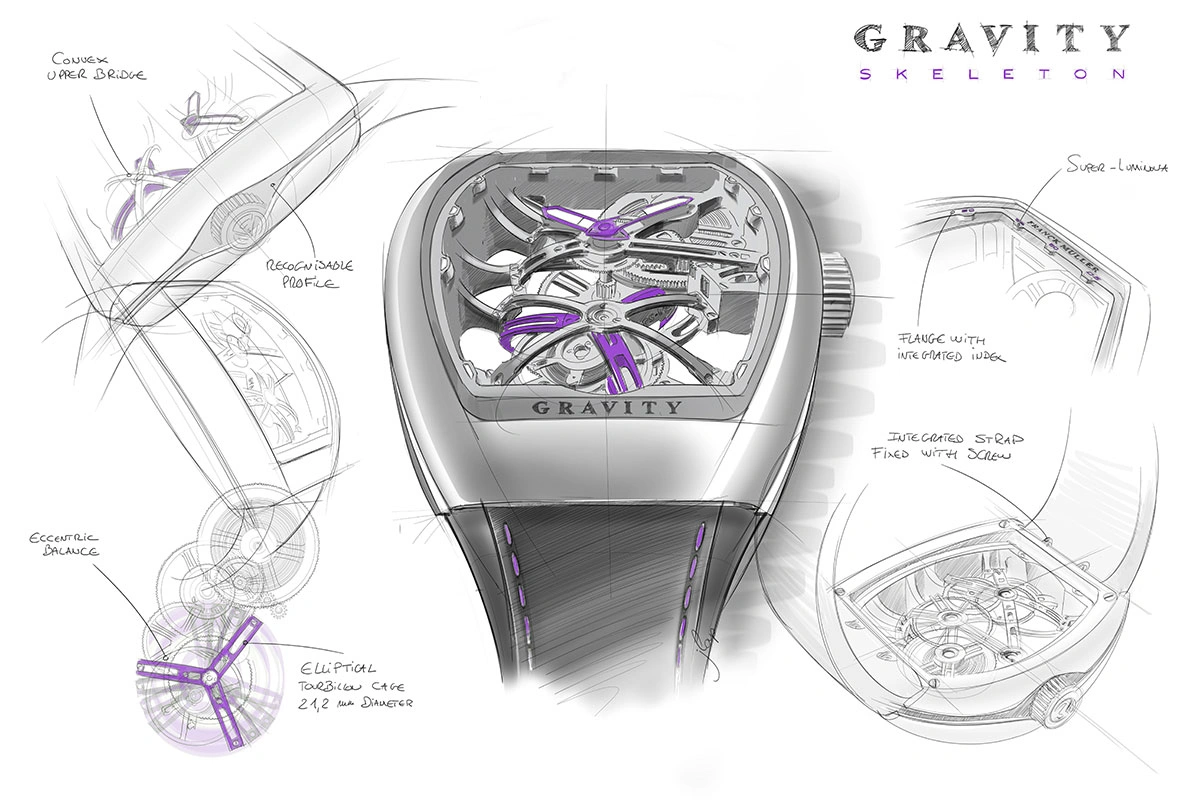
Born as a necessity to counteract the effects of gravity on the regulator, these new tourbillons from Franck Muller push the envelope to new heights.
When it comes to collecting watches, the Tourbillon is often pegged as one of the grail complications to have before eventually graduating to more subtle ones like a perpetual calendar or minute repeater. The tourbillon offers a slice of watchmaking history, as it was invented more than 220 years ago, rotating the entire regulating organ of the movement to counter the effects of gravity on a pocket watch. This was essential in a pocket watch as most of them tended to sit upright in a waistcoat pocket throughout the day, but on wristwatches, the effect is not nearly as useful. Still, it can’t be denied that these fantastic complications are a joy to look at.
Since Abraham Louis Breguet filled the patent for the tourbillon in 1801 this complication has pretty much remained the same. It was only in the early 2000s that watchmakers started to push the envelope of this complication coming up with ingenious ways to revolutionise how a tourbillon functions. Franck Muller is one of them. Since 1983 the eponymous founder has been presenting many world premieres movements and patents and since the 2000s has even reimagined what a tourbillon can be.
Tri-Axial Tourbillon
In 2001 Franck Muller introduced a tourbillon that could rise to the dial and in every subsequent year he seems to one-up his creations. In 2002 Révolution 1 offered a tourbillon that could rise to the dial when a button was pressed, the next year Révolution 2 evolved into a tourbillon that rotated on 2 axes and finally, in 2004 the tri-axial tourbillon was born. This complication takes what the tourbillon did for pocket watches and transfers that functionality to wristwatches. With the escapement and balance wheel rotating on three axes, the cancellation of gravity’s effects on time regulation also gets transformed from two to three dimensions.

Still images just doesn’t do justice to the appeal of an ultra-fast tourbillon. (Credit: Franck Muller)
Thunderbolt Tourbillon
The fastest tourbillon is one of the most pleasing complications to admire on the wrist. Normal tourbillons typically make one full rotation every 60 seconds but the Thunderbolt tourbillon makes its full rotation in only 5 seconds. This translates to 12 full rotations every minute which, as you can imagine, is a joy to look at. As with most complications of this nature, going at a faster pace means increased stress on the components. Therefore, ceramic ball bearings are used to reduce friction and ensure the longevity of the tourbillon and keep wear and tear down to a minimum.

The way the tourbillon bridge sits asymmetrical with the regulating organ within gives the tourbillon offers viewers a wonderful visual performance as it rotates. (Credit: Franck Muller)
Gravity Tourbillon
The Gravity collection from Franck Muller takes a traditional watch complication and transforms it into an incredibly contemporary form. Launched in 2016, the most eye-catching element of this complication is a combination of the elliptical shape of the tourbillon bridge and the fact that the balance wheel and escapement are placed in an off-centre position. This asymmetrical shape helps the watch to capture the viewer’s attention as it rotates. To facilitate this symphony of visual stimulation, the tourbillon can now be found with a beautiful skeleton movement. Not only is the watch a joy to behold, but it also has an extremely futuristic aesthetic.

The Clous de Paris pattern on the dial features a guilloché with a spiral effect that marvellously accentuates the rotational movement of the centre tourbillon. (Credit: Franck Muller)
Grand Central Tourbillon
What better way to celebrate the Tourbillon than to put it right smack in the middle of the watch? Achieving this task is not as simple as just shifting some components around because as watchmakers will tell you, the centre of the watch is usually where the central shaft is located and where all the hands are affixed to so you can tell the time. So, to make this central tourbillon possible, Franck Muller had to redesign the movement from the ground up, creating a new geartrain system to drive the time indication hands. Additionally, the hour and minute hands are also suspended around the spectacular tourbillon while the bridge of the 60-second tourbillon is held by the bridge which also doubles as the seconds indicator for the watch. To make things a little more complicated for the in-house engineers at Watchland, the Grand Central Tourbillon movement is housed in the signature Cintrée Curvex case that is also curved along its profile.
观点推荐
阅读所有观点-
- Cortina Curates
Metal Watches for Men: Built for Style, Strength and Longevity
2026年9月25日
-

- 品牌焦点
Why Watch Size Matters (But Not the Way You Think)
2026年9月9日
-

- 高登精选
Cortina Curates Local: 與玻璃藝術家陳建志共譜中秋琉光故事
2026年9月4日
-

- 新闻
Chronomaster Solo Sport: Distilling the Essence of High Frequency
2026年9月2日
-
- 新闻
The Navitimer That Became A Miles Davis Signature
2026年9月2日
-

- 新闻
Streamliner Tourbillon Skeleton Ceramic Alpine Limited Edition: A New Chapter, A New Material
2026年9月2日